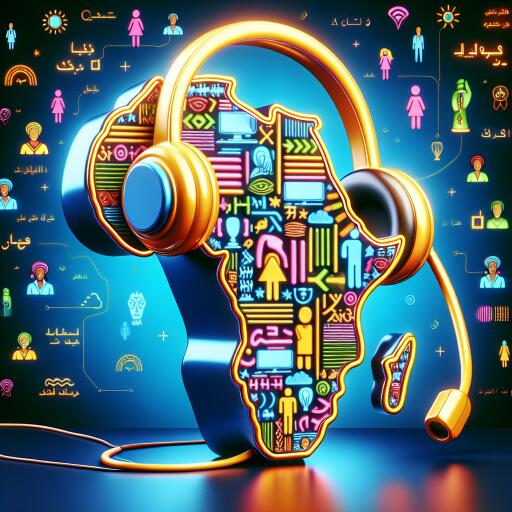

Google Opens WAXAL To Support Over 100 Million African Language Speakers – The News Chronicle
Google has unveiled WAXAL, a large open speech dataset created to accelerate artificial intelligence tools for African languages and expand access to voice-driven technology across the continent.
More than three years in the making, WAXAL targets a longstanding bottleneck: the scarcity of high-quality speech data that has kept many African languages out of modern speech recognition and text-to-speech systems.
What’s inside WAXAL
The dataset spans 21 African languages, including Hausa, Yoruba, Igbo, Swahili, Luganda, and Acholi—languages spoken by over 100 million people who are often underserved by current AI models. In total, WAXAL contains more than 11,000 hours of audio drawn from nearly two million individual clips.
- About 1,250 hours are fully transcribed, natural speech suitable for training automatic speech recognition (ASR) systems.
- Over 20 hours are studio-grade recordings intended for text-to-speech (TTS) voice generation.
To capture natural speech patterns, volunteers were asked to describe images in their native languages, producing everyday spoken language rather than scripted content. For TTS-focused data, professional voice actors recorded high-quality studio sessions.
Built with African institutions—owned by them too
WAXAL was developed in collaboration with universities and research organizations across the continent. Makerere University in Uganda and the University of Ghana led data collection for 13 languages, while Digital Umuganda in Rwanda coordinated efforts on five languages. Studio recordings were produced with support from Media Trust and Loud n Clear, and the African Institute for Mathematical Sciences (AIMS) contributed multilingual data for future releases.
Unlike many global datasets, ownership of the collected data remains with the African institutions that produced it—a model designed to empower local researchers, startups, and developers to build independently and sustainably.
“The ultimate impact of WAXAL is the empowerment of people in Africa,” said Aisha Walcott-Bryantt, Head of Google Research Africa. “This dataset provides the critical foundation for students, researchers, and entrepreneurs to build technology in their own languages and reach over 100 million people.”
Grassroots contributions at scale
At the University of Ghana alone, more than 7,000 volunteers contributed voice samples. The project’s image-description approach helped gather diverse, everyday speech across accents and contexts—crucial for building robust models that reflect real-world use.
Isaac Wiafe, an Associate Professor at the University of Ghana, said the dataset could unlock new applications across education, healthcare, and agriculture—fields where voice interfaces can lower barriers to access and information.
“For AI to have a real impact in Africa, it must speak our languages and understand our contexts,” added Joyce Nakatumba-Nabende, a Senior Lecturer at Makerere University. “WAXAL gives researchers access to the quality data needed to build speech technologies that reflect our communities.”
Why it matters
Voice technology has the potential to bridge digital divides—especially where literacy, connectivity, and device constraints can limit access to services. By opening up high-quality, carefully collected speech data in African languages, WAXAL lays the groundwork for more inclusive products: smarter voice assistants, localized call centers, language learning tools, accessibility solutions for people with disabilities, and domain-specific systems that understand local terminology and context.
Just as importantly, keeping data ownership local and involving African institutions at every stage of development helps cultivate regional expertise, fosters innovation ecosystems, and ensures that future progress aligns with community needs and values.
With WAXAL now available, the next wave of work—by students, researchers, and entrepreneurs across the continent—can begin in earnest.