
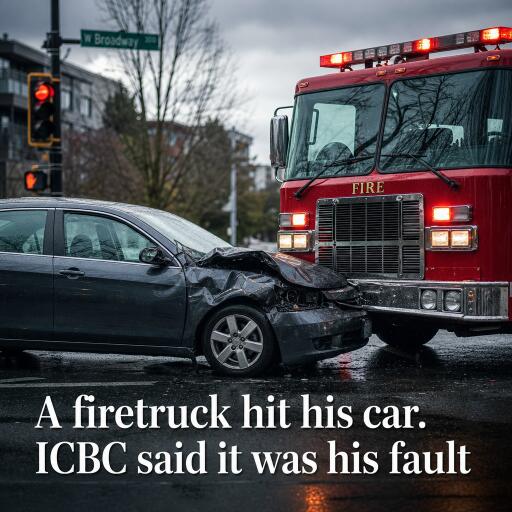
A firetruck hit his car. ICBC said it was his fault
In Port Coquitlam, a left-turn by a fire emergency vehicle clipped a motorist’s bumper at a T-intersection, initially resulting in a full blame assignment to the driver. A provincial tribunal later overturned that finding, ruling that the insurer’s fault assessment was unreasonable and should not stand.
The incident occurred around 8:30 a.m. on March 11, 2024, at the junction of Coast Meridian Road and Industrial Avenue. The motorist was traveling east on Industrial Avenue, stopping at a stop sign to scan for oncoming traffic before beginning a cautious right turn onto Industrial Avenue. A firetruck was traveling north on Coast Meridian and began a left turn onto Industrial Avenue. The two paths were not intended to cross, yet the left turn by the firetruck clipped the motorist on the front-left bumper, causing only minor damage to both vehicles.
ICBC investigated and attributed 100% fault to the motorist, prompting a request for review, which upheld the initial decision.
The turning point in the case came from how ICBC interpreted a critical piece of evidence. The firetruck operator sent an email indicating they could not recall the motorist fully stopping at the stop line and were unsure whether the motorist was completely stationary at impact or still edging forward. This statement did not explicitly say the motorist failed to stop, but ICBC treated it as if it did. The tribunal found that ICBC had mischaracterized the statement, and that the fault determination was not supported by the evidence as a whole.
With ICBC’s process deemed unreasonable, the tribunal reassessed fault from scratch. The motorist described stopping at the line, creeping forward briefly to gauge visibility, and proceeding with the turn while keeping near the curb. The firetruck driver’s account did not contradict this sequence. Since the two vehicles’ paths should not have intersected, the tribunal found there was no reasonable basis for the motorist to expect a hazard from the firetruck on that left turn.
In its reasoning, the tribunal emphasized that when competing driver accounts are in play, the proper approach is to evaluate the overall traffic dynamics and the duty of each party. The physical setup of a T-intersection, combined with the through-right-of-way for the firetruck and the motorist’s cautious approach, supported a conclusion that the motorist bore little to no responsibility for the collision.
Final ruling: The motorist was found 0% responsible for the incident, and ICBC was ordered to amend its internal records accordingly. The insurer was also required to reimburse $125 in tribunal fees within 14 days of the decision.
Takeaway: This case highlights the risk of drawing conclusions from partial or ambiguous statements. For adjusters and reviewers, it underscores the importance of weighing all available evidence and how a seemingly small interpretive gap can influence fault determinations in meaningful ways.