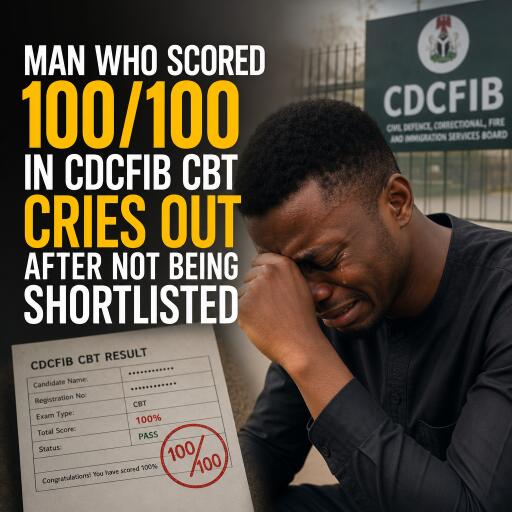

Man who scored 100/100 in CDCFIB CBT cries out after not being shortlisted
A Nigerian applicant has sparked debate after claiming he achieved a perfect 100/100 in the Civil Defence, Correctional, Fire and Immigration Services Board (CDCFIB) recruitment Computer-Based Test, only to find his name missing from the shortlist for the next phase.
Claim of a perfect score, but no shortlist
According to the candidate, the shock came when he checked his status and discovered he had not advanced despite what he described as a flawless performance in the CBT. He voiced his frustration online, lamenting that after putting in so much effort and dedication, he still couldn’t locate his name among successful candidates.
The message he says he received
The applicant shared a status update purportedly from the recruitment portal, stating that after review and evaluation, his application would not proceed to the next stage. The message did not specify any reasons, leaving him and other observers searching for answers.
Mixed reactions from the public
The story quickly drew attention across social platforms, with reactions split. Some users questioned the transparency of the screening and shortlisting process, while others noted that recruitment into paramilitary services often goes beyond a single test score. Many urged patience, suggesting that additional stages or criteria might have influenced the outcome.
Why a top CBT score may not guarantee shortlisting
Recruitment under the CDCFIB typically involves several filters beyond the initial test. While the board’s specific criteria for this cycle have not been publicly detailed for individual cases, industry watchers point to common factors that can influence shortlisting:
- Geopolitical and role-based quotas that distribute opportunities across states or cadres.
- Document and identity verification, including inconsistencies in biodata or credentials.
- Minimum and competitive cut-offs that can vary by category, gender, or specialization.
- Physical, medical, or background checks scheduled for later phases, which may require pre-screen alignment.
- Discrepancies between application details and uploaded documents.
- Administrative errors or pending reviews that may be resolved in subsequent updates.
What candidates can do next
- Regularly revisit the official recruitment portal for updates or corrections to shortlists.
- Keep application details, exam slips, and credential scans readily available for any appeals or clarifications.
- Avoid third-party intermediaries and scams that promise placement.
- Monitor official announcements for guidance on appeals, verification windows, or supplementary shortlists.
Broader call for clarity
This incident has intensified ongoing calls for clearer communication around recruitment timelines, cut-off structures, and tie-break rules. While the candidate’s claim of a perfect score remains unverified in the absence of official confirmation, the situation underscores a familiar tension in competitive public-sector hiring: high test marks are important, but they are rarely the only gatekeeper.
As discussions continue, many applicants are hoping for more transparent explanations of how shortlisting decisions are made, especially in cases where stellar test performance appears not to align with the outcomes they expected.