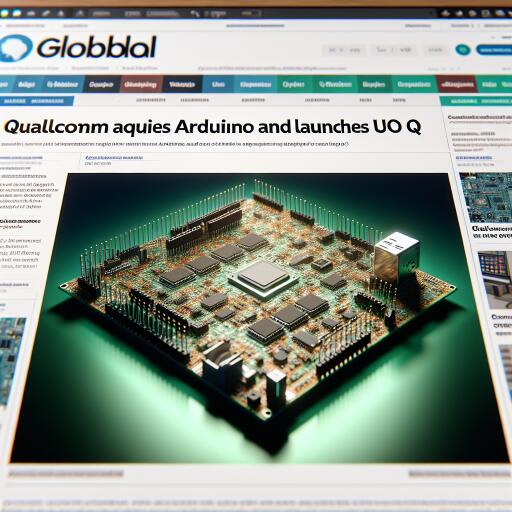

Qualcomm Just Bought Arduino and Released Uno Q
In a move that could redraw the map of DIY electronics and edge computing, Qualcomm has acquired Arduino and unveiled the Uno Q—a board that fuses Arduino’s approachable workflow with Qualcomm’s high-performance silicon. For a community raised on schematics, serial monitors, and open schematics, the big question is less about raw power and more about philosophy: can the heart of open hardware beat as loudly under a proprietary umbrella?
Why This Merger Matters
Arduino made hardware literacy accessible. It turned classroom experiments and kitchen-table tinkering into robotics, art installations, and research prototypes. Qualcomm brings deep experience in mobile-class computing, connectivity, and AI acceleration. Together, they’re aiming to collapse the distance between microcontroller simplicity and Linux-class capability, potentially giving makers a single board that can do both real-time I/O and heavy lifting at the edge.
Meet the Uno Q
The Uno Q keeps a familiar footprint but changes the playbook. At its core sits Qualcomm’s Dragon Wing QRB 2210 alongside 2 GB of RAM and 16 GB of eMMC. Think microcontroller timing with a Linux brain: GPIO and real-time responsiveness paired with on-board storage, multitasking, and modern toolchains. It’s a hybrid that invites projects traditionally split across two devices—an MCU for control and a single-board computer for compute—to live on one board.
That opens the door to:
- On-device machine learning for classification, tracking, and anomaly detection.
- Sensor fusion and robotics that demand precise I/O and mid-tier compute.
- IoT gateways that collect, process, and transmit data without a cloud round-trip.
- Prototyping pipelines that scale from breadboard to pilot deployment with fewer redesigns.
Implications for Gaming and XR
For game and VR developers, this could be a prototyping goldmine. Low-latency I/O can drive custom haptics, wearables, or motion rigs, while a Linux layer can handle pose estimation, audio pre-processing, or networking. Imagine testing new tracking modalities for mixed reality, building bespoke controllers, or orchestrating multi-device setups—without juggling separate boards.
Staying Beginner-Friendly
Arduino’s magic has always been a gentle learning curve. The promise here is continuity: sketches, shields, and familiar libraries where they make sense, with an elevator up to more advanced workflows when you’re ready. In education, that means one platform serving both first lessons in blinking LEDs and capstone projects involving computer vision or autonomous navigation.
Industry Crossover
On the professional side, a Linux-capable Arduino lowers the barrier for edge deployments. Rapid prototyping can evolve into pilots with the same board, compressing timelines and reducing integration headaches. Potential use cases include smart sensors in facilities, automation nodes on factory floors, and field-ready devices that crunch data locally before sending summaries upstream.
The Open Question: Openness
This is where the merger will be judged. Arduino’s reputation is anchored in open hardware and transparent tooling. Qualcomm’s strengths come from performance and integration, often delivered through proprietary components. The community will be watching for:
- Hardware documentation that remains clear and accessible.
- Licensing that preserves the ability to learn, modify, and share.
- Tooling that welcomes beginners while supporting power users.
If those pillars wobble, enthusiasm could cool—no matter how fast the silicon runs.
Price, Support, and Staying Power
The Uno Q is entering a crowded field where affordability and reliability often trump novelty. Its success will hinge on:
- Sensible pricing that doesn’t push students and hobbyists out of the conversation.
- Long-term Linux support, with updates and security patches that keep devices viable.
- Robust BSPs, clear APIs, and a commitment to upstream contributions where possible.
Educational institutions and industrial users plan on multi-year horizons; without dependable software maintenance, even impressive hardware can be a nonstarter.
What This Could Change
If the balance is right, the Uno Q could become a bridge device: the board you learn on, prototype with, and deploy at the edge. It could shrink development cycles for robotics, smart environments, and interactive installations. In XR labs and indie studios, it might be the backbone of experimental peripherals and spatial computing rigs that previously needed a tangle of devices.
Risks Worth Watching
- Fragmentation: a split between “classic” Arduino workflows and a new Linux-centric path could confuse newcomers if not thoughtfully integrated.
- Ecosystem shock: if shields, libraries, or core tools lose compatibility, trust may erode.
- Supply stability: makers have long memories about stock shortages; consistent availability matters.
Bottom Line
Qualcomm’s acquisition of Arduino sets an ambitious course for embedded computing. The Uno Q showcases what a microcontroller-plus-Linux hybrid can offer: real-time control meeting modern compute on a single, approachable board. Now comes the hard part—delivering openness, fair pricing, and long-term support. If those promises hold, this collaboration could redefine the path from learning to launching, with ripple effects across education, industry, and the creative tech scene—including gaming and XR. If not, it risks becoming a powerful board that few can afford or fully trust. The community will decide which story gets written.