
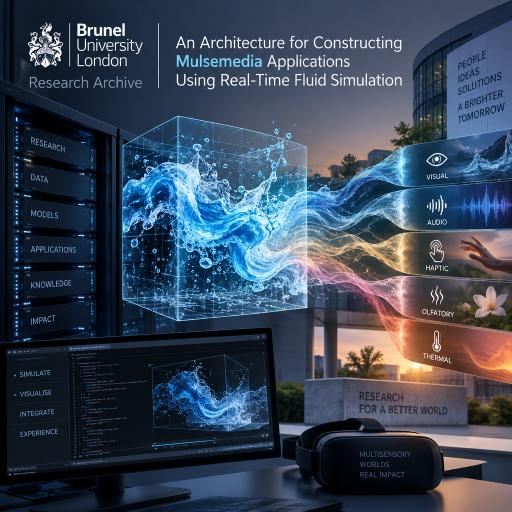
Brunel University Research Archive: An Architecture for Constructing Mulsemedia Applications Using Real-Time Fluid Simulation
Mulsemedia experiences extend digital content beyond sight and sound by introducing physical sensations such as airflow, warmth and fragrance. In gaming and virtual reality, these effects could make virtual environments feel more immediate—for example, allowing players to sense the heat of a fire or a gust of wind moving through a scene.
Delivering these sensations convincingly is technically demanding. Effects must respond to changes in the virtual environment, behave in a believable manner and remain synchronized with visual and audio events. Any noticeable delay or physically inconsistent response can diminish immersion rather than improve it.
Particle-Based Simulation for Sensory Effects
The proposed architecture uses Smoothed-Particle Hydrodynamics, commonly known as SPH, to represent gas-like phenomena in real time. Instead of relying on a fixed simulation grid, SPH models a fluid as a collection of interacting particles. This approach can support dynamic environments in which airflow, temperature and similar properties change as the scene evolves.
The system provides tools for configuring virtual spaces and defining the behavior of sensory hardware. Designers can specify the placement and characteristics of sensors and actuators, then test how an effect is expected to travel under different environmental conditions. This creates a bridge between simulated events and devices capable of producing physical sensations for the user.
Testing Wind and Temperature
A proof-of-concept scenario combines airflow with temperature variation. The simulation examines how heated or cooled air propagates through an environment and how those changes might be reproduced by physical equipment. Results suggest that the model follows important trends found in real-world measurements, while remaining responsive enough for interactive applications.
The architecture is not intended to reproduce every detail of fluid behavior with laboratory-level precision. Its value lies in balancing physical credibility with the performance requirements of games, VR and other real-time media. That balance is essential when sensory effects must adapt instantly to player actions or changing scenes.
Potential for Games and Virtual Reality
A reusable simulation framework could help developers prototype multisensory experiences before deploying specialized hardware. It may also support more consistent evaluation of comfort, timing and perceived realism across different configurations.
Future applications could include environmental storytelling, training simulations, location-based entertainment and accessibility-focused experiences. By treating wind, heat and scent as programmable elements of a virtual scene, this architecture offers a practical foundation for richer forms of interactive media.