Electric vehicle charging station recommendation system based on graph neural network and context-aware refinement – Scientific Reports
As cities race to electrify transport, one stubborn bottleneck remains: even where charging stations exist, they are underused. A new study in Scientific Reports tackles this mismatch with a recommendation system that helps drivers find the right charger at the right time—by combining graph neural networks (GNNs) with real-world context like proximity and charging preferences.
Why this matters
Charging availability can make or break the EV experience. Traditional station finders focus on distance or availability alone, ignoring nuanced factors like driver habits, station types, and how people move in urban space. The result is friction—queues at popular fast chargers and idle slow chargers nearby. This research proposes a smarter approach that learns user–station relationships from data, then refines the results with context that reflects how people actually choose where to charge.
The core idea
The team builds a two-stage recommendation pipeline:
- Stage 1: GNN-based collaborative filtering—A state-of-the-art graph neural network learns from interactions between drivers and stations, capturing complex patterns beyond what classic recommenders see.
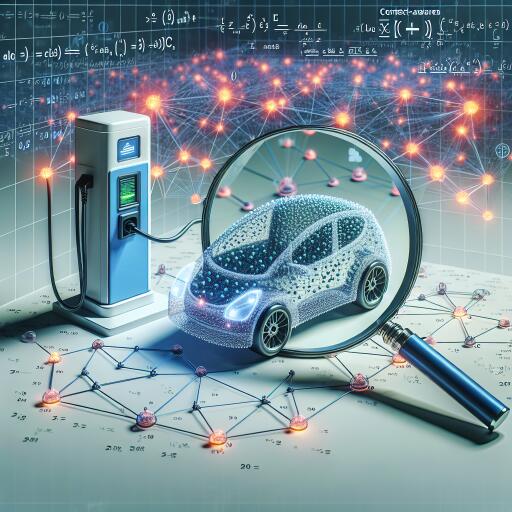
- Stage 2: Context-aware refinement—Predictions are adjusted using real-world factors: how close a user is to a station and whether they prefer slow or fast charging. A spatial clustering technique further models how users and stations are distributed across the city.
Data at scale—and a clever workaround
High-quality recommendations depend on high-quality data. The researchers collect and manage large-scale, real-time EV charging station data, covering station locations, types, and usage dynamics. But driver profiles—vital for personalization—are often absent or restricted for privacy reasons. To bridge this gap, the team develops a simulator that reproduces realistic charging behavior, learning from observed patterns and translating them into synthetic profiles that mirror real-world habits. This enables robust training and testing without compromising privacy.
How the model works
At its base, the system uses a GNN to model the EV ecosystem as a graph: drivers and stations are nodes, and their interactions (e.g., past visits) form edges. This structure helps the model learn subtle signals—such as shared station usage among similar users or relationships between station types and times of day—that traditional matrix methods might miss.
On top of this, the researchers add context-aware refinements:
- Location proximity—The model factors in how close a driver is to each station, but goes beyond simple distance metrics.
- Charging type preference—The system personalizes recommendations based on whether the driver tends to use fast or slow charging, a key determinant of utility and satisfaction.
- Spatial clustering—Instead of treating proximity as a straight line, the approach clusters users and stations to reflect real urban geography—neighborhoods, travel corridors, and local density. This produces recommendations that align with how people navigate cities.
Why clustering beats raw distance
Proximity alone can be misleading—two stations might be equidistant but separated by a river, a highway, or inconsistent traffic. The clustering step maps the real spatial structure of a city, capturing where drivers actually move and where stations compete or complement each other. By modeling these spatial communities, the system reduces irrelevant suggestions and surfaces more practical options.
Results: consistent, substantial gains
Across multiple GNN-based collaborative filtering backbones, the context-aware refinements improved recommendation quality in extensive experiments. Two factors stood out:
- Charging-type information delivered significant, reliable improvements, aligning recommendations with drivers’ functional needs (quick top-ups vs. longer, slower sessions).
- Spatial clustering produced stable performance gains over naïve proximity, better capturing the reality of urban layouts and mobility.
Used together, charging-type preferences and spatial clustering delivered the most robust results, outperforming baseline GNNs consistently. The takeaway: personalization works best when it fuses behavior and geography.
What this means for cities and drivers
- For drivers—Fewer dead-ends and better matches between urgency, charging speed, and location.
- For operators—Higher utilization and more balanced demand across stations, easing congestion while maximizing infrastructure ROI.
- For planners—Data-driven insights into where new stations will have the most impact, based on observed behavior rather than guesswork.
Why GNNs fit the problem
EV charging usage forms a web of relationships—drivers overlapping in their preferred stations, stations sharing user communities, and preferences shifting with time and context. GNNs are well-suited to capture these interconnected patterns. By layering context-aware corrections, the approach translates learned affinities into practical, real-world suggestions.
Limits and what’s next
While the simulator opens doors where profile data is scarce, real-world deployment will benefit from privacy-preserving learning on actual user data (e.g., federated learning). Future improvements could include:
- Time-sensitive context (rush hours, events, weather, grid load).
- Real-time availability and predicted wait times.
- Multi-objective recommendations balancing cost, carbon intensity, and convenience.
Bottom line
This study shows that EV charging recommendations improve markedly when algorithms learn from both people’s functional preferences and the geography of their daily lives. By pairing a strong GNN core with context-aware refinements—especially charging-type preferences and spatial clustering—the system consistently outperforms baseline models. The message for the EV ecosystem is clear: smarter, context-rich recommendations can unlock the full potential of existing infrastructure while guiding smarter investments for what comes next.