
IEEE’s Highest Honors: Meet the 2026 Pioneers Transforming Our World Through Technology
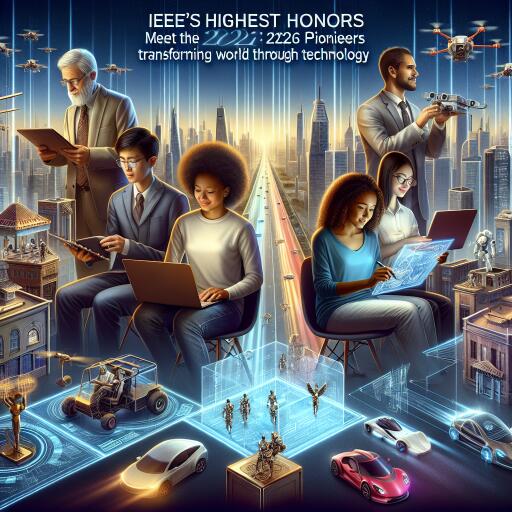
IEEE has unveiled the 2026 recipients of its top Medals, spotlighting innovators whose work is reshaping the technological landscape—from the internet’s plumbing and wireless standards to biomedical imaging, power systems, AI, and beyond. This new class of honorees showcases how research, engineering, and visionary leadership translate into tools and systems that improve everyday life, strengthen infrastructure, and expand access to knowledge and opportunity.
Their contributions are felt across industries: faster and safer networks, breakthroughs in healthcare and sensing, smarter grids for a renewable future, and advances in semiconductors, software, and computing that underpin modern communication, entertainment, and enterprise operations. Below are the highlights of this year’s awardees.
- IEEE Frances E. Allen Medal — Luis von Ahn (Duolingo): Honored for creating CAPTCHA and reCAPTCHA, pioneering human computation, and building a global platform for free language learning that has secured online systems and helped digitize massive text archives.
- IEEE Alexander Graham Bell Medal — Scott J. Shenker (UC Berkeley): Recognized for foundational work in computer networking and internet architecture, influencing software-defined networking, cloud infrastructure, and modern data center design.
- IEEE Jagadish Chandra Bose Medal in Wireless Communications — Erik Dahlman, Stefan Parkvall, Johan Sköld (Ericsson): Celebrated for leadership in LTE and 5G standardization, enabling worldwide mobile broadband and the growth of IoT, streaming, and real-time services.
- IEEE Mildred Dresselhaus Medal — Karen Ann Panetta (Tufts University): Applauded for advances in image processing with impact on medical and autonomous systems, alongside global advocacy expanding STEM pathways for girls and women.
- IEEE Edison Medal — Eric A. Swanson (MIT): Recognized for pioneering optical technologies spanning biomedical imaging, high-speed terrestrial networking, and inter-satellite optical links.
- IEEE Medal for Environmental and Safety Technologies — Wei-Jen Lee (University of Texas): Cited for leadership in power systems and renewable integration that bolster grid reliability and support large-scale clean energy adoption.
- IEEE Founders Medal — Marian R. Croak (Google): Honored for transformative contributions to VoIP and mobile donation platforms that changed global communications and humanitarian response, and for leadership guiding responsible AI advancement.
- IEEE Richard W. Hamming Medal — Muriel Médard (MIT): Recognized for breakthroughs in network coding and information theory that make data delivery more robust across wireless, satellite, and streaming applications.
- IEEE Medal for Innovations in Healthcare Technology — Rosalind W. Picard (MIT): Celebrated for founding affective computing and creating wearable tech that senses emotion and physiological signals, informing tools for mental health and personalized wellbeing.
- IEEE Nick Holonyak, Jr. Medal for Semiconductor Optoelectronic Technologies — Steven P. DenBaars (UC Santa Barbara): Honored for trailblazing work in gallium nitride and LED technologies that power efficient lighting, displays, and illumination from phones to cars.
- IEEE Jack S. Kilby Medal — Biing-Hwang “Fred” Juang (Georgia Tech): Recognized for foundational advances in speech coding and recognition that underpin voice interfaces across smartphones, virtual assistants, and contact centers.
- IEEE/RSE James Clerk Maxwell Medal — Paul B. Corkum (University of Ottawa): Celebrated for pioneering attosecond science, enabling the observation of ultrafast electron dynamics and chemical reactions.
- IEEE James H. Mulligan, Jr. Education Medal — James H. McClellan (EPFL): Honored for decades of impact in digital signal processing education and theory, with ripple effects in audio, medical ultrasound, and radar.
- IEEE Jun-ichi Nishizawa Medal — Eric R. Fossum (Dartmouth): Recognized as the inventor of the CMOS image sensor, a breakthrough that transformed digital photography and video for consumer and professional imaging.
- IEEE Robert N. Noyce Medal — Chris Malachowsky (NVIDIA): Celebrated for co-founding NVIDIA and driving GPU innovation that fuels AI, scientific computing, and modern gaming—key engines for today’s graphics-intensive applications and immersive experiences.
- IEEE Dennis J. Picard Medal for Radar Technologies and Applications — Yoshio Yamaguchi (Niigata University): Honored for advancing radar polarimetry and remote sensing used in climate monitoring and disaster mitigation.
- IEEE Medal in Power Engineering — Fang Zheng Peng (University of Pittsburgh): Recognized for innovations in power conversion, including the quasi Z-source inverter, improving efficiency and stability in renewable energy systems.
- IEEE Simon Ramo Medal — Michael Douglas Griffin (LogiQ, Inc.): Celebrated for shaping U.S. space exploration strategy and advancing aerospace engineering, laying the groundwork for today’s crewed and deep-space missions.
- IEEE John von Neumann Medal — Donald D. Chamberlin (IBM): Honored as co-inventor of SQL and a key force in database systems that support global finance, healthcare, government, and enterprise data operations.
For gamers and immersive tech enthusiasts, several of these achievements hit especially close to home. GPU advances have accelerated not only high-fidelity game rendering but also the AI models behind smarter NPCs, real-time upscaling, and emerging XR experiences. Image sensors, LED displays, and 5G networks likewise push the envelope for mobile gaming, cloud streaming, and wearable devices—tightening latency, lifting quality, and expanding where and how we play.
The honorees will be celebrated at the IEEE Honors Ceremony on 24 April 2026 in New York City. The 2026 IEEE Medal of Honor recipient will be named in January 2026.
For more than a century, the IEEE Awards program has recognized trailblazers who redefine what’s possible in computing, communications, power and energy, aerospace, materials, healthcare, and beyond. The 2026 class exemplifies how deep technical expertise, creative thinking, and persistent execution translate into technologies that connect us, safeguard critical systems, and broaden access to education and opportunity.