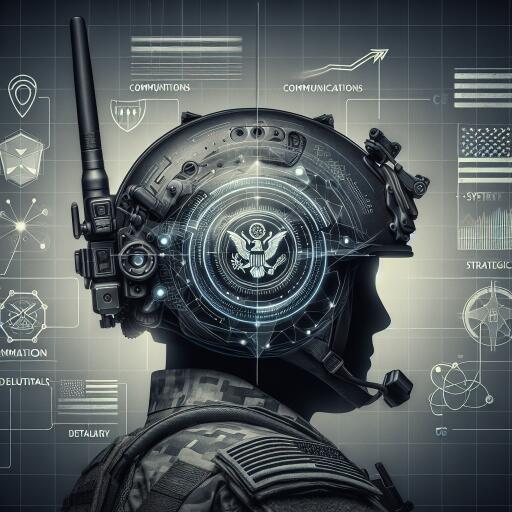

Elbit to Develop Helmet-Mounted US Soldier Mission Command System
The US Army has tapped Elbit America with a $120.5 million contract to build a helmet-mounted mission command system designed to fuse feeds from multiple battlefield sensors into a single, intuitive visual display. The Soldier Borne Mission Command (SBMC) system aims to boost dismounted troops’ situational awareness and speed up decision-making at the small-unit level.
With SBMC, soldiers will be able to share visual intelligence, threat information, and mission updates across their squad or platoon in near real time. Elbit America says the system is engineered to operate even in denied or degraded environments, preserving critical connectivity and context when GPS, bandwidth, or other infrastructure is disrupted.
“Our Soldier Borne Mission Command is critical to winning on the battlefield. Soldiers need processed data distilled, so they’re more lethal and survivable,” said Luke Savoie, President and CEO of Elbit America. “They need it at near-zero latency and in a manner that enables them to shoot, maneuver, and share instantaneously.”
Elbit America has partnered with Booz Allen Hamilton to deliver the software backbone for SBMC, integrating extended reality interfaces, resilient networking architectures, and AI-enabled analytics. The goal is to streamline information flow, prioritize what matters most, and present it through a soldier’s helmet-mounted display without overwhelming the user.
“SBMC changes the speed of decision-making and enables confident, decisive action in moments that define the fight,” said Erik Fox, Senior Vice President and General Manager of Warfighter Systems at Elbit America. “Thanks to our close collaboration with Booz Allen Hamilton we gain mission-critical information, instantly and intuitively, allowing Soldiers to think and react faster.”
From IVAS Lessons to a Broader Mission-Command Focus
The SBMC effort follows the Army’s Integrated Visual Augmentation System (IVAS) program, which faced technical, usability, and operational hurdles during testing—among them reports of headaches, nausea, and eyestrain in early device iterations. Rather than centering on augmented reality alone, SBMC shifts the emphasis to mission command and sensor fusion across the formation, aiming for a more robust, soldier-centric toolset that supports rapid comprehension and action.
To accelerate development, the Army is pursuing rapid prototyping with multiple defense tech partners. Anduril Industries and Rivet Industries have been contracted to advance night-vision and mixed-reality components under the broader program. Separately, Anduril has also been tasked with developing the SBMC software architecture that connects the data presented in a soldier’s headset to higher command echelons, ensuring that information captured at the edge can be shared upward and across the force as needed.
Why It Matters
Modern small units operate in environments defined by distributed sensors, electronic warfare, and contested communications. SBMC’s promise lies in merging these inputs into a coherent, low-latency picture that helps soldiers act faster and with more confidence—without adding cognitive burden. If the system delivers on its goals for resilience and intuitive use, it could mark a significant step forward in how dismounted troops perceive, decide, and coordinate on the battlefield.