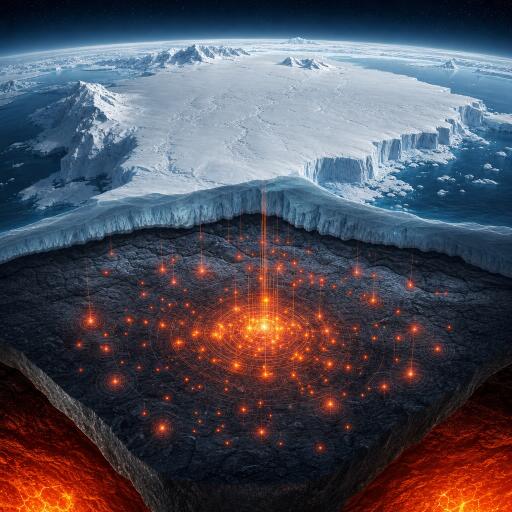

500 hidden earthquakes beneath Antarctica, and the strangest ones are shaking the middle of a tectonic plate where deep quakes were not supposed to happen
Antarctica has long been painted as Earth’s seismically quiet frontier. That image just cracked. Using artificial intelligence to re-analyze two decades of archival seismic recordings, researchers have identified more than 500 previously unseen earthquakes rumbling beneath the East Antarctic Ice Sheet—far from any plate boundary and in a place where deep quakes weren’t supposed to occur.
A quiet continent starts to rumble
Most earthquakes cluster along the edges of tectonic plates, where slabs collide, slide, or split. Antarctica, anchored near the center of a massive plate, has typically stood apart from that global pattern. But a new study in Science overturns the notion of a still interior: the team found hundreds of events about 60 to 90 miles (roughly 100 to 145 kilometers) below the surface, beneath David Glacier—a giant ice stream stretching nearly 700 miles that funnels about 4% of the East Antarctic Ice Sheet into the ocean.
Why this site puzzles geologists
Intermediate-depth earthquakes—those originating tens to hundreds of kilometers underground—are usually hallmarks of subduction zones, where one tectonic plate dives under another. David Glacier sits nowhere near such a boundary. That makes these quakes a head-scratcher for plate-tectonic theory.
The leading explanation, according to lead author Long Ho of the University of Alabama, hinges on stark thermal contrasts within the region. Beneath East Antarctica, the crust and upper mantle are cold and mechanically strong; beneath West Antarctica, they are warmer and weaker. Where these two regimes meet, warm material rising from the west can bend and stress the colder, stiffer edge to the east. That flexing builds pressure that gets released as small earthquakes. In the new catalog, magnitudes span about 1.6 to 3.5—too small to be felt, but scientifically revealing.
How AI cracked a two-decade-old mystery
The breakthrough didn’t require new instruments—it required smarter analysis. The dataset came from 49 seismic stations recording in two windows, 2001–2004 and 2012–2015. For years, those faint signals were buried in noise, below the threshold of conventional detection. The research team trained machine-learning models to recognize subtle earthquake signatures and re-swept the old records, surfacing events that earlier methods missed.
Glaciologist Richard Alley of Penn State, who wasn’t involved, notes that Antarctica’s apparent quiet was less about absent quakes and more about limited sensitivity. With improved algorithms, scientists are finally extracting what the original instruments had already captured.
Should anyone be worried?
Not at this point. These events are too small to imperil the overlying ice sheet or nearby ecosystems, the researchers say. There’s no expectation of infrastructure risk from this activity.
The broader significance lies in what the results suggest about mid-plate seismicity worldwide. If deep, quiet quakes can thrive under East Antarctica, similar activity might be percolating beneath other “stable” interiors—just below the detection limits of older techniques. A companion line of research on continental mantle earthquakes, also reported in Science, points to a wider rethink of how and where deep seismicity can occur away from plate margins. As detection improves, hazard models may need to account more fully for low-level, intraplate processes.
What researchers want to learn next
Several questions now take center stage:
- Ice load effects: How does the immense weight of the Antarctic Ice Sheet influence where and when these quakes occur? If the ice thins or shifts as the climate warms, will seismic patterns reorganize?
- Why David Glacier: Why do events cluster here instead of spreading evenly across nearby mountain belts? The answer could tie to past ice advances and retreats, or to deeper geological structures carved by long-term erosion.
Untangling these factors matters. Seismic histories help reconstruct Antarctica’s geologic past and refine scenarios for its future stability—especially as warming applies new stress to ice and rock alike.
The bottom line
Antarctica wasn’t silent; we just hadn’t learned to listen. With AI-aided detection, the continent is revealing a hidden cadence of small, deep earthquakes in a place that defies expectations. As these tools spread, expect more surprises—not only from beneath the ice, but also from seemingly quiet corners of the globe that our older methods could never quite hear.