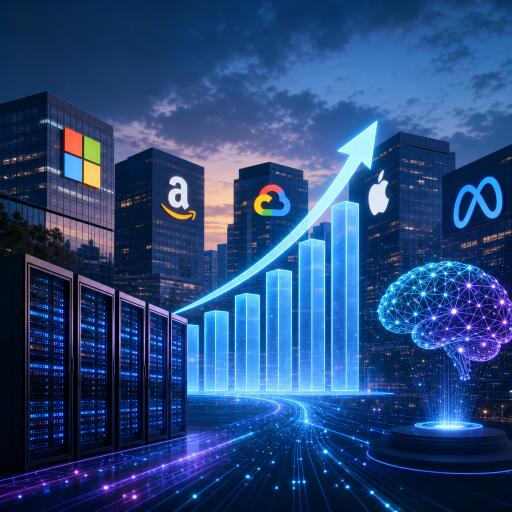

Tech giants boost CapEx to $165B in Q2, eye AI expansion
Amazon, Google, Microsoft, and Meta sharply increased capital spending in the second quarter, lifting their combined outlay to $165 billion. According to a recent report, that represents an 87% jump from a year ago and a striking 393% increase over the past three years.
The spending surge points to one clear priority: building the infrastructure needed to support the next phase of artificial intelligence. Data centers, servers, networking gear, and cloud capacity are all seeing heavier investment as the largest tech players race to meet growing AI demand.
AI buildout moves into high gear
While capital expenditures can support a range of long-term projects, the scale and timing of this increase strongly suggest that AI is now at the center of Big Tech’s infrastructure strategy. Companies are pouring money into expanding compute power, upgrading networking systems, and scaling cloud platforms capable of handling advanced AI workloads.
This trend reflects a broader shift in the industry. AI is no longer just a product layer added onto existing services; it is becoming a foundational part of how these companies plan future growth. That means the race is not only about releasing better models or applications, but also about owning the infrastructure behind them.
Pressure builds around NVIDIA’s dominance
The spending wave is also reshaping the competitive conversation around NVIDIA, which has become one of the biggest beneficiaries of the AI boom. As the dominant supplier of high-end chips used to train and run AI systems, NVIDIA has enjoyed a powerful market position and a surge in valuation.
But as Amazon, Google, Microsoft, and Meta spend more aggressively, investors are weighing whether the balance of power could start to shift. These companies are not just buying AI capacity; they are also strengthening their own ecosystems, improving internal capabilities, and in some cases developing alternatives that could reduce reliance on outside suppliers over time.
That does not necessarily weaken NVIDIA in the short term. In fact, this level of infrastructure spending can continue to support demand for its chips and systems. Still, the market appears to be reassessing how durable NVIDIA’s lead will be as the largest technology company by market capitalization, especially if hyperscalers gain more control over the AI stack.
Cloud and AI remain tightly linked
Another major takeaway from the surge in spending is how closely cloud growth and AI expansion are now connected. The biggest cloud providers are investing not only to serve enterprise computing needs, but also to host and deliver increasingly complex AI tools.
That creates a reinforcing cycle: more AI services require more infrastructure, and more infrastructure can attract more developers and customers. For Amazon, Google, and Microsoft in particular, cloud platforms are central to turning capital expenditure into long-term revenue growth. Meta, meanwhile, is investing heavily to support AI across its consumer platforms, advertising systems, and future product development.
What markets will watch next
Investors will now look closely at upcoming earnings reports, forward guidance, and management commentary to understand whether these historic spending levels are translating into stronger growth. Key questions include how quickly new infrastructure can be deployed, whether AI-related demand continues to accelerate, and how profit margins hold up under such intense investment.
Markets will also be paying attention to any announcements involving AI partnerships, custom chip development, or major data center expansion plans. Those updates could influence sentiment not just around the four companies increasing spending, but also around NVIDIA and the broader semiconductor sector.
Beyond company-specific news, macroeconomic conditions and regulation could also affect the outlook. Financing costs, energy availability, antitrust scrutiny, and AI policy debates all have the potential to shape how quickly this infrastructure expansion continues.
The bigger picture
The jump to $165 billion in second-quarter capital expenditure shows that the AI race is entering a more capital-intensive stage. The leading tech companies are no longer signaling ambition with words alone; they are committing enormous sums to the physical backbone of the next computing era.
For investors and industry watchers, the message is straightforward: AI competition is increasingly being fought through infrastructure. And as that spending accelerates, the battle for leadership across cloud, chips, and platform ecosystems is likely to become even more intense.