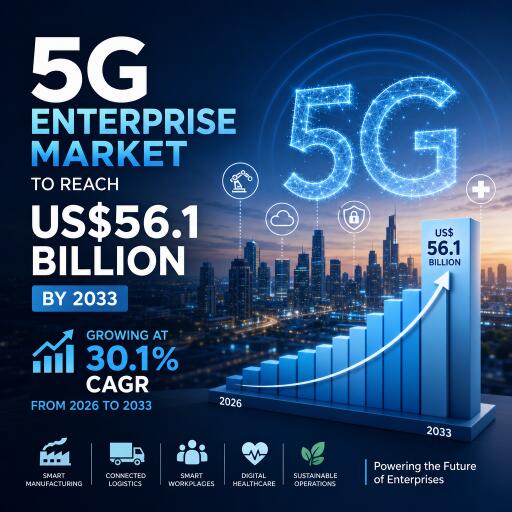

5G Enterprise Market to Reach US$56.1 Billion by 2033, Growing at 30.1% CAGR from 2026 to 2033
The enterprise 5G landscape is accelerating from niche pilots to mission-critical infrastructure. Valued at US$8.9 billion in 2026, the market is on track to hit US$56.1 billion by 2033, expanding at a 30.1% CAGR. What’s fueling this surge: the shift to private 5G networks, the rise of edge computing, and a flood of IoT devices across factories, hospitals, logistics hubs, and smart infrastructure. For immersive tech and industrial XR, that means more reliable ultra-low-latency backbones for digital twins, AR-guided workflows, and real-time analytics at the edge.
Key takeaways at a glance
- Market size: US$8.9B (2026) to US$56.1B (2033), 30.1% CAGR.
- North America leads with roughly 38% share in 2026, thanks to mature spectrum access, strong industrial clusters, and robust vendor ecosystems.
- Manufacturing is the top adopter, accounting for about 25% of the market in 2026 as factories ramp up autonomous systems and real-time control.
- Radio nodes dominate access equipment, near 59% share in 2026, delivering dense, low-latency campus coverage.
- Asia Pacific is the fastest-growing region on the back of large-scale industrial automation and smart infrastructure projects.
Why private 5G is winning inside the enterprise
Private and hybrid 5G deployments are reshaping enterprise networks by replacing rigid wiring with high-speed, highly reliable wireless. Radio nodes anchor most rollouts as they provide strong throughput and deterministic performance across plant floors, logistics yards, and large campuses. Small cells are climbing fastest: compact, power-efficient, and ideal for complex indoor environments where public macro networks fall short. Meanwhile, core and edge infrastructure is moving closer to the action, cutting latency for applications like machine vision, robotic coordination, and AR-assisted maintenance.
Who’s adopting—and how it’s used
- Manufacturing: The flagship vertical for 5G, enabling closed-loop automation, coordinated robotics, predictive maintenance, and digital twin oversight.
- Healthcare and life sciences: Among the fastest risers, leveraging ultra-reliable links for connected devices, remote diagnostics, and low-latency telemedicine.
- Logistics, energy, automotive, and retail: Rolling out 5G for asset tracking, worker safety, automated inspection, and real-time inventory orchestration.
For XR and spatial computing, private 5G unlocks stable, low-latency streams for AR overlays on the factory floor, collaborative digital twins for remote experts, and wireless VR training that doesn’t tether teams to a single room or network drop.
Regional outlook
- North America: Early spectrum availability and strong regulatory clarity have helped industrial players move quickly. Private 5G is taking root across advanced manufacturing, defense, and healthcare, while cloud and network vendors provide mature stacks.
- Asia Pacific: The fastest-growing region, propelled by expansive manufacturing bases, aggressive public investment in digitalization, and smart-city initiatives. Expect rapid scale in factories, logistics corridors, and urban infrastructure.
- Europe: A stable, high-value market with deep automation in automotive and precision manufacturing. Investments prioritize secure, compliant private networks and energy-efficient operations aligned with sustainability mandates.
What’s driving growth—and what could slow it down
Growth drivers:
- Industry 4.0 and robotics adoption that demand deterministic, ultra-low-latency connectivity.
- Edge computing that pushes AI/ML inference closer to machines for real-time decision-making.
- Exploding IoT footprints requiring massive device density and reliable QoS tiers.
Headwinds:
- Security and data privacy risks, particularly in regulated sectors handling sensitive IP or personal data.
- Upfront costs and spectrum expenses, plus integration with legacy OT/IT systems—tough hurdles for SMEs.
Opportunities:
- AI-driven network automation for autonomous optimization, slicing, and self-healing capabilities.
- Smart logistics and warehouse automation with real-time location tracking, autonomous vehicles, and computer vision at the edge.
- Enterprise XR at scale—wireless, low-latency AR/VR for training, remote support, and digital twin operations.
Competitive landscape
The field is highly competitive, with telecom infrastructure leaders, networking specialists, chipmakers, and cloud platforms shaping end-to-end solutions. Representative players include:
- Ericsson, Nokia, Huawei, ZTE
- Cisco, Samsung, NEC, Fujitsu
- Qualcomm, Intel
- Hewlett Packard Enterprise, Dell Technologies, VMware
- Amazon Web Services, Microsoft Azure, Google Cloud
Expect deeper collaboration across RAN, core, and cloud edge as enterprises demand turnkey stacks that integrate security, observability, and lifecycle management.
Outlook to 2033
Enterprise 5G is moving from pilots to platform—becoming the connective fabric for intelligent operations. With North America setting the early pace and Asia Pacific charting the fastest growth, the next seven years will see private networks anchor automation, AI at the edge, and immersive industrial workflows. Challenges around cost and cybersecurity won’t vanish, but as solutions mature and integrators streamline deployments, 5G will solidify its role as the backbone of next-generation enterprise and XR-enabled industry.