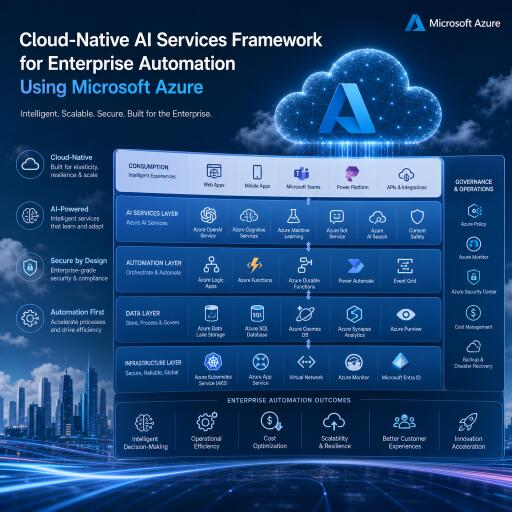

Cloud-Native AI Services Framework for Enterprise Automation Using Microsoft Azure
Enterprises racing to cut costs, move faster, and deliver always-on digital experiences are hitting the limits of legacy automation. The answer lies in cloud-native design infused with AI. Built on Microsoft Azure’s managed services, an AI-first automation framework can scale elastically, adapt to change in real time, and turn data into decisions with minimal human touch.
What “cloud-native AI” really means
Cloud-native AI isn’t a bolt-on model stitched to monolithic apps. It’s an architecture of microservices, containers, and serverless functions designed for elasticity and autonomy. By embedding intelligence throughout the stack, organizations automate not just repetitive work, but also complex, context-aware decisions—from anomaly detection to forecasting to conversational support.
Azure building blocks for an automation fabric
- Data ingestion and integration: Automation begins with trustworthy, streaming data. Services such as Azure Data Factory and Azure Event Hubs unify pipelines from on-premises systems, IoT devices, and SaaS APIs, establishing reliable, low-latency flows that feed models and workflows.
- AI and ML services: Azure Machine Learning and Azure AI Services bring together custom model training and prebuilt capabilities across vision, language, speech, and decision-making. With MLOps baked in, teams can version experiments, automate deployment, and monitor drift and performance at scale.
- Workflow orchestration: Azure Logic Apps and Power Automate translate AI insights into action. Think invoice capture using Azure AI Document Intelligence, routed through policy checks and approvals with event-driven triggers—consistent, auditable, and low-touch.
- Containerized compute: For portable, high-control workloads, Azure Kubernetes Service (AKS) runs microservices and model endpoints consistently across dev, test, and prod. Horizontal pod autoscaling balances load and allocates resources efficiently during traffic spikes, then contracts to save costs in quieter periods.
- Security and governance: Microsoft Entra ID (Azure Active Directory) enforces identity and access; Azure Policy and Microsoft Purview provide guardrails, lineage, and data classification. These capabilities are essential for sensitive domains like finance or healthcare, where least privilege, auditability, and regional controls are non-negotiable.
- Monitoring and observability: Azure Monitor and Application Insights surface health metrics, latency trends, and failure patterns. Teams can detect anomalies in model behavior or workflow timeouts early and remediate before they impact customers.
Where the value shows up
Across industries, the pattern repeats: connect data, apply intelligence, orchestrate action.
- Manufacturing: Predictive maintenance flags failing components before downtime hits, optimizing spare parts and technician schedules.
- Financial services: Real-time fraud scoring tightens risk controls without throttling legitimate transactions.
- Customer engagement: Multilingual virtual agents resolve routine cases end-to-end, escalating only nuanced issues to human experts.
- Retail and supply chain: Demand forecasting aligns inventory with seasonality and promotions, reducing overstock and stockouts.
- HR and back office: Intelligent document processing accelerates hiring, onboarding, and compliance reviews.
Design principles that make it work
- Scale by default: Use autoscaling and serverless patterns to absorb bursty demand without manual intervention.
- Resilience first: Design for failure with redundancy, circuit breakers, and retry policies so localized issues don’t cascade.
- Interoperability: Support hybrid and multicloud realities with APIs, event-driven integrations, and data virtualization where needed.
- Load balancing and resource allocation: Employ AKS horizontal/vertical autoscaling, node pools, and scheduled scaling to match compute profiles to workloads; use async queues to smooth spikes.
- Cost optimization: Right-size clusters, prefer serverless where possible, and leverage spot instances for noncritical jobs. Enforce budget alerts and review usage with Azure Cost Management to prevent waste.
- Responsible AI: Build in bias testing, explainability, and human-in-the-loop checkpoints for high-impact decisions; log model versions and decisions for audit.
Implementation tips
- Start with a narrow, high-ROI slice: For example, automate document intake or a single fraud use case, then expand once the pipeline and controls are proven.
- Standardize your MLOps toolchain: Treat models like code—CI/CD, reproducible environments, automated tests, and rollback strategies.
- Centralize data contracts: Clearly define schemas, SLAs, and quality metrics so downstream models don’t break with upstream changes.
- Instrument everything: Trace IDs across events, models, and workflows to accelerate incident response and root-cause analysis.
Challenges to expect—and how to navigate them
- Skills gap: Cloud-native and AI ops require cross-functional knowledge. Invest in enablement and create platform teams that productize common patterns.
- Data quality and drift: Poor inputs sink good models. Automate validation, monitor drift, and retrain against fresh, governed datasets.
- Legacy integration: Wrap older systems with APIs or event interfaces and migrate incrementally to reduce risk.
- Change management: Align stakeholders early, define KPIs, and communicate wins to sustain momentum.
What’s next
Azure’s rapid advances in generative AI and autonomous agents are pushing automation beyond rules and predictions into proactive, multi-step execution. Expect tighter coupling between LLM-powered reasoning, structured workflows, and real-time data streams—with stronger controls for security, cost, and compliance.
Bottom line
A cloud-native AI framework on Microsoft Azure turns fragmented workflows into a cohesive, self-optimizing system. By uniting data pipelines, ML services, orchestration tools, airtight governance, and deep observability, enterprises can scale smarter, operate leaner, and make better decisions—faster.