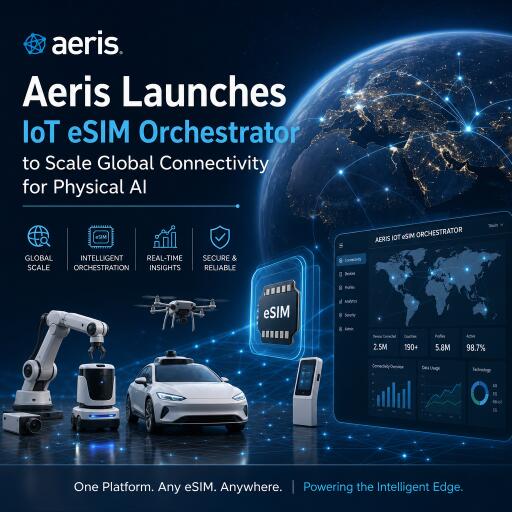

Aeris Launches IoT eSIM Orchestrator to Scale Global Connectivity for Physical AI – World Today Journal
Aeris has introduced an eSIM Orchestrator inside its IoT Accelerator platform, a move designed to simplify how businesses deploy and manage connected devices across the globe. The upgrade targets the fast-emerging wave of “physical AI”—autonomous vehicles, robots, and intelligent infrastructure—where devices must stay online securely as they roam between countries and networks without human intervention.
What’s New
The latest release adds support for the GSMA SGP.32 specification for IoT eSIM remote management and knits it together with Single SKU eSIM and Aeris eIM as a Service (eIMaaS). In practice, that means mobile network operators (MNOs), OEMs, and enterprises can centralize control of eSIM profiles and streamline large-scale rollouts, while maintaining local regulatory compliance and optimizing for performance on a per-market basis.
Why It Matters for Physical AI
Autonomous systems and connected machines can’t pause for manual SIM swaps or device-by-device tweaks. They need resilient connectivity that adapts in real time as conditions change—switching between carriers, adjusting to regional rules, and recovering from outages automatically. SGP.32 is tailored for that reality, enabling remote provisioning for IoT endpoints that typically lack screens or input methods. Aeris’ orchestration layer sits on top of this standard to automate decisions, enforce policies, and unify billing and lifecycle management from a single control point.
How the Orchestrator Works
Aeris has structured the new capabilities around three core building blocks:
- SGP.32 eSIM Orchestrator: Uses policy-based automation and event triggers to determine which local profile a device should carry, when to download or switch profiles, what network functions are permitted, and how to respond to connection failures—without touching individual units.
- Single SKU eSIM: Lets OEMs manufacture one global hardware variant and assign local operator profiles after deployment. This removes the need for multiple region-specific SKUs and reduces logistics complexity.
- eIM as a Service (eIMaaS): Offers a fully managed eSIM remote manager integrated with IoT Accelerator. Enterprises can also bring their preferred remote manager from established suppliers such as Thales, G+D, Kigen, or IDEMIA.
Scale, Standards, and Network Reach
According to Aeris, the IoT Accelerator platform oversees connectivity for roughly 110 million devices, with about 44 million using eSIM—over 40 percent of its installed base and notably higher than the broader market’s low double-digit penetration. The managed base is reportedly growing at more than 20 percent year over year.
Enterprises connecting through IoT Accelerator gain access to a pre-integrated community of 30 carrier partners spanning three generations of eSIM standards. The addition of SGP.32 complements existing enterprise and consumer frameworks, specifically addressing remote provisioning for headless IoT gear.
Designed for Cross-Border Autonomy
From smart fleets to industrial robotics, connectivity needs to be both local and global. Devices may cross borders daily, attach to different carriers frequently, and still be expected to uphold stringent security and uptime requirements. Aeris positions its orchestrator as the execution layer that turns the SGP.32 blueprint into consistent, real-world performance at scale—where the challenge isn’t flipping a single SIM profile, but coordinating thousands or millions safely and predictably.
Customer Footprint and Attachment Patterns
Aeris reports a presence across more than 7,000 enterprise customers, with device connections appearing in over 200 countries on a monthly basis. A large share of those connections—around 70 percent—attach directly to partner networks rather than relying primarily on traditional roaming, a model aimed at improving latency, reliability, and cost control.
Bottom Line
The eSIM Orchestrator extends Aeris’ IoT Accelerator into a more automated, policy-driven control plane for global connectivity. With SGP.32 support, Single SKU eSIM, and integrated eIMaaS, the platform is tailored for the next phase of connected devices—machines and vehicles that think, act, and move on their own. For organizations building or scaling physical AI, the promise is clear: fewer operational roadblocks, more predictable performance, and a consistent approach to connectivity no matter where devices land.