
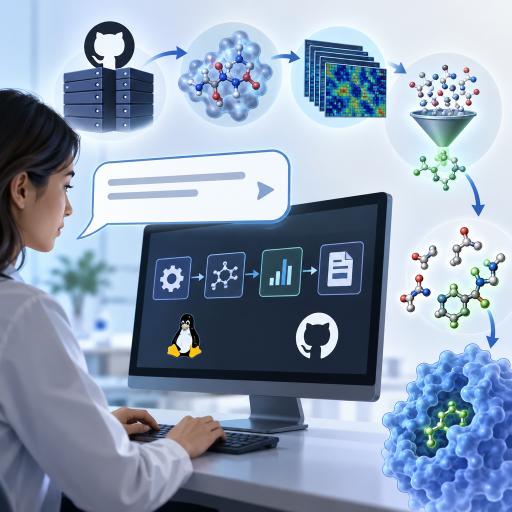

Natural-language prompting builds and operates an open-source software workflow for virtual drug-discovery
Drug discovery teams have long used tools like virtual docking and free-energy calculations to narrow down promising compounds before moving into expensive laboratory testing. The catch is that these methods usually demand specialist knowledge in structural chemistry, careful tuning of many parameters, and the integration of multiple pieces of software. That complexity has limited their use outside expert computational chemistry groups.
A newly reported study suggests that barrier may be starting to fall. Researchers show that a non-specialist scientist was able to build and run an auditable, script-based drug-discovery workflow through iterative natural-language conversations with the AI coding assistant OpenAI Codex. Rather than replacing the underlying scientific software, the AI acted as a guide and workflow builder, helping the user connect established open-source tools into a usable pipeline without direct coding.
The result is a practical demonstration of how prompt-based AI can help scientists operate sophisticated computational chemistry workflows using plain language. In this case, the assistant provided both coding support and domain-specific guidance in structural chemistry, enabling the assembly of a pipeline that handled multiple stages of a typical virtual screening campaign.
What the AI-built workflow does
The workflow covered the main steps needed for modern structure-based virtual drug discovery. It retrieved and prepared protein structures, defined binding sites, prepared ligand libraries, carried out virtual docking, analyzed molecular interactions, ran molecular dynamics simulations, and performed alchemical relative binding free-energy calculations.
Just as importantly, the AI also helped create a script generator for launching, monitoring, and interpreting workflow runs. That matters because one of the major concerns around AI-assisted research is reproducibility. In this system, each run remained scripted and auditable, making it easier to inspect what happened and repeat it later.
Benchmarking on CDK2 and beyond
To test the workflow, the researchers used public benchmarks built around cyclin-dependent kinase 2, or CDK2, a well-studied drug target. The workflow first carried out primary docking, then refined the hits using multiple random seeds. That process substantially improved the quality of the candidate set.
The fraction of active ligands in the starting library was just 1.73%. After docking and refinement, the ten-candidate handoff set reached an active-ligand fraction of 80%, representing a 46.4-fold enrichment over the input library. In straightforward terms, the workflow became much better at surfacing likely active compounds from a large pool.
The study also found that a short molecular dynamics stage worked well as a structural quality-control filter for top candidates. That suggests AI-assisted workflows may not just help automate setup, but also improve decision-making around which compounds are worth taking forward.
The approach was not limited to a single target. The researchers report that docking and hit-refinement steps also generalized to benchmark sets for human immunodeficiency virus reverse transcriptase and kinesin family member 11. That broadens the significance of the work, indicating the workflow is not merely overfit to CDK2.
Strong free-energy performance
One of the more impressive results came from the CDK2 free-energy benchmark. The workflow achieved a root-mean-square error of 0.66 kcal/mol and a Pearson correlation of 0.90. Those are strong figures for relative binding free-energy calculations, which are often regarded as among the more demanding methods in computational drug discovery.
This does not mean the AI itself performed the physics calculations. The scientific heavy lifting still came from established external software packages. What the AI contributed was orchestration: it helped a non-expert user set up the right sequence of operations, connect the tools, generate scripts, and interpret outputs in a coherent process.
Why this matters
For years, one of the great promises of AI in science has been lowering the entry barrier to powerful technical methods. This study provides a concrete example of that idea in action. A scientist without direct coding expertise was able to assemble and operate an open-source virtual drug-discovery pipeline through dialogue alone.
That could have meaningful implications for small labs, early-stage biotech teams, and interdisciplinary researchers who lack dedicated computational chemistry personnel. If natural-language prompting can reliably help users deploy complex but transparent pipelines, then more scientists may gain access to advanced in silico screening methods.
There are still limits. The reliability of any workflow depends on the quality of the external tools, the soundness of the scientific assumptions, and the care taken in reviewing AI-generated suggestions. Human oversight remains essential, especially in areas like parameter choice, structural interpretation, and benchmark design.
The bigger picture
The study does not argue that AI has replaced medicinal chemists, modelers, or simulation experts. Instead, it makes a narrower but important claim: prompt-guided AI can help orchestrate established computational drug-discovery methods in a way that is accessible to non-specialists while preserving auditability.
That may be the most realistic near-term role for AI in scientific software workflows. Rather than inventing entirely new science on its own, AI can act as an interface layer between researchers and complex open-source tools, translating plain-language intent into structured, reproducible computational processes.
If that model holds up across more targets and more labs, natural-language workflow building could become a powerful force multiplier in early-stage drug discovery.