Tencent Cloud Enterprise Unveils Full-Stack Intelligent Private Cloud for Sovereign Agentic AI
Tencent Cloud Enterprise (TCE) has introduced a new private-cloud strategy aimed at organizations that want to deploy agentic AI while keeping data, operations, and infrastructure firmly under their own control. Announced at the 2026 Tencent Global Digital Ecosystem Summit in Shenzhen, the move centers on two new offerings: the Full-Stack Intelligent AI Suite and Lite Deployment.
The launch reflects a growing concern among regulated sectors such as finance, healthcare, government, and telecom: once AI agents begin interacting with sensitive business data and mission-critical systems, model performance alone is no longer the main issue. Governance, deployment location, system control, and sovereignty become just as important.
“Once an agent starts touching core business data and calling critical systems, the question is no longer whether the model is strong enough. It is where the data is processed, who operates the system, and what foundation the agent runs on,” said Kaibo Sha, Vice President of Tencent Cloud.
Full-Stack Intelligent AI Suite targets production-grade sovereign AI
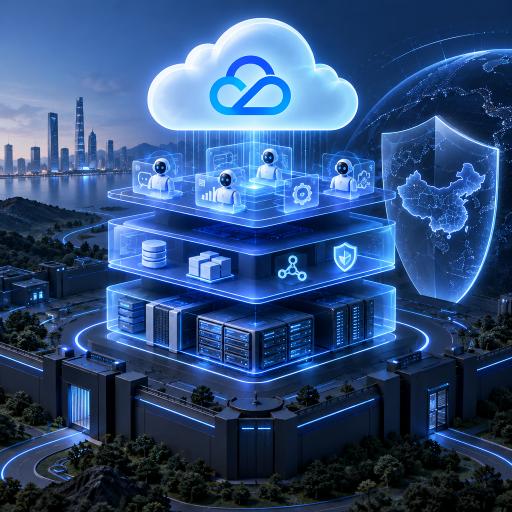
TCE’s headline release, the Full-Stack Intelligent AI Suite, is designed to help enterprises move from conventional private cloud infrastructure to what the company calls a “full-stack intelligent cloud.” The platform is structured across four layers: compute, storage, and networking infrastructure; a model service layer; an agent runtime layer; and an application layer for AI agents.
This modular design allows customers to adopt only the parts they need initially and expand over time. At the model layer, TCE is offering TokenHub, its private MaaS platform for large language model services. TokenHub turns raw compute resources into metered and manageable tokenized AI services exposed through a standardized inference API.
According to TCE, the system includes multi-tenant isolation, token-level billing by user or API key, and built-in inference acceleration. The company says it can deliver more than 250,000 tokens per minute on a single accelerator, achieve cache hit rates above 90%, and improve throughput by as much as 220% on alternative silicon platforms.
For enterprise buyers, the more important message may be around control and resilience. TCE says agent behavior is fully auditable, runtime environments can be provisioned in minutes, and unified scheduling across training and inference tasks can raise heterogeneous compute utilization by up to 60%. The suite is also designed so that data, model weights, and inference traffic remain inside the customer’s sovereignty boundary.
The platform supports mainstream x86 and ARM processors, works with multiple accelerator vendors, and has reportedly been validated at 10,000-GPU scale. TCE also says it offers financial-grade disaster recovery with a recovery time objective of two minutes or less and zero recovery point objective.
Lite Deployment starts small without forcing a future rebuild
TCE’s second major announcement, Lite Deployment, addresses a practical challenge in private cloud projects: how to start small without creating a dead-end architecture.
The company says Lite Deployment can deliver a full-stack cloud using as few as eight servers, including three master nodes, three block storage nodes, and two network function nodes, while preserving core IaaS capabilities. For organizations that want a lower-cost entry point focused on AI services, an AI-only configuration can start with just three servers.
The idea is to let enterprises begin with a pilot, then scale to production without changing platforms. TCE says the same architecture can expand from a single availability zone to active-active metro deployments and then to cross-region disaster recovery. Because the software can run on existing hardware, customers can avoid major infrastructure refresh cycles and minimum-spend commitments.
Tencent highlighted one example from the financial sector: a major futures brokerage used the approach to build a private cloud supporting core trading systems across heterogeneous chip architectures, while initially launching AI workloads on only three servers and later expanding capacity as demand grew.
Tencent teams with Gartner on sovereign AI guidance
Beyond product launches, TCE also announced joint research with Gartner titled A Practical Guide to Building Sovereign AI Cloud Platforms. The report is aimed at highly regulated industries building AI platforms under their own control.
The guide frames sovereignty across three pillars: data, operations, and technology. It also outlines adoption paths for sectors including financial services, healthcare, public services, and telecommunications.
TCE pointed to Gartner research in the report that suggests sovereign AI is becoming a pressing issue. By 2028, more than 25% of regulated enterprises are expected to bring their main generative AI workloads back on-premises due to stricter data sovereignty and privacy mandates. Through 2029, more than half of GenAI adopters could remain locked into a single public cloud ecosystem because of dependence on proprietary foundation models. Gartner also notes that only 17% of organizations believe they currently have enough talent to support AI adoption.
Omdia report highlights telecom opportunity
TCE also partnered with Omdia on a second report, Telco Cloud and AI Transformation: Global Market Opportunities and Case Studies. The report examines how telecom operators are trying to move beyond connectivity into cloud and AI services as mobile ARPU declines and over-the-top platforms capture most of the value riding on network traffic.
According to Omdia, telco-led investment in AI data centers could reach $160 billion between 2026 and 2031, representing around 9% of combined fixed and mobile capital expenditure. The report identifies three major trends: full-stack industry cloud platforms, national cloud infrastructure, and AI monetization models that go beyond GPU-as-a-Service toward MaaS and token-based offerings.
Omdia’s recommendation is clear: telecom operators should move quickly on sovereign AI and work with partners that offer hardware openness, software independence, and strong white-label capabilities.
Customer deployments span government, healthcare, finance, and telecom
Tencent used the summit session to showcase customer deployments across several markets. These included Shanghai Xuhui District’s multi-chip government cloud, Shenzhen Second People’s Hospital’s AI foundation for clinical and administrative workflows, and a large Hong Kong-based organization migrating from VMware Tanzu to a cloud-native hybrid cloud on TCE.
The company also highlighted a Thai digital infrastructure provider that replaced VMware-based systems with two TCE-powered data centers in just eight weeks and now operates a white-labeled, metered cloud business.
Why this matters
Tencent Cloud Enterprise is making a calculated pitch to organizations that want the benefits of advanced AI without relying fully on hyperscale public clouds. Its message is that sovereign AI will require more than model access: it will require private infrastructure, flexible deployment choices, open hardware compatibility, and governance built into the stack.
For enterprises in regulated industries, TCE’s new launches suggest a broader market shift. The future of agentic AI may not be defined only by smarter models, but by who controls the environment those models run in.