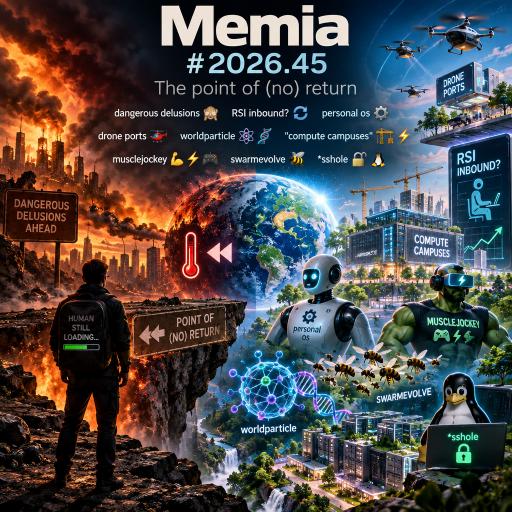
Memia #2026.45: The point of (no) return🌍🌡️⏪ dangerous delusions🙉 RSI inbound?🔁🤖📈 personal os⚙️ drone ports🚁 worldparticle⚛️🧬 “compute campuses”🏗️⚡ musclejockey💪⚡🎮swarmevolve🐝 *sshole🔓🐧
This week’s technology horizon stretches from an increasingly unstable climate to AI systems helping build their own successors. Between those poles sit private smart glasses, robot cleaners, quantum threats, drone infrastructure, biological storage and interfaces capable of moving human muscles before conscious action fully begins.
Several developments remain preliminary, experimental or based on projections rather than mature products. Treat the numbers accordingly.
🌍 The climate bill is arriving
The chance of remaining below 1.5°C without temporarily crossing that threshold appears to have disappeared. The least damaging pathway now discussed would peak near 1.7–1.8°C around mid-century before declining toward 1.5°C by 2100. Even that scenario demands extraordinarily rapid emissions reductions before 2030.
Recent carbon accounting reinforces the problem: global fossil-fuel emissions rebounded beyond pre-pandemic levels, with electricity and heat generation remaining the largest source. Financial institutions are also beginning to reassess loans exposed to severe El Niño conditions, as drought, flooding and commodity disruption become credit risks rather than distant environmental concerns.
🏦 Digital finance meets physical panic
Large cryptocurrency breaches are becoming stress tests for conventional banks. Regulators are asking institutions how they would respond to exchange shutdowns, prolonged token crashes and losses spreading through connected firms.
Meanwhile, stolen assets routed through decentralised protocols expose a basic limitation: some digital funds cannot be frozen in the way traditional bank transfers can. In countries facing banking instability, customers are increasingly turning to dollar-linked tokens, often paying a steep premium for immediate liquidity.
🔁 Is recursive AI acceleration beginning?
A closely observed AI laboratory reportedly achieved nearly twice its historical research pace, with much of the improvement attributed to internal use of AI rather than additional computing power. Employees described dramatic productivity gains and early signs of systems contributing autonomously to research.
That does not prove an intelligence explosion is underway. Benchmarks can be narrow, incentives can distort interpretation and laboratory work does not always transfer cleanly into the real world. Still, AI improving the process used to create better AI is now an operational concern rather than science fiction.
Other research points toward swarms of compact agents outperforming larger evolutionary systems, while “world particle” models attempt to simulate materials ranging from granular sand to proteins. The frontier is shifting from chat toward systems that search, coordinate, model and act.
⚙️ Your next computer may be personal in a new way
A newly demonstrated Linux-compatible operating-system kernel was produced largely by an AI coding agent in only 11 days. It can already boot a conventional Linux environment in a virtual machine, although most system calls, hardware support and production safeguards remain unfinished.
Smart glasses are following a similar decentralised path. One emerging design combines eye tracking, voice control, Linux, replaceable battery modules and a physical camera shutter without requiring a phone. Another experimental wearable pairs laboratory glasses with a backpack computer so visual AI processing remains local. These concepts offer a possible alternative to always-streaming cloud eyewear.
Privacy remains fragile, however. Short recordings can reveal location through subtle background sound, while AI-generated search summaries have demonstrated how confidently false accusations can be attached to real people. Provenance, correction mechanisms and local processing are becoming core product features rather than optional ethics.
🎮 Interfaces move beyond controllers
MuscleJockey offers a striking glimpse of post-controller interaction. The prototype electrically stimulates shoulder muscles to begin an action while leaving directional control to the user. Tests showed faster movement initiation with a low error rate.
For gaming and XR, this suggests interfaces that do not merely detect intent but physically assist execution. Competitive applications would raise obvious fairness and safety questions, but rehabilitation, accessibility and training could be more immediate uses.
Elsewhere, appetite-suppressing headwear is being presented as an electronic counterpart to weight-loss medication, although convincing clinical evidence has yet to emerge. Brain and body interfaces are moving faster than the standards needed to evaluate them.
🤖 Robots are learning through awkward labour
A humanoid hired to clean an apartment illustrated the current reality of domestic robotics: remote operators remain heavily involved, movement is clumsy and ordinary objects can become unexpected hazards. Yet every folded shirt or wiped surface can generate training data for future autonomy.
More unusual experiments include a moth-shaped robot carrying chemical fluid through its body. Ultraviolet light can create new conductive sensor patches on demand, effectively allowing the machine to grow a capability after construction.
Drone deployment faces a more familiar obstacle: neighbours. Delivery hubs may reduce road traffic, but repeated flights create noise, safety and surveillance concerns. Public acceptance could become a harder engineering problem than navigation.
⚛️ Quantum systems challenge today’s locks
A proposed error-resistant “cat qubit” architecture could sharply reduce the hardware required to break RSA-2048 encryption, at least in theory. Cryptocurrency developers are already discussing defensive mechanisms that would make attempts to move quantum-vulnerable coins financially dangerous.
Room-temperature supersolid behaviour has also been observed in a light–matter system. The state combines crystal-like structure with frictionless flow, although the experimental material degraded quickly. It is a scientific milestone, not yet a practical device.
🧬 Data becomes biological
An automated microfactory has converted conventional archives into synthetic DNA. Molecular storage promises immense density, negligible standby power and potential longevity measured in centuries or millennia.
Biomaterials may also reshape photonic computing. Silk, proteins, DNA and chlorophyll could enable self-assembling components that interact naturally with living tissue. This overlaps with renewed interest in quantum effects inside biological systems, including tunnelling, coherent vibrations and magnetoreception.
🏗️ The compute-campus backlash
AI infrastructure continues expanding into enormous power-hungry campuses, including facilities using higher-voltage direct-current systems to improve efficiency. Yet communities are increasingly resisting projects that consume water, reshape electricity markets and shift grid costs onto rural households.
Distributed alternatives are recruiting smartphones as a loose computing layer. Phones may prove more useful as sensors and network endpoints than as miniature data centres, but small deployments show that retired devices can handle meaningful workloads.
🔓 The human vulnerability remains
Cybersecurity is expanding from stolen credentials to hijacked AI accounts, exposed agent configuration files, compromised connected appliances and attacks on industrial equipment. Even sleep matters: losing a single hour was associated with a measurable increase in phishing susceptibility.
The week’s clearest message is that capability is compounding faster than trust. AI can write kernels, coordinate swarms and accelerate research, but it can also fabricate histories, weaken judgment and magnify insecure systems. The next frontier is not simply more intelligence—it is preserving human agency while intelligence becomes abundant.