
German employment agency chief: AI will destroy, generate many jobs
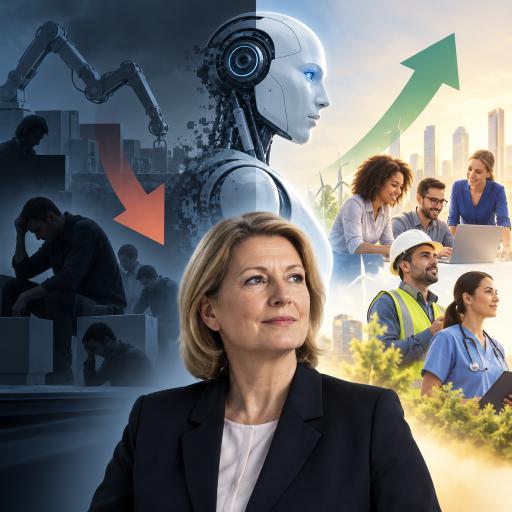
Artificial intelligence is set to reshape Germany’s labour market in a profound but not entirely negative way, according to Andrea Nahles, head of the Federal Employment Agency (BA). In comments published Tuesday, Nahles said AI is likely to eliminate a large number of roles over the next 15 years, while also creating roughly the same number of new ones.
Nahles told Handelsblatt that the BA expects about 800,000 jobs in Germany to disappear because of AI-driven change. At the same time, she said, a comparable number of new positions should emerge, suggesting a major restructuring of work rather than a simple collapse in employment.
The warning highlights a familiar pattern in past technological shifts: automation removes certain tasks, but productivity gains and new business models can open fresh demand for workers elsewhere. The real challenge for Germany may be less about the total number of jobs and more about how quickly workers can move from fading roles into new ones.
Nahles pointed to business service providers, as well as analytical roles in banks and insurance companies, as sectors likely to feel the pressure more sharply. These are areas where routine cognitive work can increasingly be supported or replaced by AI systems able to process documents, analyze data and assist with decision-making.
Even so, she did not frame AI as something Germany should resist. On the contrary, Nahles said she wants to see more investment in AI, but with a clear condition: the technology should be deployed to improve productivity rather than adopted simply because it is the latest trend.
That distinction matters. For employers under pressure from slow growth and high costs, AI can look like both a strategic necessity and a fashionable buzzword. Nahles’ comments suggest policymakers should focus less on hype and more on whether AI tools deliver measurable economic value.
She also pushed back against the idea that higher-qualified workers will necessarily bear the brunt of AI disruption. Referring to research from the United States on the difficulties faced by young university graduates, Nahles said Germany is seeing some similar signs, with graduates taking longer to enter the labour market and sometimes missing out on their ideal first jobs.
Still, she argued that degree holders remain in a stronger position than most other groups. While AI may complicate career starts for some young professionals, especially in office-heavy sectors, their long-term employment prospects are still comparatively solid.
Nahles emphasized that AI is not the only force shaping hiring trends. Germany’s broader economic weakness is also weighing on the labour market, she said, making it harder to separate the effects of technology from the effects of sluggish growth.
At the same time, some occupations appear relatively shielded from AI disruption. Skilled trades, for example, are proving more resilient because their work often depends on physical presence, manual expertise and problem-solving in real-world environments—areas where current AI tools remain limited.
She added that even unskilled and semi-skilled workers are not automatically at risk of being pushed aside. In some cases, Nahles said, replacing them with AI simply does not make economic sense, a reminder that automation decisions are driven not just by technical feasibility but by cost and practicality.
Taken together, her remarks present a nuanced picture of Germany’s AI transition. The country is unlikely to escape disruption, particularly in white-collar and analytical work. But the forecast is not one of mass technological unemployment. Instead, it points to a long period of labour-market churn in which some jobs vanish, others emerge, and adaptation becomes the central policy and business challenge.
For Germany, the message is clear: AI is coming for parts of the workforce, but it may also help build the next wave of employment—if companies invest with discipline and workers are supported through the shift.