
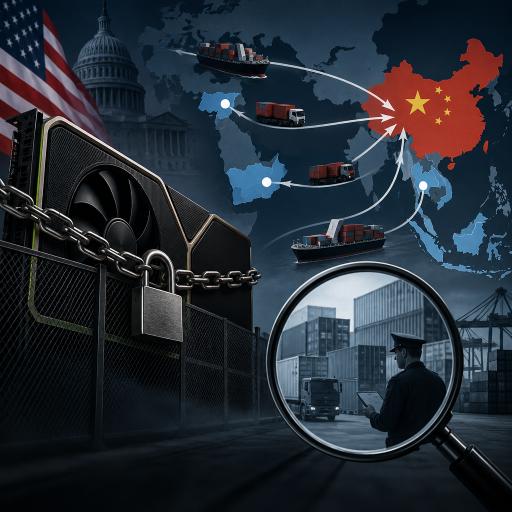
Restricted AI Chips, Third-Country Routes: How China’s Nvidia Supply Chain Is Being Probed
US and Southeast Asian authorities are intensifying scrutiny of suspected routes used to move restricted Nvidia AI chips and servers toward China, with Singapore- and Malaysia-linked entities emerging in multiple investigations. While India has export controls covering certain advanced semiconductors, no official evidence has surfaced showing a similar India-based smuggling pipeline.
At the center of the latest allegations is a report by The Information, which said a network spanning China and Singapore may have helped channel roughly 240,000 Nvidia H100, H200 and some A100 chips into China. The shipments were estimated to be worth at least $7.5 billion. The report named Singapore-based cloud company Megaspeed and its Malaysian subsidiary Speedmatrix. Reuters said it could not independently verify those claims.
The alleged activity points to two distinct methods. One is the direct physical movement of restricted hardware into China through intermediary jurisdictions. The other involves offering Chinese customers access to computing power hosted in Southeast Asian data centers, allowing them to use advanced AI capacity without necessarily taking delivery of the chips themselves.
That difference is crucial. A physical shipment can trigger export-control and re-export issues tied to the equipment’s destination and end user. Remote access to AI compute raises a different set of regulatory questions, including where the hardware is located, who controls it, and whether use by a restricted party violates existing rules.
How the third-country routes allegedly worked
A separate US Department of Justice case offers a more concrete example of how such transshipment networks may operate. In October, US prosecutors charged Greg Lui, the owner of Earthmade Computer, with allegedly conspiring to smuggle more than $300 million worth of export-controlled servers containing US-made GPUs to China.
According to the indictment, the servers were bought using false end-user documentation, routed through Malaysia and Singapore, and then re-exported to Chinese customers. In one example cited by prosecutors, 27 servers valued at about $7.6 million were shipped to Kuala Lumpur before being transferred onward to a China-based buyer. These remain allegations, and the case has not been adjudicated.
Malaysian authorities have also publicized seizures involving advanced AI hardware. Customs officials said they confiscated 30 servers containing high-end AI chips at Kuala Lumpur International Airport on October 15. The shipment was valued at RM49.5 million, or about $12.1 million, and had reportedly been declared as ordinary electronic components. Officials said it was meant for re-export to another Asian country.
Authorities linked that case to a suspected syndicate tied to five attempted operations, including an earlier June seizure of 72 servers. Malaysia has not publicly identified the latest shipment’s origin or final destination, but the pattern has reinforced concerns that the country may be used as a logistics waypoint for controlled computing hardware.
Singapore’s role under examination
Singapore’s position is more nuanced. Local police have charged four individuals and four companies in separate server-supplier fraud cases involving alleged false statements that Singapore-based firms would be the final end users of equipment purchased from suppliers such as Dell and Super Micro Computer.
The country’s Ministry of Home Affairs has said investigations involving Megaspeed are ongoing. At the same time, Singapore has stressed that it does not automatically enforce unilateral US export controls. What it does enforce are its own laws, including cases involving fraud, misrepresentation, and false declarations.
That distinction matters because many export-control disputes hinge not only on where a product was made, but also on what representations were given to suppliers, customs agencies, and regulators. A company may not be prosecuted in one jurisdiction for violating another country’s sanctions alone, but it can still face serious legal jeopardy if it used false paperwork or deceptive end-user claims.
Where India fits — and where it does not
India has entered the conversation largely because it maintains an export-control framework for certain advanced semiconductor items. Under the Directorate General of Foreign Trade’s SCOMET system, some advanced integrated circuits and computers containing them fall under Category 7 controls.
These rules do not apply to every commercial processor or GPU. Instead, they target chips and systems that cross specific technical thresholds. In that sense, India does have a legal structure relevant to advanced AI hardware exports.
But that is not the same as evidence of evasion. Based on currently available official material, there is no confirmed government finding that India has been used in a comparable smuggling chain moving restricted AI chips to China. Unlike the documented probes, indictments, and seizures tied to Singapore and Malaysia, India’s role remains hypothetical rather than established.
A widening enforcement challenge
The broader issue for regulators is that AI chips are both extremely valuable and strategically sensitive. High-end Nvidia accelerators such as the H100 and H200 are central to training advanced AI models, making them prime targets for diversion networks seeking to bypass export restrictions.
As the US tightens controls on advanced computing exports to China, enforcement is increasingly shifting beyond direct shipments to a tougher problem: tracking intermediaries, shell entities, cloud access models, and re-export routes across multiple jurisdictions.
For now, the clearest documented enforcement trail runs through Singapore and Malaysia. India, despite having relevant export-control provisions, has not been officially tied to an equivalent scheme. That distinction is important, especially as geopolitical tensions around AI hardware continue to rise and every regional trade hub comes under closer watch.