
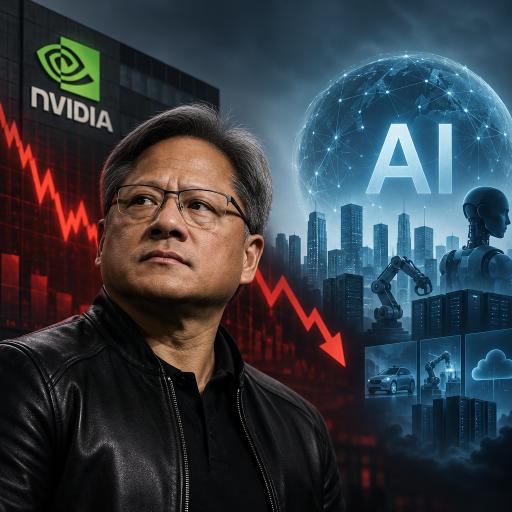
Is bad news for Jensen Huang also bad news for the AI industry?
Nvidia’s leadership crisis has arrived at an uncomfortable moment for the artificial intelligence sector. The company is not simply one of the most valuable chipmakers in the world; it is a central pillar of the computing infrastructure supporting today’s AI boom.
That is why reports surrounding Jensen Huang’s departure have prompted questions far beyond Nvidia’s boardroom. Investors, cloud providers, AI laboratories and data-center operators all have reasons to wonder whether the company will continue its aggressive strategy without its long-standing chief executive.
A sudden change at the top
Huang’s exit reportedly followed revelations about personal relationships involving individuals connected to Nvidia and one of its customers. One of those relationships was said to involve a person with possible links to Chinese intelligence, raising concerns that extended beyond corporate conduct and into national security.
Other reports suggested that a separate relationship involved an Nvidia employee. Although some of the allegations had apparently circulated within government and intelligence circles for months, the situation escalated rapidly once the information became public.
The board initially signaled confidence in Huang while reviewing the matter. That position appeared to change after further reporting raised questions about how Nvidia’s legal team had interacted with a U.S. Commerce Department inquiry. The speed of the subsequent leadership change surprised many observers.
Nvidia’s finance chief, Collette Kress, has been positioned as an interim leader. Such an arrangement would normally be viewed as a temporary measure rather than a permanent succession plan, particularly because Huang had become so closely identified with the company.
Why Huang matters so much to Nvidia
Huang is more than Nvidia’s chief executive. He is the company’s most recognizable public representative, its largest shareholder and the figure most associated with its transformation from a graphics hardware specialist into the dominant supplier of AI accelerators.
That personal connection creates a major succession challenge. Nvidia reportedly had no obvious long-term replacement ready to step into the role, leaving the board to manage an abrupt transition while trying to reassure markets and business partners.
The controversy also intersects with Huang’s position on technology exports to China. He has argued for a less restrictive approach to selling advanced chips in the country. Supporters see that stance as commercially logical: tighter rules can encourage Chinese companies to develop domestic alternatives. Critics argue that powerful Nvidia hardware could help Chinese AI firms improve systems with military and strategic applications.
That disagreement makes the leadership crisis more complicated. The issue is no longer only whether Huang’s conduct met corporate standards. It is also whether Nvidia’s chief executive could be trusted to balance commercial interests with broader national-security concerns.
The “Nvidia economy”
The potential consequences reach well beyond the company’s stock price. Nvidia supplies a huge share of the world’s AI-focused GPUs, hardware that powers large language models, image-generation systems, robotics platforms and increasingly sophisticated virtual-reality applications.
The company has also invested heavily across the wider AI ecosystem. Its financial commitments reportedly include stakes in cloud-computing companies, AI laboratories and major data-center projects. Nvidia is therefore involved in the sector not only as a supplier, but also as a funder and strategic partner.
This interconnected structure has sometimes been described as a circular AI economy. Nvidia provides the chips, helps finance companies that buy computing capacity and supports the infrastructure needed to train and operate their systems. If the leadership turmoil causes Nvidia to become more cautious, the effect could spread quickly.
A temporary freeze on investments might leave startups struggling to secure funding. Cloud providers could delay expansion plans. AI developers might face higher computing costs or longer waits for access to hardware. Companies working on real-time graphics, simulation and VR could also feel the pressure, since many of those projects depend on the same high-performance accelerators used by generative-AI services.
What happens next?
Nvidia’s immediate priority will be stability. The board must reassure customers, investors and governments that the company can continue supplying hardware and making strategic decisions without disruption.
Whether the company maintains Huang’s highly aggressive investment strategy will be closely watched. A retreat could slow parts of the AI market, but it might also give Nvidia an opportunity to create clearer boundaries between its commercial activities, political positions and national-security obligations.
The larger lesson is that the AI industry has become dangerously dependent on one company—and, to a surprising degree, on one individual. If Nvidia can navigate the transition successfully, the crisis may eventually strengthen its governance. If it cannot, the fallout could expose just how fragile the current AI boom really is.