
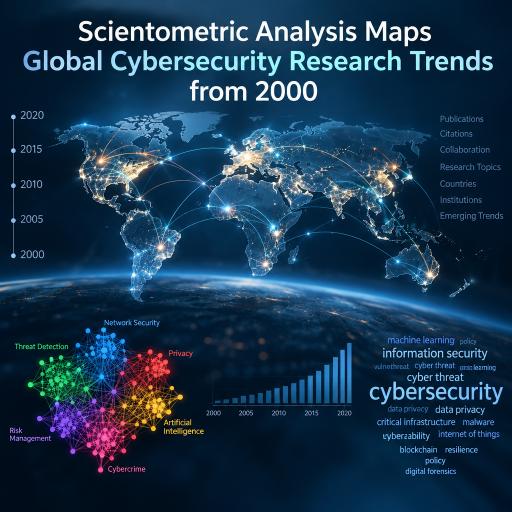

Scientometric Analysis Maps Global Cybersecurity Research Trends from 2000
Cybersecurity research has evolved from a relatively small academic field into a major global discipline. A large-scale scientometric analysis covering 2000 to 2024 found that annual journal output accelerated sharply after 2009, eventually reaching a record 1,852 articles in 2023. Citation activity peaked earlier, in 2021, when papers in the dataset attracted a combined 24,456 citations.
The findings illustrate how digital threats—including ransomware, phishing, malware and attacks on connected devices—have pushed security research into the scientific mainstream. They also reveal which countries, universities, journals and technical subjects have shaped the field over nearly a quarter-century.
A Focused Dataset of Almost 10,000 Articles
The analysis began with 32,409 database records. To reduce irrelevant results, researchers limited the search to cybersecurity terminology appearing in article titles rather than incidental references within abstracts or keyword lists.
Only final, English-language, peer-reviewed journal articles were retained. Conference proceedings, reviews, editorials, book chapters, notes and retracted publications were excluded. After screening, the final collection contained 9,967 articles published between 2000 and 2024.
Bibliometric software was used to examine publication growth, citation performance, recurring keywords, institutional productivity and international collaboration. The study also tested three established mathematical models used to describe how academic literature is distributed.
>
A Small Group of Journals Carries Much of the Field
Cybersecurity articles appeared across 2,074 journals, but their distribution was highly concentrated. Just 41 core publications accounted for 3,293 papers. Another 267 journals produced 3,385 articles, while the remaining 1,766 outlets collectively published 3,289.
This pattern closely matched Bradford’s Law, which predicts that a compact nucleus of journals will carry approximately the same volume of research as much larger groups of less specialized publications. The difference between the predicted and observed number of journals was only 0.02%, indicating an exceptionally strong fit.
The 15 most productive journals published 2,115 papers, or 21.19% of the complete dataset, and generated 43,239 citations. IEEE Access led by volume with 395 articles and 8,799 citations. Computers & Security recorded the strongest average among the major outlets, reaching roughly 31 citations per paper across 386 articles.
Research Output Is Concentrated Among Prolific Specialists
The dataset included 19,945 individual scholars. Most contributed only one article, while a comparatively small group produced a disproportionate share of the literature. Statistical testing showed that this authorship structure closely followed Lotka’s Law, a model describing the uneven distribution of scientific productivity.
The keyword landscape displayed a similar pattern. A limited set of widely used terms dominated the research corpus, followed by a long tail of narrowly focused concepts. The relationship between keyword frequency and rank produced a near-perfect power-law fit, supporting Zipf’s Law.
In practical terms, broad labels such as cybersecurity, artificial intelligence, machine learning and Internet of Things appear repeatedly, while specialized techniques, attack types and platforms occur much less often.
China and the United States Lead Global Activity
China recorded 6,086 author appearances and 26,675 citations, while the United States produced 5,447 appearances and 27,334 citations. India ranked third with 3,269 author appearances and 8,860 citations.
Relative citation performance produced a different hierarchy. The United Kingdom achieved the highest field-weighted citation impact at 1.79, narrowly ahead of the United States at 1.78. China reached 1.47, while India scored 0.89.
Chinese institutions occupied several of the leading positions. Sichuan University ranked first with 199 articles, followed by Beijing University of Posts and Telecommunications with 183 and the University of Electronic Science and Technology of China with 152. King Abdulaziz University followed with 136 publications.
International collaboration connected 88 countries across eight major research clusters. One network brought together numerous European nations, while another linked China, the United States, Australia and Singapore through 454 jointly associated documents. Even so, the overall map indicated continued regional fragmentation and room for broader cooperation.
AI, IoT and Automated Detection Shape the Research Agenda
Concept mapping divided the literature into several thematic groups. Artificial intelligence, Internet of Things security and general cybersecurity emerged as mature, influential areas with strong connections to the rest of the field.
Machine learning, deep learning, ransomware, Android security and malware detection were classified as fundamental topics that remain central but are still developing stronger internal research structures. Malware propagation formed a more isolated specialist niche.
Phishing, social engineering, anti-phishing systems and behavioral analytics occupied an emerging-or-declining category. Their position does not necessarily indicate decreasing importance; it can also signal a subject undergoing rapid transformation as terminology, attack methods and defensive practices change.
Important Gaps Remain
The results come with limitations. Restricting the dataset to indexed journals excluded conference papers, despite conferences being important rapid-publication channels in computer science. Citation metrics may also favor older papers that have had more time to accumulate recognition.
The analysis identified limited integration between technical security research and fields such as law, ethics, psychology and public policy. It also highlighted the need for deeper work on fast-moving threats, including Android malware and AI-enabled attack systems.
Overall, the evidence depicts cybersecurity as a rapidly expanding and increasingly interconnected discipline. Its next phase is likely to be defined by intelligent defensive tools, connected-device protection and stronger cooperation across countries and academic specialties.