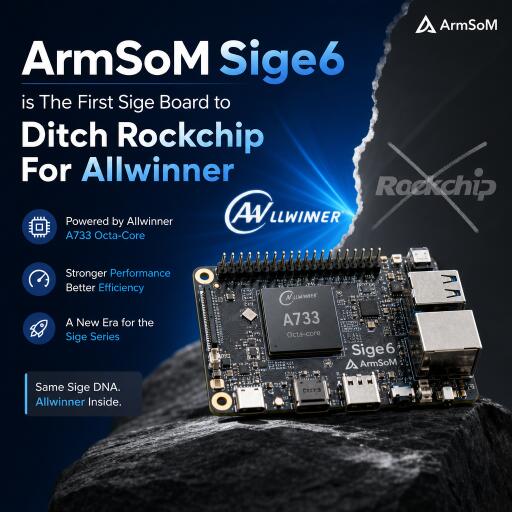

ArmSoM Sige6 is The First Sige Board to Ditch Rockchip For Allwinner
ArmSoM’s Sige line is taking a new path. For the first time, a Sige board pivots away from Rockchip silicon and lands on Allwinner’s latest SoC. The new Sige6 targets modern edge workloads—AI inference, lightweight cloud tasks, media delivery, and small-form-factor PCs—while keeping power draw and cost under control.
Why the switch to Allwinner?
The Sige6 rides on the Allwinner A733, a 12 nm octa-core platform designed to solve three common SBC headaches: a lack of built-in AI acceleration, reliance on older memory standards, and power budgets that aren’t friendly to always-on deployments. By integrating a 3 TOPS NPU, supporting LPDDR5, and focusing on efficiency, the A733 aims to tick all those boxes without neutering performance.
CPU, GPU, and AI at the edge
Under the hood, the A733 combines two Cortex-A76 cores clocked at up to 2.0 GHz with six Cortex-A55 efficiency cores at up to 1.8 GHz. Graphics come from an Imagination BXM-4-64 MC1 GPU, with support for modern APIs including OpenGL ES 3.2, Vulkan 1.3, and OpenCL 3.0—useful for both UI-heavy dashboards and compute-adjacent tasks. A 3 TOPS NPU brings on-device AI into play, unlocking real-time inference for vision, analytics, and automation without leaning on the cloud.
Memory, storage, and connectivity
The Sige6 scales from 2 GB up to 16 GB of LPDDR5, matching the needs of everything from basic gateways to more demanding AI or multimedia builds. Onboard eMMC options include 32 GB, 64 GB, or 128 GB, with room to grow via removable storage and NVMe.
- Video decode: H.265/VP9/AVS2 up to 4K at 60 fps; H.264 up to 4K at 30 fps
- Video encode: H.264/H.265 up to 4K at 30 fps
- Additional storage: SPI flash (64 Mb to 256 Mb), microSD slot, and M.2 Key M (PCIe 3.0, 2 lanes) for NVMe SSDs
- Networking: 1x Gigabit Ethernet (Power over Ethernet with an external HAT), Wi‑Fi 6, Bluetooth 5.4, external antenna connector
- Display: 1x HDMI 2.0 (4K60), 1x 4‑lane MIPI DSI
- Cameras: 1x 2‑lane + 1x 4‑lane MIPI CSI
- USB: 1x USB 3.1, 1x USB 2.0, 1x USB Type‑C (OTG/power)
- Audio: 3.5 mm audio jack, HP‑OUT
- Expansion: 40‑pin header with GPIO, UART, SPI, I2C, PWM
- OS options: Debian and Android 13 officially; community images such as Armbian are expected
- Form factor: 89 mm × 56 mm; weight 47.2 g
What it’s built to do
Between the integrated NPU and robust VPU, the Sige6 can juggle edge AI workloads and 4K media duties comfortably. That makes it a fit for computer vision nodes, smart kiosks, digital signage, and compact media servers. The M.2 slot adds fast NVMe storage for snappy databases, Plex-like libraries, or local AI models, while Gigabit Ethernet with optional PoE gives it a clean path into network appliances and always-on infrastructure.
Software and developer angle
Out of the box, the Sige6 supports Debian and Android 13, covering both traditional Linux deployments and embedded multimedia stacks. With LPDDR5 and an NPU onboard, developers can expect modern toolchains for AI frameworks, plus a smoother time with memory-intensive workloads. Community distributions are likely to follow quickly, broadening the choice for makers and integrators.
Longevity and deployment
ArmSoM has committed to keeping the Sige6 in production through January 2036. That long runway is a big deal for anyone planning fleet rollouts or industrial installs where continuity and spare-part availability matter as much as specs.
Availability
The board is slated to go on sale in August, with multiple configurations to match different budgets and use cases. Expect standard retail channels and direct purchase options to come online as launch nears.
Bottom line
By moving to Allwinner’s A733, the Sige6 brings AI acceleration, LPDDR5, and strong media capabilities to a compact, power-conscious SBC. It’s a notable shift for the Sige family and a welcome option for builders who need modern I/O, a capable GPU, and an NPU without stacking add-on modules or cranking power bills. If your next project lives at the edge—streaming 4K, recognizing objects, crunching telemetry, or serving as a network appliance—the Sige6 looks ready to carry the load.