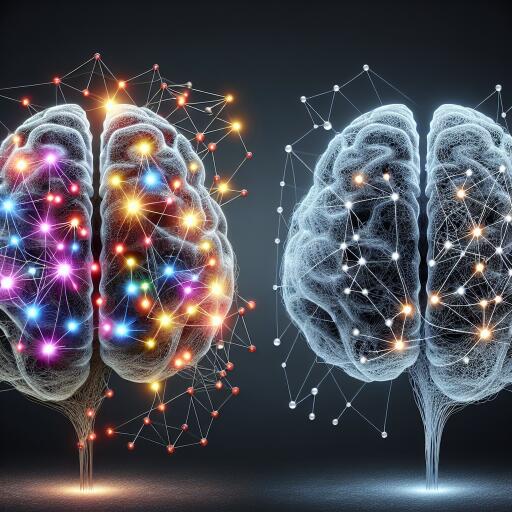

Telecommunication-inspired network models of healthy and diseased brains – Scientific Reports
Advances in nanoelectronics are transforming how we probe the brain, pushing researchers to model not just single neurons but the dynamic conversations across entire regions. As neurological diseases often derail those conversations—weakening or severing connections—the question is: can we borrow tools from telecommunications to understand, predict, and perhaps even repair the brain’s network behavior?
From neurons to networks: why telecom analogies make sense
Telecom engineers have long solved the problem of moving information across unreliable, ever-changing wireless links. The brain faces a similar challenge: signals must travel across large, distributed, and noisy networks of neurons. While neurons don’t ship “packets,” their spike trains and synchronization patterns must still be routed through a complex graph of connections with varying reliability.
The study at the center of this article treats neurons and local groups of neurons as discrete, finite-state systems—a well-established way of capturing behavior with a set of states (for example, quiescent, active, refractory) and probabilistic transitions. By scaling up from individual neurons to “neuronal agglomerates,” the authors create a mesoscopic model that is both computationally manageable and behaviorally expressive.
What the researchers built
First, the team models each neuronal agglomerate as a finite-state machine that captures how local populations switch activity patterns over time. Next, they map the interactions between agglomerates onto a clustered wireless network: each agglomerate becomes a cluster, and inter-agglomerate signaling becomes inter-cluster communication. This framing unlocks a rich toolbox from routing theory and wireless systems engineering.
With this mapping, they study how “links” between clusters behave under two key stresses:
- Temporal variation: changes in timing and synchronization that affect how reliably signals propagate.
- Degradation: reductions in effective bandwidth or increases in loss that mimic damage, inflammation, or degenerative disease.
In simulations, disease is represented by altering transition probabilities within agglomerates (internal dysfunction) and by weakening or disrupting inter-cluster links (connectivity loss). The researchers then analyze how information flow adapts—or fails—under these conditions using routing concepts that evaluate reachability, latency, resilience, and load distribution.
Healthy vs diseased communication patterns
In the healthy regime, the model exhibits hallmark features of robust networks: redundancy, alternative pathways, and dynamic reconfiguration that maintain functional communication in the face of local disturbances. Timing variations are absorbed by network-level adaptability, and information can still find viable routes.
Under disease-like degradation, the system shows predictable shifts:
- Reduced synchronization and increased effective latency across clusters.
- Emergence of bottlenecks as once-reliable routes degrade.
- Loss of global reachability when damage crosses a threshold, leading to functional partitioning—akin to a network splitting into isolated islands.
These changes mirror what telecom engineers observe when wireless networks face interference, fading, or node failures. Early-stage damage leads to graceful degradation; severe damage triggers abrupt breakdowns in long-range coordination.
Why this matters
By unifying finite-state modeling with clustered wireless network theory, the study offers a powerful, scalable way to examine how disease perturbs brain-wide communication—not just at the level of single synapses, but across the mesoscale architecture where cognition and behavior emerge. This approach could help researchers:
- Identify network biomarkers that signal early dysfunction before structural damage becomes obvious.
- Test how therapeutic strategies—pharmacological, electrical, or behavioral—might restore communication pathways.
- Design neuromorphic systems and neuroprosthetics that leverage routing principles for resilience and efficiency.
What it doesn’t do (yet)
Like all abstractions, finite-state models trade biophysical detail for tractability. They don’t capture the full complexity of ion channels, dendritic computations, or glial modulation. The assumption of clustered organization fits many brain architectures but is not universally precise. And while routing metrics are informative, they must be grounded in empirical data to ensure clinical relevance.
Still, the framework is a significant step: it bridges descriptive neuroscience and actionable engineering, yielding testable predictions about how brains maintain function—and how they falter—under stress.
Key takeaways
- The brain’s communication challenges resemble those of wireless networks, making telecom theory a natural fit for modeling.
- Finite-state models at the level of neuronal agglomerates capture essential dynamics without drowning in biophysical detail.
- Mapping agglomerates to clustered networks enables rigorous analysis of routing, resilience, and failure modes.
- Disease can be modeled as temporal variability and link degradation, revealing thresholds where communication collapses.
- This is among the most advanced applications of discrete finite-state processes and routing theory in brain modeling, with clear implications for diagnostics, interventions, and neuro-inspired computing.