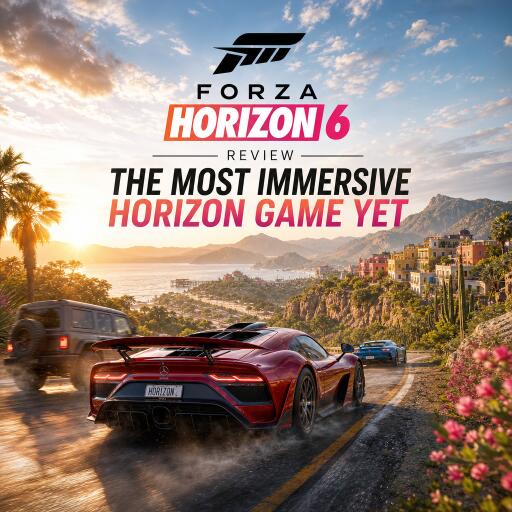

Forza Horizon 6 review: The most immersive Horizon game yet
Fans have been dreaming about a Horizon festival in Japan for years, and the wait has paid off. Forza Horizon 6 doesn’t just drop a new map and more cars—it invites you to linger. It’s a racer that’s as happy to let you coast and breathe as it is to rocket past the redline. From misty mountain passes at sunrise to neon-drenched city nights where rain-slick streets glow like chrome, this is an open-world drive you’ll want to savor.
Japan, rendered as a playground you’ll want to live in
There were countless times when the game felt less like a traditional racer and more like a big-budget car movie you can step into. Night runs through dense cityscapes become hypnotic: puddles mirror kanji signs, tail-lights smear across the tarmac, and headlights paint convincing cones of light across traffic and roadside barriers. The density of incidental detail—condensation on guardrails, drifting fog, the texture of cobblestones—pushes immersion in a way that begs you to slow down and look.
Ray tracing is the quiet hero here. Reflections behave believably across body panels and windows, and the way sunlight scatters across snowy ridgelines or fades into rural roads at dusk borders on photoreal. Water, too, is a stand-out: beaches, lakes, and rivers have a tranquility that can make you park up and just listen to the world go by.
Performance that flat-out flies
On a PC running an AMD Ryzen 7 9800X3D, 32GB RAM, and an NVIDIA GeForce RTX 5060 Ti, the results were stellar. With settings cranked and ray tracing enabled, DLSS plus frame generation delivered a silky ~130fps, turning high-speed sprints into liquid motion. Switching DLSS off still kept things playable at around 60–70fps on max settings—solid, if less luxurious.
At 1080p, it gets wild. DLSS paired with 4X frame generation pushed performance up to roughly 260fps without brutalizing image quality, making this a dream for players who prize ultra-high refresh over everything else.
Swapping in an RTX 5090 and hooking up a 55-inch OLED turned the dial to absurd. In 4K with extreme settings and ray tracing on, DLSS with auto frame generation held near 200fps during gameplay, with the benchmark hovering around 195fps. For kicks, bumping frame gen to 4X produced about 350fps in play and around 339fps in the benchmark.
Across hours of driving, there were no meaningful stutters, sluggish loads, or distracting drops. For a visual showcase this demanding, the optimization is remarkable—and credit to modern frame generation tech for keeping even the 5060 Ti experience buttery.
A racer that’s in no hurry to rush you
Yes, the racing itself is electric: urban dashes carve through tight traffic, mountain drifts bite hard on hairpins, and highway pulls are intoxicating at speed. But what sets this entry apart is how comfortable it is letting you meander. The world is a sandbox with a steering wheel.
Side activities are plentiful and surprisingly charming. Food delivery runs sound throwaway but are genuinely entertaining, and guided daytime excursions introduce postcard-perfect locations with a relaxed, almost tour-like vibe. Exploration is rewarded with hidden byways, photo-op spots, and scenic landmarks tucked into the map’s edges.
Photography lovers will get lost in the camera suite. Weather, time of day, and deep manual controls let you sculpt images that feel editorial. It’s easy to spend an entire session composing shots instead of chasing podiums—and that’s part of the magic.
A soundscape that makes your ears lean forward
Visual polish would mean less without the audio to match, and this game nails it. Engines don’t just differ in volume; they have character and texture that change how each car feels under your fingertips. Drop into a tunnel and the acoustics swell in a way that’s goosebump-inducing on headphones. Ambient layers—rain patter, tyres slicing through slush, the distant hum of the city—fuse with the visuals to lock you into the cockpit.
Progression hits right; characters don’t
Story has never been the Horizon series’ headline act, and that remains true here. The good news: the climb feels more grounded. You start as a rookie striving to qualify for the Festival, not a pre-packaged superstar. That modest beginning makes early wins feel earned and turns each step up the ladder into a small victory. You don’t get the dream garage on day one—you build towards it.
The flip side is that the narrative scaffolding and side cast fade into the background. After hours of sightseeing, side gigs, and spontaneous races, it’s easy to lose the thread of the main campaign. NPCs are functional—handing out events, riding shotgun for tours—but rarely memorable.
Character customization also feels conservative compared to the rest of the game’s lavish detail. You’ll find sensible options, but deeper tools for face, hair, and styling would better match the game’s otherwise expressive world.
Verdict
Forza Horizon 6 is a visual and sensory triumph. Its vision of Japan is breathtaking, the driving is sublime at any speed, and the sheer freedom to explore makes the map feel alive. On PC, performance shines across tiers of hardware—especially with DLSS and modern frame generation in play. The story and supporting characters won’t linger in your memory, but the roads will. If you’ve ever wanted to tour Japan behind the wheel, this is the most immersive way to do it without leaving home.