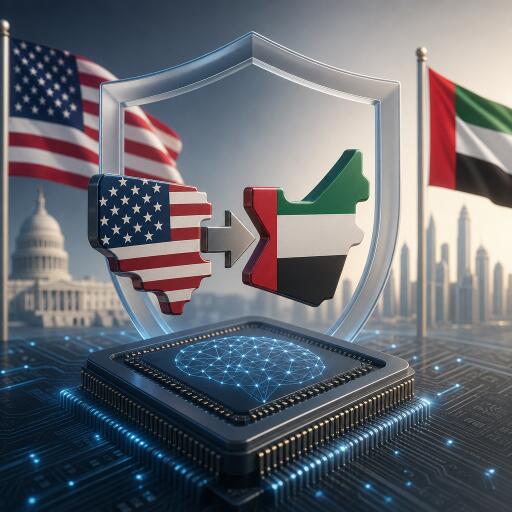

G42 considers US ownership to secure AI chip access
Abu Dhabi-based AI heavyweight G42 is weighing a dramatic corporate overhaul: reincorporating in the United States and shifting majority ownership to American investors. The goal is straightforward—make it easier to secure the advanced Nvidia and AMD chips needed to compete in the global AI race.
For G42, the issue is not just growth. It is access. As US export controls on advanced semiconductors tighten, companies outside Washington’s closest circle face greater friction when trying to buy high-end AI processors at scale. By becoming a US entity, G42 could reduce those barriers and place itself on firmer footing with regulators, suppliers, and strategic partners.
Why chips are forcing a rethink
Advanced AI systems depend on a steady supply of cutting-edge chips, and those components have become one of the most politically sensitive technologies in the world. G42, chaired by Sheikh Tahnoon bin Zayed Al Nahyan, has found itself navigating that reality as it tries to expand its AI and cloud ambitions.
The company has faced scrutiny in Washington because of earlier ties to Chinese technology groups, including Huawei. That history complicated its standing at a time when the US has become increasingly cautious about where powerful AI hardware ends up and who ultimately controls it.
That pressure was evident in Microsoft’s $1.5 billion investment in G42, completed in April 2024. The deal came with a clear expectation: G42 needed to unwind its Chinese investments and align more closely with US security and compliance concerns.
Chief executive Peng Xiao has spent the past two years working toward that alignment. Part of that effort included the introduction of a monitoring system known as the Common Operating Picture, which gives US partners greater visibility into where purchased chips are deployed after delivery.
A temporary opening from Washington
Recent policy shifts have improved G42’s position, but only to a point. In July 2026, the US Commerce Department moved the UAE into a more favorable export category, making it easier for the country to obtain high-performance AI chips and certain dual-use technologies.
The change followed close UAE-US cooperation during the Iran conflict and created a nine-month window for more streamlined access. Even before that reclassification, G42 had already won approval in November 2025 for as many as 35,000 Nvidia Blackwell-equivalent chips, with talks continuing over larger allocations.
Still, a temporary policy window is not the same as long-term certainty. For a company planning data center buildouts and major AI infrastructure investments, nine months is a narrow runway. That is why a US reincorporation is being considered not just as a symbolic move, but as a structural solution.
What US reincorporation would mean
If G42 were to reincorporate in the US and place majority ownership in American hands, the company’s regulatory identity would change significantly. It would operate under US legal and disclosure frameworks, potentially making it easier to qualify for technology partnerships, procurement opportunities, and large-scale semiconductor purchases that are harder for foreign entities to access.
Just as important, the move could reshape how the company is perceived in Washington and Silicon Valley. In the AI industry, trust is increasingly tied to jurisdiction, governance, and ownership. A US-domiciled G42 would present itself less as a Gulf company seeking access to American technology and more as a US-aligned operator with global reach.
That distinction matters when negotiating with chipmakers like Nvidia and AMD, whose exports are subject to intense scrutiny. It also matters for customers that want assurance their AI infrastructure provider will not be caught in the middle of future geopolitical restrictions.
The Microsoft effect
Microsoft’s investment already marked a turning point in G42’s international strategy. The partnership signaled that G42 was willing to reshape itself to remain connected to the US technology ecosystem. A full reincorporation would take that logic to its conclusion.
Such a move could also unlock additional capital. US institutional investors may be more comfortable backing a company governed by American corporate rules and majority-owned by US shareholders than one rooted in the Gulf but dependent on US-made strategic technology.
In that sense, the restructuring would be about far more than export compliance. It would be a bid to secure long-term relevance in an AI market where access to chips, capital, and political trust are becoming inseparable.
A sign of the new AI order
G42’s deliberations highlight a broader shift in the tech industry: corporate structure is now a competitive weapon. In the past, companies reorganized for tax efficiency or market expansion. In AI, they may increasingly do so to secure access to semiconductors and to satisfy national security expectations.
For G42, the calculation appears clear. If becoming more American is the price of guaranteed access to the hardware powering the next generation of AI, it may be a price worth paying.