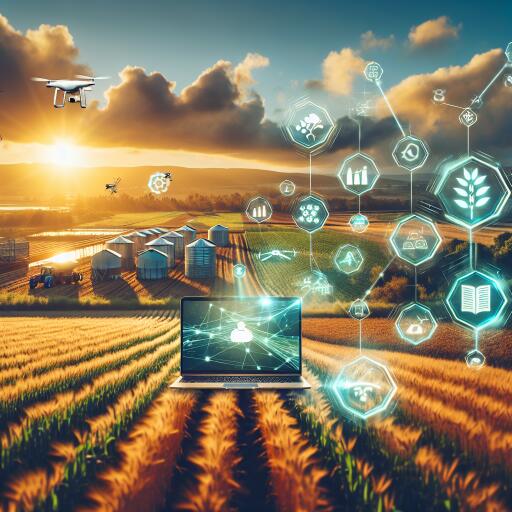

Farm Management Software Market Insights | Growth to USD 14.84 Billion by 2032
The global market for farm management software (FMS) is accelerating, rising from an estimated USD 4.11 billion in 2024 to a projected USD 14.84 billion by 2032, reflecting a robust 17.4% CAGR from 2025 to 2032. Momentum is coming from the rapid uptake of precision agriculture, the proliferation of IoT devices on farms, and the shift toward data-led decision-making to boost yields, curb input costs, and strengthen sustainability.
The role of software in modern farming
FMS has become the digital operating system for agriculture, unifying data from sensors, drones, weather models, satellite imagery, and machinery telematics. By tying together AI, cloud computing, and predictive analytics, these platforms help farmers fine-tune planting, irrigation, fertilization, and harvesting while improving traceability and resource efficiency across the entire operation.
Core technologies powering FMS
- Precision tools: GPS-guided equipment and IoT sensors enable real-time field mapping, crop vigor tracking, and variable-rate applications.
- AI and machine learning: Models forecast pest pressure, weather impacts, disease risk, and yield outcomes to inform timely interventions.
- Remote sensing and drones: High-resolution imagery supports soil analysis, irrigation optimization, and early stress detection.
- Cloud analytics: Centralized dashboards grant multi-user access, cross-farm comparisons, and integration with ERP and finance systems.
- Predictive maintenance: Equipment health monitoring lowers downtime and reduces repair costs during critical field windows.
What’s driving growth
- Smart ag at scale: As global food demand rises, producers are turning to digital tools to extract more from each hectare while using fewer inputs.
- Policy tailwinds: National and regional programs incentivize precision farming, climate-smart practices, and digital record-keeping.
- Shift to the cloud: Subscription-based, cloud-hosted platforms reduce upfront costs, streamline updates, and simplify multi-site management.
- Sustainability and carbon goals: Precision irrigation, input optimization, and carbon accounting features align with ESG targets and emerging carbon markets.
Regional snapshot
North America
With more than a third of global revenue in 2024, North America leads adoption thanks to high mechanization, widespread connectivity, and strong interest in AI-driven agronomy and fleet management. Innovators continue to push capabilities in equipment tracking, prescription mapping, and compliance reporting.
Europe
Europe follows closely, driven by stringent sustainability standards and farm-to-fork traceability requirements. Decision support systems that optimize chemical use and help meet environmental regulations are seeing rapid uptake across Germany, the Netherlands, France, and beyond.
Asia-Pacific
The fastest-growing region, Asia-Pacific is expanding at over 14% CAGR. China, Japan, and India are embracing FMS to counter labor shortages and climate variability. Mobile-first solutions for smallholders and national digital agriculture initiatives are accelerating deployment across the region.
Latin America and the Middle East & Africa are emerging opportunities, where expanding connectivity and mechanization are opening the door to cloud-based platforms and sensor-led field management.
Notable recent moves
- John Deere added AI-based pest detection and autonomous decision modules to its Operations Center.
- Trimble introduced a unified cloud environment combining equipment tracking with agronomic analytics.
- AgriWebb expanded partnerships across Japan and Southeast Asia to scale digital livestock management.
Headwinds to address
- Upfront investment: Hardware and software bundles can strain budgets for smaller farms.
- Data privacy and security: Questions around data ownership and cyber risk continue to shape buying decisions.
- Connectivity gaps: Limited rural broadband in many markets hampers real-time analytics and remote updates.
- Interoperability: Integrating mixed-brand equipment, legacy systems, and disparate data formats remains complex.
Market segmentation
- By application: Precision farming, livestock monitoring, aquaculture, smart greenhouse, and others.
- By farm size: Large, medium, and small operations with tailored feature sets and pricing models.
Outlook to 2032
As digital platforms become standard across large-scale operations, the next wave of FMS will fuse AI, robotics, and blockchain to enable predictive and prescriptive farm management, tighter traceability, and automated compliance.
- Blockchain-backed records for farm-to-fork transparency and food safety.
- AI-driven agronomic insights hyper-tuned to local soils and microclimates.
- Edge computing for faster, offline decisions where connectivity is limited.
- Seamless integration with carbon-credit programs to monetize sustainability gains.
Actionable recommendations
- Prioritize modular, cloud-native architectures with open APIs to ensure scalability and interoperability.
- Support smaller producers with flexible pricing, training, and lightweight mobile deployments.
- Invest in AI and IoT data pipelines that deliver real-time, field-level insights and automated workflows.
- Embed carbon tracking and ESG reporting to meet regulatory requirements and attract investment.
- Partner across the ecosystem—OEMs, input providers, and connectivity firms—to reduce integration friction.
Bottom line: farm management software is rapidly becoming agriculture’s digital backbone. With the market set to climb to USD 14.84 billion by 2032, the winners will be platforms that make data actionable, workflows seamless, and sustainability measurable—at scale and across every size of farm.