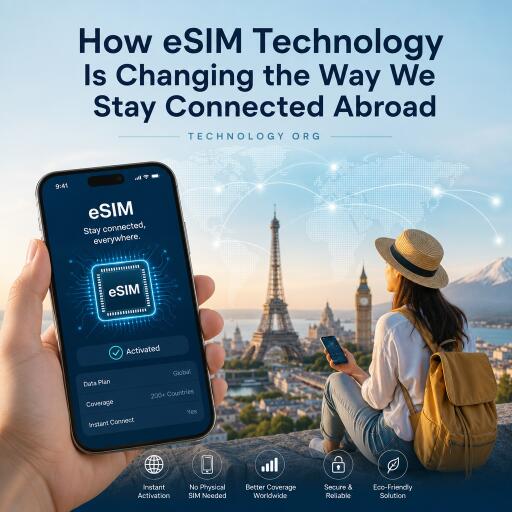
How eSIM Technology Is Changing the Way We Stay Connected Abroad – Technology Org
Crossing borders used to mean juggling pricey roaming, hunting down a local SIM, or clinging to patchy café Wi‑Fi. Embedded SIM technology—eSIM—flips that script by letting travelers set up mobile service digitally, often before departure, with no tiny plastic card in sight. The result is faster onboarding, greater flexibility, and a smoother travel routine built around software, not hardware.
What Makes eSIM Different
An eSIM performs the same fundamental job as a traditional SIM: it links a subscriber to a mobile network. The difference is that the “card” is integrated into the device and receives its credentials via secure remote provisioning. Activation typically happens through a QR code, a dedicated app, or your phone’s settings, and once installed, the profile connects to supported networks just like a physical SIM would.
- No physical swapping: Keep your existing SIM in place—no trays, no tools.
- Remote activation: Install a plan at home and land ready to go.
- Multiple profiles: Store and switch between profiles for different regions.
- Flexible plans: Choose data packages tailored to destination and usage.
- Less plastic: No card to buy, carry, or lose.
Why It Matters When You Travel
Roaming is convenient but can be unpredictable, with fees, throttling, or limited control. Local SIMs are cost‑effective yet require time on the ground to find a shop and set up service. eSIM streamlines both approaches: research options before you leave, install a travel profile onto your device, and simply toggle to it when you arrive. Adoption has grown quickly as travelers prioritize hassle‑free, app‑driven connectivity across hundreds of destinations.
Keep Your Main Number, Use Travel Data
Modern phones can run multiple lines at once. Many travelers leave their primary number active for calls, texts, and two‑factor authentication while routing mobile data through a separate eSIM plan. To avoid bill shock, double‑check which line handles data, whether data roaming is enabled on your primary line, and how your device prioritizes calls and messages across SIM and eSIM profiles.
Beyond Wi‑Fi: Connectivity That Moves With You
Public Wi‑Fi is useful, but it ends at the café door. Mobile data follows you to the curb, into a rideshare, across city streets, and down into transit hubs—crucial for maps, translation, digital tickets, and on‑the‑go messaging. When travel plans shift—delays, cancellations, last‑minute rebookings—being able to activate or switch an eSIM without finding a kiosk can make the difference between scrambling and staying on track.
Before You Activate: A Quick Checklist
- Device support: Confirm your phone or tablet is eSIM‑capable and unlocked.
- Network compatibility: Ensure the eSIM works with carriers in your destination.
- Coverage footprint: Verify included countries and regions if you’re visiting multiple stops.
- Data allowance: Match the plan to your habits—navigation, streaming, hotspotting, or light messaging.
- Validity window: Know when the plan starts and how long it lasts (activation vs. first use).
- Activation method: Check whether you’ll need Wi‑Fi or can activate over mobile data.
- Phone settings: Set default line for data, disable unwanted roaming, and review APN if required.
Part of a Bigger Connected Ecosystem
eSIM isn’t just for tourists. Wearables, connected cars, laptops, industrial sensors, and other IoT hardware increasingly rely on embedded connectivity and remote provisioning. Manufacturers can deploy the same device in different markets and switch networks by software rather than by swapping cards. For players and creators on the move, eSIM also pairs neatly with cloud gaming, mobile esports, and AR navigation; steady cellular data keeps latency in check and experiences seamless, whether you’re streaming a match or using translation overlays through smart glasses.
Security and Privacy Basics
- Source matters: Only install profiles from trusted providers; avoid unknown QR codes or links.
- Secure the device: Use a strong passcode, keep the OS updated, and enable account protections.
- Line management: Know which number handles calls, texts, and data at any given time.
- Review policies: Check how your provider treats location, usage data, and identity information.
From Plastic to Software
eSIM marks a shift from physical cards to software‑defined connectivity. Instead of buying a SIM after landing, travelers can set up a digital plan alongside boarding passes, hotel confirmations, and travel apps—then switch it on the moment wheels touch down. As devices and networks continue to embrace embedded profiles, staying connected abroad is becoming simpler, cleaner, and far more flexible—no countertop kiosk required.