
Karnataka looks to deepen AI ecosystem with industry partnership, focus on youth and rural education
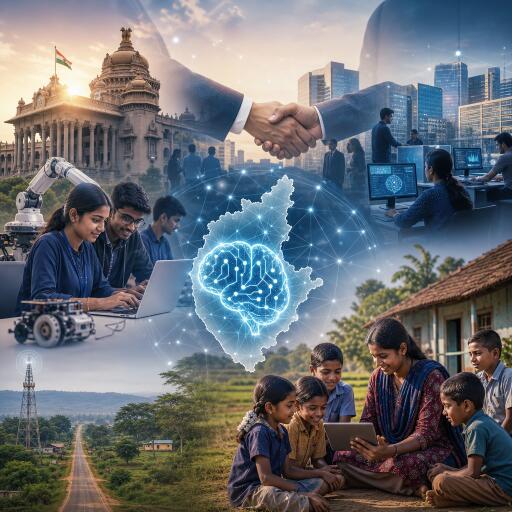
Karnataka is sharpening its artificial intelligence ambitions with a dual focus: building stronger partnerships with industry and taking AI education beyond major cities to reach young learners in rural areas.
Speaking on the sidelines of a CEOs’ meeting ahead of the Bengaluru Tech Summit, Karnataka Chief Minister DK Shivakumar said the state wants AI to become part of the educational journey of children across the state, not just those in urban centres. He said the government is particularly keen to ensure that rural schools are included in the next phase of technology-led development.
According to Shivakumar, the state has asked industry stakeholders to support investment in rural schools rather than concentrating only on towns and cities. He also indicated that Karnataka is considering a dedicated curriculum to help introduce AI learning in a more structured way.
The push reflects a broader strategy to widen access to emerging technologies while preparing students for future jobs. Karnataka’s leadership appears to be framing AI not only as an economic opportunity, but also as an educational and social one.
Shivakumar also used the occasion to encourage greater participation in the Bengaluru Tech Summit later this year, positioning the event as a platform to showcase Karnataka’s strengths to a global audience. He said the government is open to deeper collaboration with businesses as it works to reinforce the state’s standing as a technology leader.
That industry backing was visible at the meeting. Biocon Executive Chairperson Kiran Mazumdar-Shaw said Bengaluru remains India’s key technology hub and is well placed to lead the country’s growth in AI. In her view, the city has already emerged as the nation’s AI capital, supported by an ecosystem that is steadily being strengthened through government and industry efforts.
She described Karnataka’s approach to building the architecture for AI as encouraging, and stressed that the long-term value of AI lies in how effectively it is integrated into education and employment. For her, AI is not just a passing technology wave, but a foundation for future job creation and national competitiveness.
The remarks underscore a growing consensus between government and business leaders that Karnataka’s next tech chapter will depend on talent development as much as infrastructure and investment. Educating young people in AI, especially at an early stage, is increasingly being seen as critical to sustaining the state’s edge.
Earlier in the day, while addressing CEOs at a breakfast meeting, Shivakumar invited companies to take part in Karnataka’s next phase of growth. He pointed to the state’s strong software export performance, saying exports had crossed Rs 4.36 lakh crore and are expected to go beyond Rs 5.5 lakh crore this year.
He also outlined a larger roadmap for the state’s tech ambitions. Among the key proposals are the creation of an AI University with industry participation, the expansion of world-class technology infrastructure beyond Bengaluru, and fresh policy measures designed to further strengthen Karnataka’s innovation ecosystem.
Another important part of the vision is the introduction of AI education from Class 6 onward. If implemented effectively, that could help create an early pipeline of AI-literate students while reducing the urban-rural gap in access to high-value technology education.
Taken together, the announcements suggest Karnataka wants to move beyond its reputation as India’s established IT powerhouse and position itself as a more inclusive AI growth engine. The state’s message is clear: the future of AI should not be limited to boardrooms and big cities, but extend to classrooms, young people and underserved communities across Karnataka.