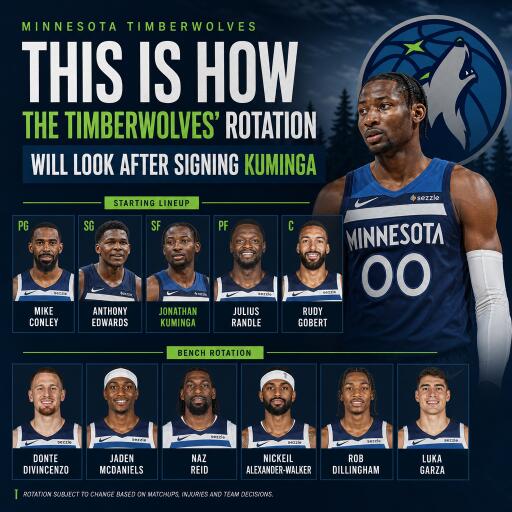

This is how the Minnesota Timberwolves’ rotation will look after signing Kuminga
Minnesota has swung for upside and edge by bringing in Jonathan Kuminga, a hyper-athletic forward built to amplify what Anthony Edwards and Rudy Gobert already do. He arrives as a two-way jolt: bigger role, bigger runway, and a chance to grow from spark plug into foundational piece on a contender.
Why the fit makes sense
Kuminga slides naturally into the forward spot alongside Edwards and Gobert without demanding heavy on-ball volume. He thrives attacking seams, sprinting in transition, and finishing through contact—exactly the kind of complementary pressure that benefits a roster with a star shot-creator and an elite rim-runner. When defenses load up on Edwards, Kuminga’s cuts, baseline relocations, and trail runs can punish late rotations. When Gobert dives, Kuminga can mirror the action as a secondary cutter or fill the dunker spot to crash the back line.
Defensively, his blend of strength and quick-twitch movement broadens Minnesota’s scheme. With Jaden McDaniels handling top perimeter assignments, Kuminga can toggle across wings and combo forwards, absorb more physical matchups, and help keep Edwards fresher for closing-time offense. The Wolves can switch more often, press higher on the floor, and still recover to protect the rim with Gobert anchoring.
Unlocking the Gobert connection
The Gobert partnership is a potential goldmine. Kuminga’s best offense shows up when the game is moving—hit-ahead passes, early seals, and decisive cuts. Next to a gravity big who lives at the rim, those reads get simpler and more frequent. Expect plenty of:
- 45 cuts when Edwards or the lead guard drive middle,
- dunker-spot finishes when Gobert screens and rolls,
- short-roll catches off inverted actions to attack rotating bigs,
- runway opportunities in transition after Gobert clears the glass.
The swing skill remains perimeter shooting. Minnesota doesn’t need Kuminga to be a high-volume sniper, but they do need reliable corners and confident catch-and-shoots to prevent defenses from pinching the paint. Even modest improvement—better footwork into the shot, consistent release, quick decisions—can keep the lane open for Edwards and maintain Gobert’s roll gravity.
The rotation map
On paper, the starting core practically writes itself: a steady lead guard orchestrating, Edwards as the headliner, McDaniels as the stopper, Kuminga at the aggressive 4, and Gobert at center. That alignment checks boxes for size, rim protection, point-of-attack resistance, and downhill pressure.
The second unit should lean into complementary roles rather than star turns. Think: a defensive-minded guard to hound the ball, a movement shooter to stretch the floor, a multi-tool wing who can finish or swing the extra pass, and a stretch big to pull a rim protector away from the basket. Staggering Edwards and Kuminga provides constant rim pressure across 48 minutes; one of them should be on the floor at nearly all times. Expect creative looks too:
- Small-ball bursts with Kuminga at the 5 to turbocharge transition and switching,
- Jumbo-wing groupings to smother opponents with length,
- Offense-defense subs late, pairing Kuminga with McDaniels and Gobert to close out stops.
How his game scales in Minnesota
Three development lanes will dictate how far this fit can go:
- Shooting reliability: Corner threes, catch-and-shoot rhythm, and free-throw growth to stabilize efficiency.
- Decision speed: Faster reads on cuts, kickouts from short rolls, and knowing when to slow down versus attack.
- Defensive discipline: Fewer reach-ins, cleaner verticality, and consistent screen navigation to maximize his tools.
Even without a major leap, Kuminga’s athleticism and motor raise Minnesota’s baseline. But if the jumper steadies and the processing tightens, he can shift from energy piece to closing-time problem—someone who finishes plays on one end and erases them on the other.
What it means for the Wolves’ ceiling
Minnesota didn’t just add depth; they targeted a profile that addresses structural needs: more downhill threats, more lineup flexibility, and more two-way size at forward. The beauty of the fit is that Kuminga doesn’t have to carry creation duties to be impactful. Surrounded by an elite scorer on the wing and a premier defensive anchor at the rim, his best traits get spotlighted without overextension.
If the staff sharpens his shooting base and tightens his decision tree, Kuminga has a path to becoming the third pillar—an elastic forward who thrives in playoff environments where physicality, speed, and versatility decide margins. That’s the bet: turn raw tools into reliable impact, and turn an already rugged rotation into one that can dictate terms against anyone.