
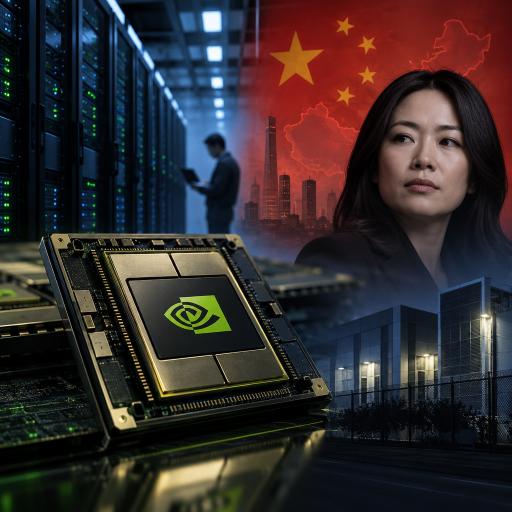

Nvidia’s Blackwell AI chips found at China data centre linked to Alice Huang: Report
Nvidia’s most advanced Blackwell AI hardware has reportedly been identified at a Shanghai data centre, intensifying concerns over how restricted US semiconductor technology continues to appear in China despite export bans.
According to a Bloomberg report, filings made to Chinese regulators indicate that two local companies installed Nvidia Blackwell-based server systems at the Yangtze River Delta Project, a major data centre linked to Alice Huang, a former Megaspeed executive. Huang has previously drawn attention in US investigations over alleged ties to Chinese intelligence, and separate reports have also linked her personally to Nvidia CEO Jensen Huang.
The development is likely to deepen scrutiny from Washington, where officials have been increasingly focused on possible back-channel shipments of high-end AI chips into China.
Blackwell systems disclosed in regulatory filings
One of the most striking details in the report involves Shanghai Shuoyao, which disclosed in November documents that it had pledged a GB300 NVL72 server rack as collateral for a 96 million yuan loan, roughly $14 million, from Shanghai Innovation Bank.
The GB300 NVL72 is one of Nvidia’s flagship AI systems. It combines 72 Blackwell Ultra chips with 36 Grace CPUs in a single rack-scale platform built for large-scale artificial intelligence workloads. The system can weigh more than 1,500 kilograms, underscoring that this is not a consumer or off-the-shelf item but a highly specialised piece of infrastructure.
A second company, Shanghai Kezhan, reportedly declared ownership of a GB200 server housed at the same facility. That machine was also used as collateral, this time in support of a 90 million yuan loan obtained in late 2025 from a finance and leasing company tied to a Shanghai government agency.
Both the GB300 and GB200 product lines are based on Nvidia’s Blackwell architecture, technology that cannot legally be exported to China without approval from the US government.
Serial number points to Gigabyte-built hardware
Bloomberg said it traced the GB300 system through a public warranty database using the rack’s serial number. The search indicated that the machine was manufactured by Taiwan-based Gigabyte Technology, one of Nvidia’s hardware partners.
What remains unclear is who first bought the server and what route it took before ending up in Shanghai. That unanswered question is central to the broader issue facing US regulators: whether advanced AI systems are being rerouted through third countries or intermediaries before they reach China.
Data centre tied to Alice Huang and Megaspeed
The Yangtze River Delta Project itself is also drawing attention because of its reported links to Alice Huang. Huang founded Megaspeed in 2023, and the company quickly emerged as one of Nvidia’s biggest customers in Southeast Asia.
Shanghai Shuoyao has acknowledged that it provides services to Megaspeed, though it characterised the relationship as standard commercial cooperation and not evidence of any deeper operational link.
Megaspeed had previously used a rendering of the same project in investor materials, presenting it as its largest data centre. The facility is reportedly designed to hold as many as 800,000 servers, making it a significant site in China’s AI infrastructure buildout.
At the same time, the report said there was no direct evidence that Megaspeed itself diverted Nvidia hardware to the site. The company has denied wrongdoing in response to US scrutiny.
More restricted Nvidia chips reportedly on site
The findings do not stop with Blackwell systems. Bloomberg also reported that Shanghai Kezhan disclosed the presence of 32 servers using Nvidia’s H200 chips at the same facility. Those processors are also subject to US export restrictions, adding to the seriousness of the discovery.
Taken together, the disclosures suggest that the Shanghai site may host multiple generations of Nvidia’s restricted AI hardware, from H200 systems to the much newer Blackwell-based GB200 and GB300 platforms.
Fresh pressure on US export controls
The report lands at a sensitive moment for Nvidia and for US policymakers trying to enforce semiconductor controls on China. Washington has repeatedly tightened restrictions on advanced AI chips, arguing that such processors could strengthen China’s military and surveillance capabilities.
The Trump administration recently added Megaspeed to a US trade blacklist, citing what it described as a significant risk that the company could be involved in diverting restricted chips. That move reflected growing frustration in Washington over the apparent persistence of grey-market supply chains.
Nvidia, for its part, has faced recurring questions about whether it can effectively prevent unauthorised resales of its most advanced hardware once products leave approved channels.
Why this matters
If confirmed, the presence of Blackwell systems in China would represent a major test of US export enforcement. These are among the most powerful AI servers Nvidia makes, designed for training and running cutting-edge models at industrial scale.
More broadly, the episode highlights a core challenge in the global AI race: export controls may limit direct sales, but tracking the movement of high-value computing systems across complex international supply chains remains far more difficult.
For now, the key issue is not only whether restricted Nvidia hardware reached China, but who moved it, who financed it and whether current safeguards are strong enough to stop it from happening again.