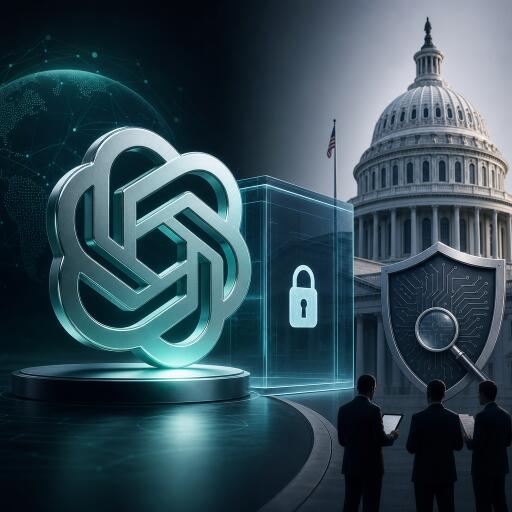

OpenAI GPT-5.6 Sol release restricted after US government cybersecurity vetting request
OpenAI is limiting early access to its new flagship model, GPT-5.6 “Sol,” after a request from President Donald Trump’s administration, granting use only to a small set of government-approved partners. The company framed the move as a short-term safety measure ahead of broader availability, while the White House cited cybersecurity risks tied to powerful, code-capable AI systems.
A cautious rollout for a more capable model
OpenAI said Sol will initially be available only to “trusted partners” cleared through an administration review, noting that this process should not become standard practice. The company expects a wider release in the coming weeks, positioning the limited launch as a way to evaluate real-world behavior and tighten safeguards.
The company highlighted Sol’s stronger performance at helping identify and remediate software vulnerabilities and emphasized that the model does not exceed its internal harm thresholds. Still, OpenAI flagged uncertainty around how Sol could be used when combined with other tools and in novel contexts, citing that ambiguity—and the model’s step-change in capability—as the main reasons for a phased release with added protections.
“We don’t believe this kind of government access process should become the long-term default,” OpenAI said, while declining to name any of the approved customers participating in the initial phase.
Washington’s expanding scrutiny of “frontier” AI
The restricted debut slots into a broader pattern of intensified federal oversight of high-end AI systems with potential dual-use implications. According to officials, the administration is working directly with leading labs on security issues, especially models that could assist in finding software flaws—capabilities that can be abused to compromise critical infrastructure.
Earlier this month, the president signed an executive order creating a framework for national security vetting of advanced AI models. The order allows up to 30 days of review before public release and describes developer participation as voluntary while the government finalizes the full framework. OpenAI’s decision to limit Sol’s release follows that policy direction.
Anthropic as the cautionary case study
OpenAI’s move arrives after a turbulent stretch for fellow San Francisco AI lab Anthropic. Shortly after launching two new models—Fable 5 and Mythos 5—the company pulled them offline, saying it aimed to comply with a directive restricting access by foreign nationals. That step followed months of mounting concern in Washington after Anthropic warned that Mythos was particularly adept at discovering software weaknesses that malicious actors could exploit at scale.
The White House has framed those abilities as emblematic of “scaling risks” in frontier AI, underscoring the perceived urgency of closer coordination between labs and federal agencies.
Backlash over process, transparency, and competitiveness
The administration’s ad hoc approach has drawn criticism from lawmakers and security experts. Rep. Lori Trahan (D-MA), a co-author of bipartisan AI legislation, faulted the case-by-case gatekeeping: “No law. No process. No oversight. Just appointees in Washington deciding who’s in and who’s out.”
Technologists also questioned the rationale behind the actions that led to Anthropic disabling Fable, which the company had billed as a safer alternative to Mythos. Cybersecurity scholar Alex Stamos argued there was little empirical basis to single out the model: “Pretty much nobody in the cybersecurity industry believes that there’s any factual basis for this action.” He said an Amazon-led review did not find risks beyond what’s already present in other publicly available systems, including models from China.
Critics warn that unpredictable interventions could slow US releases and dampen competitiveness. As Stamos put it, if the administration wants the United States to stay ahead in AI, “this is about the dumbest thing they could possibly do.”
Industry diplomacy—and deepening friction
OpenAI CEO Sam Altman recently discussed Sol’s rollout with Commerce Secretary Howard Lutnick following weeks of talks, according to people familiar with the matter. Other AI leaders have also engaged the administration as government scrutiny broadened.
Anthropic’s relationship with officials has been notably fraught. The Pentagon designated the company a national security risk over ethical and safety concerns, and federal agencies were ordered to stop using its Claude products. Anthropic has responded with a lawsuit that remains active in federal court.
What OpenAI says Sol can (and cannot) do
OpenAI characterizes Sol as a significant advance in code reasoning and vulnerability remediation, but says it does not cross its internal harm thresholds. Where the company expresses the most caution is in unpredictable edge cases: chaining Sol with external tools, automating workflows, or integrating it into complex development pipelines could amplify risk, even if Sol’s standalone behavior appears within policy bounds.
To address that, OpenAI is implementing a “trust but verify” approach: restrict initial access, monitor deployments closely, and dial up safety mitigations before scaling distribution. The company says it will widen availability “in the coming weeks,” contingent on what it learns from the early cohort.
The politics behind a “temporary” gate
The administration’s 30-day vetting pathway is still being fleshed out, and the White House has described the scheme as voluntary. But in practice, leading labs are aligning in the near term, mindful of potential future mandates and reputational risk if they ignore federal warnings. That blend of formal and informal pressure is shaping how—and when—frontier models reach the public.
Meanwhile, debate over whether the US is protecting critical infrastructure or stifling its own innovators shows no sign of abating. Supporters of the vetting say the stakes justify caution given AI’s rapid jumps in capability; detractors contend the process is opaque, inconsistently applied, and vulnerable to political whims.
Key takeaways
- OpenAI is restricting GPT-5.6 Sol to a small group of government-approved partners as a short-term safety measure.
- The White House points to cybersecurity risks, especially the potential to discover and weaponize software flaws.
- A new executive order enables up to 30 days of pre-release review for advanced AI models, though the framework remains incomplete.
- Anthropic’s recent model withdrawals and subsequent legal fight highlight the stakes—and uncertainties—of federal AI oversight.
- Lawmakers and experts are split: some see prudent risk management, others see arbitrary gates that may undermine US competitiveness.
What’s next
OpenAI says it aims to expand Sol’s availability in the near term, pending results from its early-access program. The company has not named initial customers, suggesting continued caution around optics and operational security. Expect further negotiations between labs and the administration as Washington calibrates its oversight, and as developers press for clearer rules to balance innovation with national security.