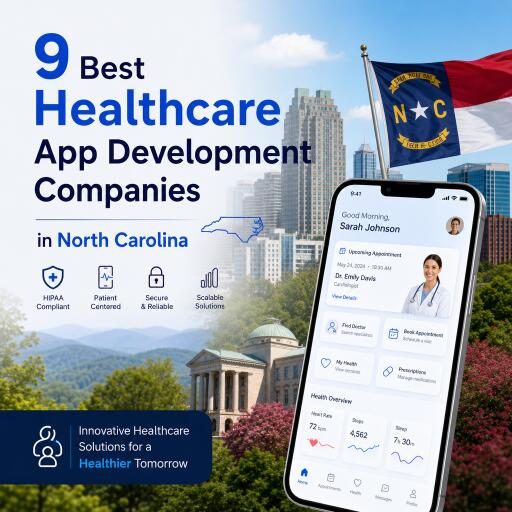

9 Best Healthcare App Development Companies in North Carolina
Healthcare is racing into a digital-first era, where intuitive apps power everything from telehealth and EHR access to remote monitoring and AI-assisted triage. North Carolina has quickly become a standout destination for building these tools, blending medical expertise with a strong technology talent pool. The state’s top development teams are fluent in HIPAA compliance, interoperability, and cloud-native architectures—critical ingredients for safe, scalable patient experiences.
Below is a curated list of standout healthcare app development companies across North Carolina. Whether you’re building a telemedicine platform, a patient engagement companion, or a data-driven clinical workflow tool, these teams are known for delivering secure and usable products that move care forward.
Top Healthcare App Developers in North Carolina
Apptunix
Apptunix crafts custom healthcare apps for startups, provider groups, and enterprises, emphasizing data security and speed to market. The team builds mobile and web solutions that integrate AI, analytics, and IoT to connect patients, clinicians, and devices seamlessly.
- HIPAA-ready platforms
- Telemedicine and RPM
- Cloud migration and modernization
Dualboot Partners
Charlotte-based Dualboot Partners teams up with clients to shape strategy, design, and development for healthcare products. Expect clean UX, pragmatic roadmaps, and integrations that streamline front-line and back-office workflows.
- Custom mobile and web apps
- Product strategy and UX
- Data dashboards and integrations
RoleModel Software
From Apex, RoleModel Software focuses on complex operational challenges inside clinics and health systems. Their approach translates domain knowledge into reliable tools that reduce manual steps and surface meaningful insights.
- Workflow automation
- Patient and staff tools
- Data and system interoperability
CrossComm
Durham’s CrossComm is known for building engaging digital experiences, often pushing into immersive tech. In healthcare, that means patient-facing apps, provider portals, and interactive tools that can include AR/VR to enhance training, education, and adherence.
- Mobile and web apps
- Patient engagement platforms
- AR/VR in clinical use cases
Method
Method blends design thinking with engineering to help healthcare organizations modernize legacy systems and craft patient-centered products. Expect rigorous discovery, accessibility-minded UX, and solutions aligned with privacy and security standards.
- Digital transformation
- UX research and design
- Enterprise-grade delivery
Levvel
Levvel brings consulting and engineering together to build secure, scalable healthcare platforms. The team is adept at cloud-native architectures, API ecosystems, and modernization efforts that improve reliability and reduce operating costs.
- Cloud and API engineering
- Mobile app development
- Software architecture and compliance
Anthroware
Anthroware partners with startups and established providers to turn ideas into shippable, user-validated products. Their agile process emphasizes communication, rapid iteration, and measurable outcomes for patient experience and operations.
- Custom healthcare apps
- Product strategy and discovery
- Web app development
Flynaut
Flynaut builds feature-rich healthcare apps designed to improve access and engagement. With a strong UI/UX focus, they deliver products that help patients navigate care and keep clinicians connected across devices.
- Telehealth and patient portals
- Mobile and web development
- Design and product planning
Lithios
Lithios specializes in mobile and web software for high-growth teams and enterprises. In healthcare, they emphasize secure builds, dependable cloud deployments, and close collaboration from discovery through launch and beyond.
- Cross-platform apps
- Cloud-native development
- Ongoing maintenance and scaling
How to Pick the Right Development Partner
The best partner does more than write code—they understand care delivery, data governance, and the realities of clinical workflows. Use these criteria to guide your selection:
- Healthcare track record: Look for proven outcomes in telemedicine, EHR connectivity, or clinical tools.
- Compliance proficiency: Ensure a solid grasp of HIPAA, data encryption, access controls, and audit trails.
- Technical depth: Prioritize teams fluent in AI/ML, cloud services, FHIR/EHR integration, IoT and wearables, and secure APIs.
- UX for all users: Patient, provider, and admin experiences should be accessible, intuitive, and performant.
- Interoperability mindset: Robust data exchange and reliable integrations prevent downstream bottlenecks.
- Lifecycle support: Post-launch monitoring, security updates, and iterative feature work are non-negotiable.
Final Take
North Carolina’s healthcare app scene blends engineering rigor with human-centered design. The companies above routinely ship secure, compliant, and scalable products—whether you’re building remote monitoring, a telehealth platform, or tools that bring AR/VR into training and patient education. Choose a partner that aligns with your compliance needs, technical goals, and long-term roadmap, and you’ll be positioned to deliver digital health experiences that truly matter.