
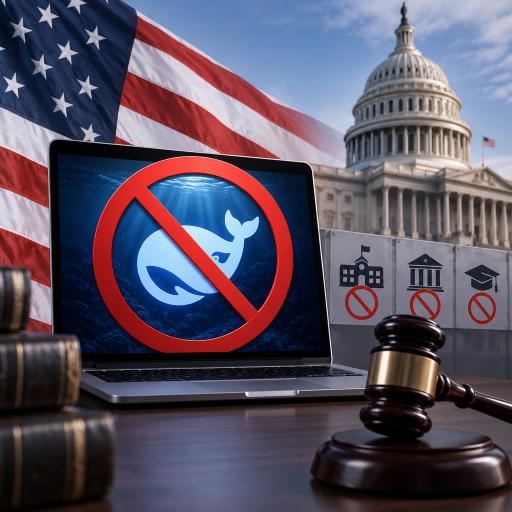

RaillyNews – USA Officially Bans Deepseeking Usage in Institutions
The US Department of Homeland Security (DHS) has prohibited the use of DeepSeek artificial intelligence products within federal environments, citing concerns about cybersecurity, data privacy and potential foreign access to sensitive government information.
The measure reflects growing scrutiny of foreign-developed AI services, particularly tools that may collect prompts, documents, device information and other user data. For government institutions handling classified or sensitive records, uncertainty over how that information is stored, processed or shared can represent a significant security risk.
Why DeepSeek Is Considered a Security Risk
DeepSeek offers advanced generative AI capabilities, but federal security officials are concerned about the potential exposure of government data to infrastructure outside US control. Information submitted to an AI platform can include far more than ordinary search queries: employees may inadvertently upload internal reports, source code, operational plans or personal records.
Authorities and cybersecurity analysts have highlighted several potential threats:
- Data exposure: Prompts and uploaded files could contain confidential, personal or classified information.
- Surveillance and profiling: Usage records may reveal employee behavior, government priorities or institutional workflows.
- Software vulnerabilities: Weaknesses in applications, integrations or programming interfaces could provide an entry point for attackers.
- Foreign jurisdiction: Data handled by an overseas provider may be subject to different legal and regulatory requirements.
- Supply-chain risk: Updates or third-party components could introduce vulnerabilities into federal networks.
The concern is not limited to deliberate espionage. Poor access controls, insecure storage, accidental disclosure and compromised vendor systems can also expose sensitive information.
How Federal Agencies May Implement the Ban
Removing an AI service from government systems involves more than uninstalling an application. Agencies must identify browser access, mobile apps, software integrations and third-party platforms that may rely on DeepSeek technology.
- Conduct an inventory: IT teams identify devices, accounts, applications and vendors using DeepSeek models or services.
- Block and remove access: Administrators disconnect integrations, uninstall software and restrict relevant domains or programming interfaces.
- Review previous usage: Security teams determine whether employees submitted protected information and whether an incident investigation is required.
- Update procurement rules: Agencies prevent new contracts or products from introducing prohibited AI components.
- Audit systems: Technical reviews search for residual software, stored credentials, data transfers and unapproved connections.
- Adopt approved alternatives: Departments move affected work to AI services that satisfy federal security and privacy requirements.
Operational Consequences
In the short term, the prohibition could delay projects that depend on generative AI for research, coding, translation or document analysis. Agencies may also face additional costs as they replace tools, retrain employees and examine whether government information was previously shared with the platform.
Over time, however, the policy could strengthen federal AI governance. It may encourage agencies to use systems with clearer data-retention rules, stronger access controls and independently tested security protections. The decision could also increase demand for domestically developed or government-hosted AI models.
A Wider Debate Over Foreign Technology
The DeepSeek restriction is part of a broader international debate about data sovereignty and the role of foreign technology in critical institutions. Governments increasingly want to know where AI data is stored, who can access it and whether providers can be compelled to disclose information under local laws.
The policy may add to tensions between Washington and Beijing, but it also illustrates a wider change in technology procurement. Performance and price are no longer the only considerations: agencies are evaluating ownership, infrastructure, training-data practices, software dependencies and the legal jurisdiction governing a service.
What Institutions Should Do Now
Organizations affected by the restriction should combine technical controls with clear employee guidance. Recommended measures include:
- Cataloging all approved and unapproved AI tools used across the organization.
- Blocking prohibited services on managed networks and devices.
- Rotating credentials or API keys associated with removed integrations.
- Reviewing logs for previous transfers of sensitive data.
- Strengthening vendor assessments and contractual security requirements.
- Training personnel not to enter confidential information into public AI systems.
- Creating an approval process for future generative AI deployments.
Security Before Adoption
The federal action against DeepSeek underscores a central challenge of the AI era: powerful tools can improve productivity while creating new channels for data leakage and cyber intrusion. For institutions responsible for national security and public records, adopting AI without verifying its architecture, ownership and data practices can introduce unacceptable risk.
The ban signals that federal AI adoption will increasingly depend on demonstrable security, transparent data handling and effective oversight—not simply technological capability.