
Deep neural network-based mechanical modeling of nonlinear vibration behavior in porous GPL-reinforced plates with cutouts – Acta Mechanica
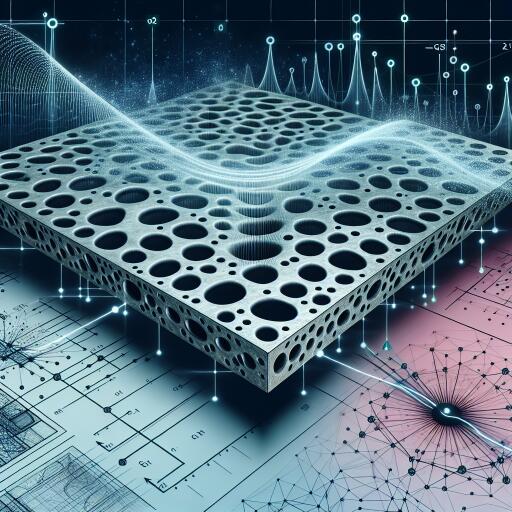
A team of researchers has built a fast, data-driven surrogate for a notoriously hard problem in computational mechanics: predicting the nonlinear vibration of porous nanocomposite plates reinforced with graphene platelets (GPLs) and featuring central cutouts. Where conventional solvers can be accurate but slow—especially during high-dimensional parametric sweeps or near real-time decision-making—this approach uses a compact artificial neural network (ANN) to emulate the physics with striking fidelity.
Why this matters
Engineers increasingly rely on lightweight, high-stiffness nanocomposites for aerospace, energy, and advanced manufacturing. But when plates include porosity for weight reduction and cutouts for functionality, their dynamics become highly nonlinear. Exploring how geometry, porosity, and reinforcement strategies interact can demand thousands of simulations, bottlenecking design. A well-trained surrogate model collapses this cost, enabling rapid “what-if” analyses without sacrificing accuracy.
The physics engine under the hood
Before it learns, the model must know what to learn. The authors derive the governing equations using Hamilton’s principle, embedding von Kármán geometric nonlinearity to capture large-amplitude effects and applying Mindlin’s first-order shear deformation theory to account for both bending and transverse shear. To handle a central cutout, the plate is partitioned into sub-domains. Within each sub-domain, orthogonal polynomials are crafted to satisfy geometric boundary conditions; continuity conditions then stitch the fields across interfaces.
For frequency extraction, the workflow couples the Rayleigh–Ritz method (to obtain linear frequencies) with a Newton–Raphson scheme (to resolve the amplitude-dependent, nonlinear response). This high-fidelity solver becomes the teacher: it generates the reference data that trains the neural surrogate.
The surrogate: small network, big payoff
The ANN is trained to map design and operating variables—plate dimensions, cutout size, GPL distribution patterns, reinforcement volume fraction (or weight fraction), and porosity—directly to vibration characteristics. The standout configuration is refreshingly lean: an architecture with 8 neurons in the first hidden layer and 2 neurons in the second hidden layer delivered the best accuracy–efficiency trade-off among the tested models.
The result is a fast-running predictor that captures complex, nonlinear interactions among parameters, making it practical to explore design spaces that would be prohibitively expensive with traditional solvers alone.
Ground truth checked: finite element validation
To ensure credibility, the surrogate’s outputs were benchmarked against ABAQUS finite element simulations. The reported discrepancy was under 3%, lending confidence that the emulator tracks the high-fidelity model and the commercial solver closely enough for design and optimization workflows.
What the study found
- Cutout size matters: Larger central cutouts reduce both linear and nonlinear natural frequencies. Interestingly, they also increase the nonlinear frequency ratio (the nonlinear frequency normalized by its linear counterpart) compared with smaller cutouts.
- Porosity is a double-edged sword: Increasing porosity lowers the linear frequency by about 28% but raises the nonlinear frequency ratio by roughly 21%. The takeaway: porosity decreases baseline stiffness yet enhances amplitude-dependent stiffening effects.
- GPL reinforcement sensitivity grows with amplitude: The nonlinear frequency becomes more responsive to the GPL weight fraction at higher vibration amplitudes; the study notes up to a 25% change at elevated amplitudes. This underscores the importance of tuning reinforcement levels based on the operating regime.
How the pieces fit together
In essence, the researchers pair a rigorous mechanics backbone with a learned emulator. The mechanics model captures the essential physics of porous GPL-reinforced plates with cutouts, including geometric nonlinearity and shear effects, and resolves boundary and continuity conditions across multiple regions. The ANN then internalizes the mapping from design variables to vibrational response, letting users sweep parameters in milliseconds rather than minutes or hours.
Design levers covered by the model
- Plate geometry and aspect ratios
- Size of the central cutout
- Porosity level and distribution
- GPL distribution patterns and weight/volume fractions
Because these variables co-influence both stiffness and inertia—and because nonlinearity couples modes and amplitudes—the surrogate’s ability to represent intricate interactions is a practical step forward for early-stage design, sensitivity studies, and uncertainty quantification.
Where this could go next
While the current work zeroes in on plates with a central cutout, the methodology is extensible: additional cutout shapes, boundary conditions, or load cases could be folded into the training corpus. With careful curation of training data, such surrogates can support optimization loops, rapid trade-space visualization, and potentially real-time monitoring or control when paired with sensors.
Bottom line
This Acta Mechanica study shows that a compact neural network—just 8 neurons in the first hidden layer and 2 in the second—can stand in for expensive solvers when modeling the nonlinear vibrations of porous GPL-reinforced plates with cutouts. It does so without losing touch with the underlying physics, as evidenced by sub-3% deviations from ABAQUS. For engineers tasked with navigating tight performance envelopes and vast design spaces, that’s a compelling combination of speed and trust.