
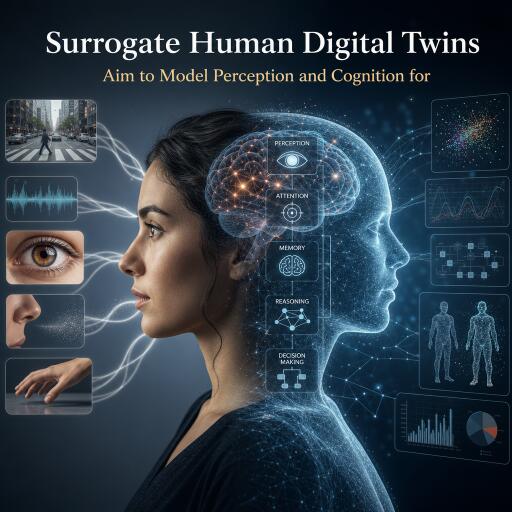
Surrogate Human Digital Twins Aim to Model Perception and Cognition for
A new class of human digital twins is moving past joints, muscles, and motion capture to model how we actually sense, think, and decide in the moment. Dubbed the Surrogate Human Digital Twin (S-HDT), this approach targets the brain–body loop behind real-time attention, perception, fatigue, emotion, and task engagement—opening the door to predictive, adaptive systems for XR, gaming, and high-stakes work environments.
From muscles to minds
Conventional human digital twins are excellent at biomechanics: they estimate movement, load, and injury risk. But modern settings—from VR headsets that can trigger sensory conflict to control rooms buzzing with alarms—stress our perceptual and attentional bandwidth in ways a purely physical model can’t capture. The S-HDT tackles this gap by explicitly modeling the cognitive layer that filters multisensory input, prioritizes what matters, and steers behavior under pressure.
How S-HDT “thinks”: a generative brain-in-the-loop
At its core, S-HDT uses active inference, a computational framework where perception, cognition, and action are treated as one continuous process. Instead of passively reading sensors, the model carries an internal “story” of the world, predicts what should be sensed next, and revises that story when reality disagrees. Multimodal inputs—physiology (e.g., heart-rate variability, muscle activity), behavior, and context—are fused to infer hidden cognitive states, represented not as fixed labels but as evolving probability distributions.
Free energy, uncertainty, and attention
Under the hood, the system minimizes variational free energy—an upper bound on surprise—to keep its internal beliefs aligned with observations. Two forces drive this: how well the model explains incoming data (prediction error) and how uncertain it is about its own beliefs (entropy). Attention naturally emerges as precision weighting: sensory channels deemed more reliable gain influence, while noisy ones are down-weighted. In dynamic scenes, sudden spikes in free energy can trigger reflexive attentional shifts, reallocating cognitive resources where they’re needed most.
Core and mantle: organizing cognition without hard walls
The framework distinguishes between “core” processes—fast, evolutionarily conserved functions like prediction, attention, motor control, and threat detection—and “mantle” processes—slower, learned capabilities such as goal management, language, social reasoning, and symbolic thought. This isn’t a strict anatomical split; it’s a modeling choice that helps coordinate different timescales and contexts within one unified generative model.
Why this matters for XR, games, and mission-critical work
- Predictive cognitive simulation: Forecast workload spikes, attentional lapses, or fatigue before they manifest behaviorally—vital for esports analytics, live-ops in VR training, or safety-critical operations.
- Adaptive, personalized interfaces: Dynamically tune HUD density, haptics, audio cues, or quest complexity to match a player’s or operator’s cognitive state and intent.
- Counterfactual “what-if” reasoning: Safely test how changes in difficulty, sensory conflict, or stressors might affect performance and physiology without exposing users to risk.
A first look: quiet room vs. cocktail party
An early simulation contrasts two scenarios: a low-distraction environment and a “cocktail party” teeming with competing stimuli. The setup focused on auditory attention and closed-loop perception–action dynamics. Binaural input was represented with high-dimensional spectral features, passed through a hierarchical predictive-processing model that computed multi-level prediction errors. The agent adapted head orientation and attentional focus in response to error dynamics, and abrupt free-energy surges induced automatic attentional reallocation.
Results were intuitive: the busy scene drove higher uncertainty, more frequent belief updates, and greater cognitive effort across measures. Importantly, this was a behavior illustration of selected components—not a full validation of human cognitive-state prediction.
The identifiability problem: reading minds from bodies is hard
Multiple internal states can produce similar physiological or behavioral signatures, making latent-state “decoding” inherently ambiguous. The boundary that separates internal states from the environment depends on model assumptions, timescale, and granularity. Autonomic signals are non-specific; the same interoceptive profile can support different affective interpretations depending on context and prior beliefs. Physiological variables also serve dual roles: they are evidence about internal states and are actively regulated to maintain stability (allostasis). S-HDT leans into this uncertainty, treating cognitive states as probabilistic surrogates rather than definitive labels—and keeping that uncertainty explicit.
Engineering realities and ethical guardrails
- Real-time multimodal fusion: Synchronizing biosignals, behavior, and context streams efficiently and robustly in the wild.
- Generalization: Adapting to new users and tasks with minimal calibration while resisting overfitting to lab conditions.
- Explainability and control: Communicating uncertainty, providing human-in-the-loop overrides, and requiring consent before consequential adaptations.
- Privacy and autonomy: Handling intimate physiological and behavioral data responsibly, with transparent policies and strong protections.
Bottom line
The Surrogate Human Digital Twin reframes neuroergonomics around a predictive, generative view of the human operator—one that unifies perception, cognition, and action. For VR and games, that could mean interfaces that sense when to ease off or ramp up, simulations that anticipate motion sickness or cognitive overload, and NPCs or copilots that reason about player attention. For industry and medicine, it points to safer, smarter human–machine teams. The next steps are clear: multimodal validation at scale and translating the framework into dependable tools for real-world environments.