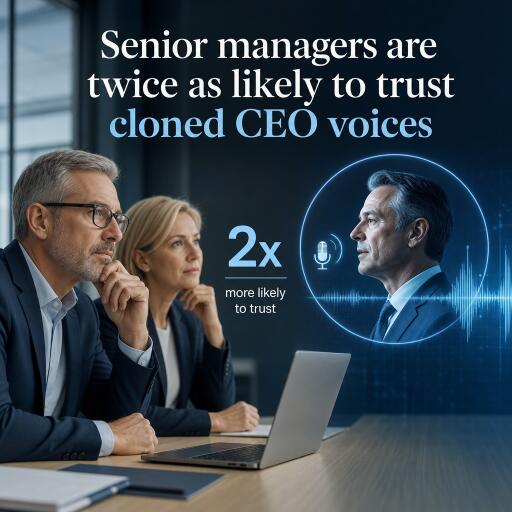

Senior managers are twice as likely to trust cloned CEO voices
A Singapore-focused online survey of 500 office workers conducted from 6 to 11 August reveals that senior managers are disproportionately likely to act on instructions voiced by an AI-reproduced CEO, even when there’s no independent verification. Specifically, 35% of senior managers indicated they would comply with such a request, versus 16% of clerical staff. This gap highlights how authority dynamics can be leveraged by convincing AI impersonations.
The self-assessment gap is notable: 78% of senior managers believed they could distinguish real CEO messages from AI-generated ones, while only 49% of clerical workers felt similarly. In other words, many employees underestimate the risk while overestimating their own discernment in the moment of a high-stakes instruction.
Experts suggest that in hierarchical workplaces, trust shortcuts can be exploited by sophisticated impersonations. A voice that mimics a top executive—or a message that sounds like a direct directive—can trigger a quick, reflexive compliance without time for careful verification. The risk isn’t the technology alone; it’s how people respond to perceived authority under pressure.
Perception vs. reality in recognizing AI messages
The survey also found that 36% of office workers felt uncertain about telling an authentic message from one that’s AI-generated. This confidence gap points to a broader need for awareness training that specifically addresses AI-driven scams involving senior leadership.
Across the workforce, only 26% reported receiving cybersecurity training that specifically covers scams tied to senior leaders and AI. In contrast, higher-level staff were somewhat more likely to have access to such training: 39% of senior managers versus 23% of middle managers, 22% of junior managers, and 12% of clerical workers.
Training gaps and exposure differences by organization type
Participation in targeted training also varied by organization size and reach. Employees at multinational firms were more likely to have received specific guidance (34%) than those at local or national companies (20%).
The behavioral impact of workplace hierarchy
The study underscores how hierarchy can shape responses to suspicious requests. Half of respondents admitted they would feel uneasy challenging a request from a senior executive. More than half (52%) worried about potential negative outcomes if they questioned leadership, while 45% worried that delaying a response could both hinder business and potentially trigger a cybersecurity incident you can’t see coming. A smaller contingent, about 9%, was primarily concerned with the delay itself.
What can organizations do to bridge the gap?
Experts advocate for ongoing training and realistic simulations that engage employees at every level. By normalizing verification steps and embedding a culture where questioning high‑level directives is safe and expected, organizations can shorten the time between a questionable request and a proper check. Regular drills, clear escalation paths, and role-specific scenarios can help close the gap between perceived ability and actual readiness to handle AI-driven impersonations.
Methodology quick note
The findings come from an online survey conducted with 500 office workers based in Singapore. The fieldwork occurred over a one-week window in early August, capturing responses across several sectors and organizational sizes.