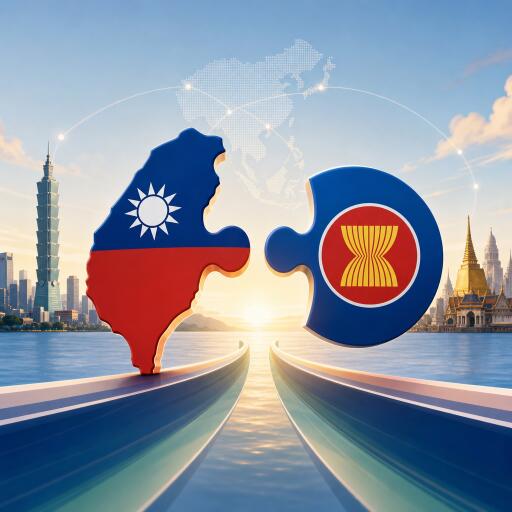

The future of Taiwan-ASEAN ties
Taiwan’s profile has surged across Southeast Asia as China sharpens its military and diplomatic posture in the Taiwan Strait. That shift is no longer abstract for ASEAN policymakers: when Philippine Secretary of National Defense Gilbert Teodoro Jr. said Manila could not remain neutral in a Taiwan conflict, it crystallized a wider regional realization that events across the Strait directly affect Southeast Asia’s security, economies, and digital resilience.
Two converging trends reshaping the region
Two dynamics now shape how ASEAN views Taiwan. First, Taiwan’s strategic importance to Southeast Asia’s peace, security, and economic stability is steadily rising. Second, while ASEAN continues to uphold the “one China” policy and a stance of strategic neutrality, member states increasingly acknowledge they can play a constructive role in preserving peace and stability across the Strait—without abandoning that foundational position.
From commerce to strategy: an ecosystem of interdependence
This shift did not happen overnight. It stems from Taiwan’s sustained engagement with Southeast Asia in high-impact sectors—semiconductors, artificial intelligence, digital infrastructure, and other advanced technologies—alongside education, public health, and people-to-people links. What began as pragmatic, unofficial outreach under the New Southbound Policy+ has matured into a strategic web of interdependence that now underpins supply chains and digital transformation across the region.
The numbers tell the story. More than 6,200 Taiwanese firms operate throughout Southeast Asia, generating over US$260 billion in annual revenue and employing around 960,000 workers as of the end of 2024. ASEAN manufacturers and digital industries depend heavily on Taiwanese high-end components, machinery, and integrated circuits. These inputs are not easily replaced—particularly in segments like advanced logic, memory, and specialized equipment that anchor the region’s electronics exports and smart manufacturing push.
The human dimension is equally important. Nearly 700,000 Southeast Asian migrant workers and residents live in Taiwan, knitting together social, cultural, and economic ties that extend well beyond trade statistics. These communities help transfer skills, shape remittance flows, and create durable links that make the region’s interdependence with Taiwan resilient to political headwinds.
The security layer: health tech, agriculture—and cybersecurity
Taiwan has also become a partner of choice for tackling non-traditional security challenges. In Vietnam, the Taiwan Smart Healthcare Alliance—a consortium of Taiwanese technology companies—has deployed telemedicine and advanced surgical imaging solutions that help alleviate healthcare staffing shortfalls. In Indonesia, Taiwan-backed programs to improve field management and agricultural productivity are directly tied to food security, a core stability issue for any government.
Crucially for a region digitizing at speed, Taiwan and Thailand have significantly deepened cybersecurity cooperation. This reflects a shared interest in hardening critical infrastructure, government networks, and supply chains against ransomware, state-backed intrusions, and cyber-enabled IP theft. As ASEAN countries build out 5G, cloud, and AI capabilities, Taiwan’s experience in defending a high-threat environment offers practical playbooks—ranging from incident response and threat intelligence sharing to secure-by-design procurement and workforce development.
Why a Taiwan crisis would hit ASEAN hard
The depth of ASEAN’s economic and technological ties to Taiwan means a Taiwan Strait conflict would reverberate quickly and painfully across the region. Immediate effects would include supply chain shocks for electronics and industrial inputs, rippling through manufacturing hubs from Vietnam and Thailand to Malaysia and Indonesia. Even short-term disruptions could spike prices, delay production cycles, and trigger inventory shortages in sectors that drive export earnings.
The maritime dimension is even starker. Roughly one-third of global shipping—and around US$3 trillion in annual trade—passes through the South China Sea. Any Taiwan contingency could force traffic onto longer, pricier routes, pushing up freight rates, insurance premiums, and delivery times. That would squeeze ASEAN economies reliant on just-in-time logistics for energy imports, food staples, and manufacturing components.
Geography compounds the risk. Taiwan sits next to the Luzon Strait, a critical chokepoint connecting the Pacific Ocean and the South China Sea. Control over Taiwan would substantially enhance Beijing’s capacity to monitor, restrict, or dominate naval and commercial movements through this corridor. For ASEAN states, that translates into heightened vulnerability to geopolitical pressure along vital sea lines of communication—an exposure that no amount of strategic ambiguity can fully offset.
Values and the regional order
Beyond hardware and shipping lanes, Taiwan represents a model of democratic governance and rule of law at a time when concerns are growing over efforts to reshape the regional order through coercion. For Southeast Asian societies navigating their own debates over digital rights, data governance, and AI accountability, Taiwan’s experience balancing innovation with transparency and civil liberties provides a useful counterpoint—and a partner for norm-setting in emerging tech.
A pragmatic ASEAN playbook
None of this requires ASEAN to abandon its “one China” policy or strategic neutrality. But it does argue for a more coherent, practical approach that reinforces peace and stability across the Strait while building resilience at home. Several steps are both consistent with ASEAN’s principles and actionable in the near term:
- Consistent signaling: Continue including references to peace and stability in the Taiwan Strait in ASEAN Chair’s Statements, Foreign Ministers’ Statements, the East Asia Summit, and the ASEAN Regional Forum. Repetition matters; steady diplomatic messaging helps reinforce the importance of maintaining the status quo and lowering escalation risks.
- Maritime and coast guard cooperation: While joint military activities with Taiwan are off the table, individual ASEAN members can expand cooperation in maritime domain awareness, coast guard training, search and rescue, humanitarian assistance and disaster relief, fisheries management, and protection of sea lines of communication. Pragmatic, issue-based coordination improves safety and reduces miscalculation at sea.
- Cyber and critical infrastructure resilience: Scale up information-sharing mechanisms, joint exercises, and capacity-building on incident response, OT/ICS protection, and ransomware defense with Taiwan’s public and private sectors. Enhance secure-by-design procurement for telecom, cloud, and AI systems to prevent single points of failure in regional supply chains.
- Track 1.5 and Track 2 dialogues: Empower universities, think tanks, policy institutes, and former officials to run regular strategic exchanges on Taiwan-related contingencies. These channels can stress-test crisis communications, deconfliction protocols, and humanitarian corridors without politicizing official ties.
- Minilateral capacity-building: Work with Taiwan, Japan, India, Australia, the US, and the EU on infrastructure, digital connectivity, maritime governance, and supply chain security. Keep cooperation issue-based, not alliance-driven, to preserve ASEAN centrality while delivering concrete outcomes.
- Supply chain transparency: Map dependencies on Taiwanese semiconductor inputs and equipment. Develop diversified sourcing, buffer inventories, and coordinated reboot plans to accelerate recovery after shocks—cyber or kinetic.
Opportunity under the Philippine chairmanship
With the Philippines chairing ASEAN this year, the bloc has a window to translate intent into initiatives. Manila’s frank recognition that a Taiwan conflict would not be a distant problem aligns with the lived realities of ASEAN supply chains and sea lanes. It also creates political space to:
- Institutionalize Strait-related language in ASEAN communiqués, locking in consistent signaling.
- Launch a regionwide maritime domain awareness working group that includes technical exchanges with Taiwan’s coast guard and maritime agencies.
- Stand up a cyber incident response fellowship that pairs ASEAN CERTs with Taiwanese counterparts for joint exercises and post-incident forensics.
- Commission a Track 2 tabletop series on Taiwan contingencies covering shipping rerouting, humanitarian assistance, disinformation response, and emergency procurement for critical components.
The bottom line
Taiwan’s role in Southeast Asia is no longer peripheral—it is embedded in the region’s factories, data centers, hospitals, farms, and shipping routes. That integration raises the stakes of any crisis in the Taiwan Strait, but it also equips ASEAN with practical levers to shape outcomes: steady diplomatic signaling, targeted cooperation in maritime safety and cybersecurity, and robust Track 1.5/2 dialogues that keep communication channels open even as geopolitics harden.
A coherent ASEAN approach—neutral, principled, and relentlessly pragmatic—can help deter miscalculation, protect critical supply chains, and sustain the digital and economic momentum that Southeast Asia has worked hard to build. With the Philippines at the helm, the bloc has both the impetus and the opportunity to deepen issue-based ties with Taiwan in ways that bolster peace, security, and prosperity across the region.