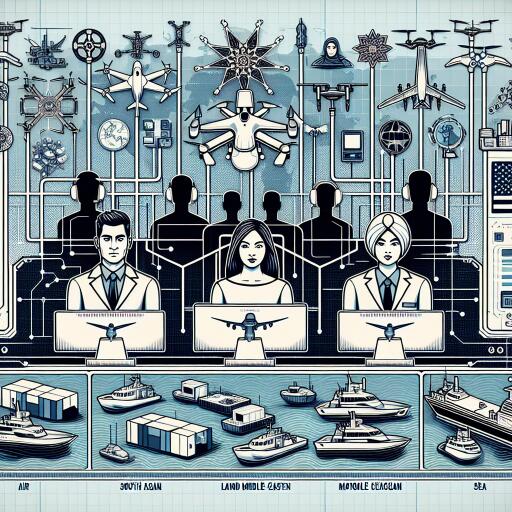

One Operator, Multiple Platforms: US Firms Create Unified Control for Air, Sea Systems
Leidos and Havoc are pushing the boundaries of autonomous operations with a new capability designed to let a single human operator coordinate and control multiple unmanned platforms in contested environments. The effort centers on weaving Havoc’s collaborative autonomy software into Leidos’ Autonomous Vessel Architecture, with initial integration focused on the Sea Archer unmanned surface vessel (USV).
The vision is an architecture in which air, surface, and underwater systems can collectively sense, decide, and act as a cohesive team—even when communications are degraded or denied. By distributing decision-making across vehicles and enabling resilient, on-board autonomy, the approach aims to keep missions moving when networks are jammed, bandwidth is scarce, or contact with a command center is intermittent.
Why it matters
Modern maritime and littoral operations increasingly depend on unmanned systems, but scaling those systems introduces a control problem: how do you manage many vehicles across multiple domains without overwhelming human operators or relying on pristine communications? Leidos and Havoc are tackling this by pairing a modular vessel architecture with collaborative autonomy that emphasizes:
- Cross-domain coordination: Air, surface, and subsurface assets can share tasks and adapt roles as conditions change.
- Edge intelligence: Critical decisions are made on board, reducing dependence on continuous connectivity.
- Human-on-the-loop control: One operator supervises a team, setting goals and constraints rather than micromanaging every move.
- Resilience in contested spaces: Behaviors are designed to degrade gracefully when links are lost, then resynchronize when connections return.
Inside the integration
Havoc’s collaborative autonomy components are being integrated with the Leidos Autonomous Vessel Architecture to establish common interfaces and behaviors for multi-vehicle operations. Starting with Sea Archer as a reference platform gives the effort a concrete testbed to validate autonomy, networking, and safety cases at sea. The same architectural approach can extend to other unmanned systems, enabling:
- Modular upgrades: New sensors, effectors, or autonomy behaviors can be added without overhauling the entire system.
- Interoperability: Standardized data and control pathways pave the way for joint operations across services and partners.
- Mission flexibility: From surveillance to logistics support, tasking can be reconfigured dynamically based on mission needs and conditions.
Operating in degraded or denied communications
In contested environments, communications are often the first casualty. The integrated architecture emphasizes:
- Local decision loops: Vehicles maintain mission momentum using preplanned behaviors and onboard perception.
- Adaptive tasking: Teams redistribute roles if a node drops offline or conditions shift unexpectedly.
- Synchronization on reconnect: When links are restored, assets reconcile state and plans to realign with operator intent.
Implications for the fleet
If successful, this approach could reduce operator workload, accelerate mission timelines, and improve survivability by dispersing capability across many autonomous nodes. It also supports a strategy of using affordable, attritable platforms that collaborate as a force multiplier, rather than relying solely on a few exquisite assets.
The initial focus on Sea Archer provides a practical on-ramp: demonstrate coordinated behaviors on a USV, then scale outward to airborne and underwater vehicles under the same control philosophy. As the architecture matures, it could help standardize how multi-domain autonomous teams are fielded, trained, and sustained.
The bottom line
By combining Leidos’ vessel architecture with Havoc’s collaborative autonomy, the partners aim to make one-operator, many-vehicle control a reality—without assuming perfect communications. Starting with Sea Archer, the integration seeks to prove that unmanned air, surface, and underwater systems can operate as a unified, resilient team, sensing, deciding, and acting together even when the network doesn’t cooperate.