
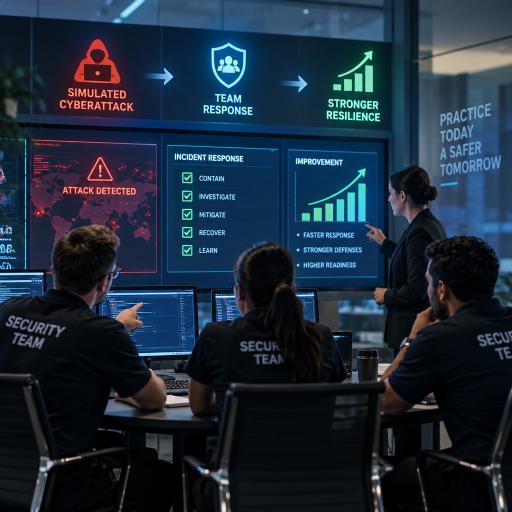
Regular simulated Cyberattack Drills improve Incident
Cybersecurity tools can detect suspicious activity, but technology alone does not guarantee an effective response. When an attack unfolds, employees and executives must make rapid decisions, communicate clearly, and follow established procedures. Regular cyberattack simulations help organizations test those abilities before a genuine crisis occurs.
Much like a cooperative game scenario or a virtual reality training exercise, a security drill places participants in a controlled environment where actions have consequences without putting real systems at unnecessary risk. Teams can rehearse their response to ransomware, stolen credentials, compromised cloud services, data leaks, or attacks against connected industrial equipment.
Turning Incident Plans Into Practical Skills
An incident response document may appear comprehensive until it is tested under pressure. Simulations expose unclear instructions, outdated contact chains, missing permissions, and uncertainty over who has authority to make critical decisions. They also reveal whether technical teams can coordinate with legal, operations, communications, privacy, and senior management.
Exercises can range from tabletop discussions to realistic technical scenarios conducted in isolated environments. The most productive programs use varied situations and involve people from across the organization. Repetition builds familiarity, while changing the scenario prevents participants from simply memorizing a fixed sequence.
Building a Security-First Workforce
Security awareness should extend beyond annual training modules. Role-specific instruction, phishing simulations, and incident drills give employees direct experience in recognizing and reporting suspicious behavior. Developers can practice responding to vulnerabilities in software pipelines, while infrastructure teams can test containment and recovery procedures across cloud and on-premises systems.
These exercises support a zero-trust approach, in which every request is verified and access is limited according to need. Identity and access management, endpoint protection, continuous monitoring, and automated response platforms provide the technical foundation. Drills determine whether those systems produce useful alerts and whether staff can interpret them quickly enough to reduce damage.
Preparing for Complex Digital Environments
Modern enterprises often operate across hybrid and multi-cloud platforms, connected devices, automated factories, and data-driven business applications. This flexibility also creates more potential entry points for attackers. A successful simulation should therefore examine dependencies between services rather than treating each system as an isolated asset.
For example, a compromised identity could affect cloud workloads, business software, production systems, and customer data at the same time. Testing such a scenario can show whether monitoring tools provide a unified view and whether teams can contain the threat without causing avoidable operational disruption.
Leadership Must Rehearse Too
Cyber incidents are business events, not solely IT problems. Technology, security, privacy, finance, and operations leaders must agree on priorities before an emergency. Their responsibilities should be clearly separated while still supporting fast collaboration.
During a drill, leaders may need to decide whether to shut down services, notify affected parties, preserve forensic evidence, or activate recovery systems. Practicing these choices helps prevent delays and conflicting instructions. It also gives executives a clearer understanding of how cybersecurity investments affect resilience, compliance, and continuity.
Measuring Improvement After Every Exercise
A drill delivers value only when its findings lead to action. Organizations should record detection speed, escalation time, containment performance, communication gaps, and recovery outcomes. Lessons should be translated into revised procedures, technical improvements, and targeted training.
Regular simulations create a cycle of testing, evaluation, and refinement. They cannot eliminate cyber risk, but they can replace uncertainty with practiced coordination. When a real attack occurs, teams that have rehearsed together are better equipped to identify the threat, limit its impact, and restore essential operations.