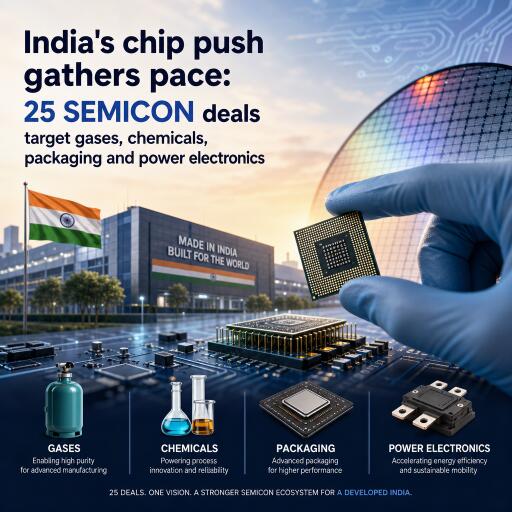
India’s chip push gathers pace: 25 SEMICON deals target gases, chemicals, packaging and power electronics
SEMICON India 2026 shifted into high gear in New Delhi with a wave of 25 fresh tie-ups spanning the semiconductor value chain, from ultra-pure gases and wet chemicals to advanced packaging, logistics and power electronics. With nearly 12,000 attendees on day one and more than 600 exhibitors (about half from overseas), the show floor made clear that India’s chip ambitions are accelerating—and getting global buy-in.
From materials to modules: India doubles down on supply chain depth
Day two announcements zeroed in on reducing import dependence and building out domestic capabilities. High-purity inputs—traditionally a bottleneck—were a prime focus. Tata Electronics unveiled a cluster of deals: partnering with INOX Air Products for semiconductor-grade gases; with Sumitomo Chemical for local manufacture of high-purity wet chemicals and front-end materials; and with Kelington Engineering to establish gas distribution systems, high-purity piping and tool hook-ups, complete with training programs for local vendors.
On the backend, Tata is teaming with Japan’s Enomoto for advanced packaging, including R&D and localization of lead-frame manufacturing. A separate strategic pact with L&T Semiconductor Technologies will explore production of L&T devices at Tata’s fab and OSAT sites, starting with consumer-grade camera modules.
Power electronics surge: solar, data centers and smart meters
L&T Semiconductor Technologies lined up a slate of power-focused partnerships. With Virtual Forest, it will target high-efficiency solutions for air-conditioning and solar systems. A collaboration with Newen Systems centers on Silicon Carbide (SiC) power modules for renewables and AI data centers, while an agreement with Fimer India aims to develop IGBTs tailored to clean-energy applications. Another tie-up with Capital Power Systems will build IoT modules for smart meters, beginning with an indigenous 4G communication module.
On the grid front, MeitY, the Ministry of Power and POWERGRID announced support for indigenous SiC power modules for VSC-based HVDC transmission, with a pilot slated at POWERGRID’s 1,000 MW Pusauli project in Bihar.
Design to device: India’s first indigenous SOM steps up
In a notable product debut, IndieSemiC and C-DAC launched the ISC-VEGA-SOM, described as India’s first homegrown System-on-Module. It marries C-DAC’s VEGA-Thejas32 processor with IndieSemiC’s LoRa RF module under the Industry Support Centre initiative—signaling a shift from blueprinting chips to delivering deployable products.
Pushing advanced packaging, Kaynes Semicon and IndieSemiC announced an OSAT collaboration covering qualification, assembly and test for QFN and BGA, plus custom System-in-Package work. In parallel, Kaynes Semicon, Microchip Technology and GridCrest Technologies will explore an end-to-end Indian pathway for energy-metering SoCs.
Logistics and raw materials: building the backbone
To tighten the supply chain, the India Semiconductor Mission signed an MoU with Nippon Express Holdings to bring semiconductor-grade logistics expertise across warehousing, customs and specialized handling. On the materials front, C-MET Pune and Hindalco Industries agreed to scale critical raw inputs vital to fabs and packaging units.
Officials underscored that global competitiveness will hinge on cost discipline, quality, manufacturability, product life cycles and power consumption—benchmarks that will define who thrives as the ecosystem expands.
Talent pipeline: skilling up at speed
Bridging the talent gap was a recurring theme. SEMI and the India Deep Tech Alliance will co-develop the India Semiconductor Academy, an industry-led skilling hub. Early partners include Cadence, CG Semi, Dixon Technologies, Micron Technology, Synopsys, 3D Glass Solutions, UC San Diego and IIT Kanpur.
NIELIT announced collaborations with Siemens EDA, Tata Electronics, Singapore Polytechnic International, IESA and SEMI University to bolster design education, training and certification. NIELIT and SCL also rolled out an indigenous 0.8-micron open-source PDK on the eChipHub platform for students and innovators.
Separately, Silvaco and C-DAC’s ChipIN Centre will provide startups and MSMEs onboarded under the Design Linked Incentive program with access to advanced TCAD tools, alongside C-DAC’s research and training resources. The India Deep Tech Alliance reported $263 million invested across 56 Indian deep-tech firms—evidence of momentum building beyond the show floor.
Sustainability and global presence
With fabs and data centers on the rise, sustainability took the spotlight. Extensive water recycling within fabs and closed-loop cooling in data centers were flagged as must-adopt practices to curb resource intensity and ensure long-term viability.
International participation remained robust: more than 30 companies each from Japan and Singapore arrived with country pavilions, while delegations from South Korea and European nations—including Belgium, the Netherlands and Sweden—added further weight.
The road ahead
Running September 17–19 at Yashobhoomi, the event is projected to draw around 50,000 visitors from 52 countries, with more than 400 executives and over 150 speakers on the docket. If day two’s flurry of deals is any indication, India’s chip program is quickly shifting from intent to execution—anchoring critical materials at home, sharpening power electronics for the clean-energy era and building the talent and logistics muscle to sustain it.