
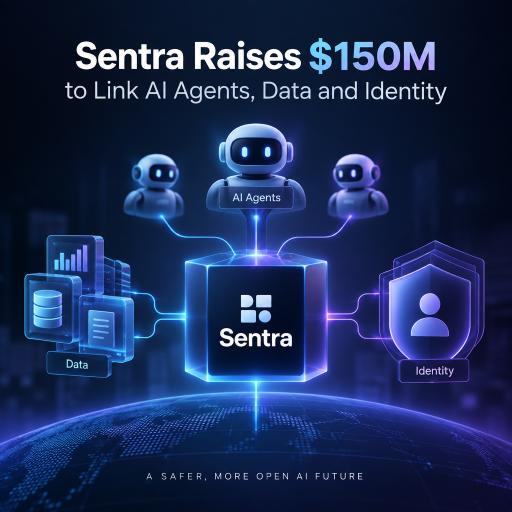
Sentra Raises $150M to Link AI Agents, Data and Identity
Sentra has secured $150 million in Series C funding as it expands from data security posture management (DSPM) into a broader platform designed to control how artificial intelligence systems access sensitive information.
The investment, led by Capital One Ventures, will support new tools for data loss prevention, AI governance, agent security, identity management and data discovery. Sentra also plans to continue improving the systems it uses to locate, classify and contextualize information across an organization.
Founded in 2021, the New York-based company now employs around 210 people and has raised approximately $253 million in external funding. Its chief executive and co-founder, Yoav Regev, previously served for nearly two decades in Israel’s Unit 8200 military intelligence organization.
Preparing Businesses for AI Agents
As companies deploy copilots, large language models and autonomous software agents, security teams are facing a more complicated question: which systems can access which data, and under what circumstances?
Sentra’s strategy is to bring several traditionally separate security functions together. Data loss prevention, DSPM, AI security and identity controls can work more effectively when they share information about the nature of the data, its location and the people or applications requesting access.
That approach is particularly important for AI agents, which can perform tasks across multiple services and may require temporary access to corporate systems. Sentra is developing technology intended to connect human and non-human identities with the data they can reach.
The goal is to provide permissions that change according to the task. Rather than granting an agent broad, permanent access, organizations could issue limited privileges for a specific operation and revoke them when the work is complete.
“The agentic era has just started,” Regev said, describing the rapid growth expected in systems capable of taking action on behalf of users.
Reducing the Risk of AI Data Exposure
Before organizations can safely introduce AI tools, they need a clear view of their information. Sentra’s current capabilities are focused on identifying sensitive data, improving data hygiene and highlighting excessive permissions.
These controls can help prevent confidential information from being sent to an unsuitable model. They can also reduce the risk of an AI assistant retrieving documents for a user who should not be able to see them.
The company expects demand for these tools to come from multiple departments. Chief information security officers, chief information officers and chief data officers increasingly share responsibility for AI deployment, governance and compliance.
That shift could expand Sentra’s customer base beyond traditional security buyers. Data and technology leaders are also becoming involved in decisions about which AI systems can be used and how those systems interact with internal information.
Building on DSPM Foundations
Sentra says its expansion into AI and identity security will depend on continued investment in its core data platform. Planned improvements include broader data coverage, faster analysis and more accurate classification.
The platform is also designed to add context by linking information to its location, sensitivity, ownership and access permissions. This foundation can then be used to assess the risks associated with models, copilots and autonomous agents.
Sentra faces competition from established security providers and other data protection startups. The company believes its advantage comes from combining data discovery with AI security and loss prevention, while allowing customer information to remain within the customer’s own environment.
Regev argues that many security products focus on one particular feature, but do not fully connect that feature to the underlying data. Sentra’s larger objective is to make data the central layer linking identity, access and AI behavior.
With the new funding, the company plans to accelerate that vision as businesses move from experimenting with AI assistants to deploying agents capable of making decisions and carrying out tasks across their digital infrastructure.