
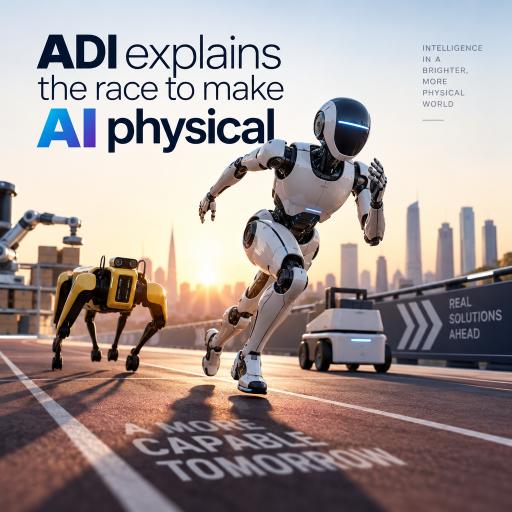

ADI explains the race to make AI physical
Artificial intelligence has made major progress in understanding language, images, and software code. The next major challenge is bringing that intelligence into the physical world, where machines must interpret their surroundings, make decisions, and act safely, according to Analog Devices Inc. (ADI).
This shift is often described as physical AI or embodied AI. Unlike conventional software, physical systems operate with incomplete information and unpredictable conditions. They must deal with sensor noise, changing environments, strict timing requirements, and the real-world consequences of every decision.
ADI argues that the success of physical AI will depend on much more than the quality of an AI model. Progress will also require improvements in sensing, simulation, processing hardware, connectivity, and control systems. These technologies form the foundation beneath applications such as industrial automation, robotics, mobility, healthcare, and energy management.
From fixed rules to machine judgment
The difference between traditional automation and physical AI can be seen in how a machine responds to potential faults. A basic system might shut down when vibration exceeds a predefined limit. A more advanced machine could combine vibration data with temperature, electrical current, and motor behavior to identify the early signs of bearing wear.
Instead of waiting for a failure or reacting to a single threshold, the system could recognize a developing pattern and adjust its operation before damage occurs. That ability to interpret several sources of information and respond to changing circumstances is closer to judgment than simple rule-following.
For manufacturers, this capability could make production systems more adaptable and resilient. Machines equipped with physical AI may be able to respond to unexpected conditions, compensate for changes in their environment, and continue operating without relying entirely on instructions written in advance.
AI that acts in the real world
Digital AI generally produces an answer, prediction, or recommendation. Physical AI must go further: it needs to choose and execute an action while accounting for imperfect measurements and uncertain outcomes.
That makes the development process more complex. A system may need to understand what is happening, predict what could happen next, and select a useful response within a limited amount of time. It must also operate within the capabilities and safety limits of the hardware controlling it.
ADI describes this as a race to connect intelligence with the physical world. Its semiconductor and software technologies are designed to bridge analog signals, digital processing, artificial intelligence, and edge computing. The company says this approach can support intelligent machines across industrial automation, robotics, transportation, healthcare, energy, and data-center infrastructure.
Industry focus turns to robotics
The growing interest in physical AI is also being reflected in the robotics industry. ADI is scheduled to participate in RoboBusiness 2026, including a robotics startup session focused on collaboration, opportunities, and the practical challenges involved in developing intelligent machines.
As AI moves beyond screens and servers, the key test will be whether machines can reliably perceive the world, understand changing conditions, and take appropriate action. The companies that solve that problem will help define the next generation of automation and robotics.