Economic Watch: AI takes on bigger role in China’s express delivery during Singles’ Day peak
China’s Singles’ Day shopping rush is once again putting the country’s delivery networks under intense pressure, but this year the biggest story is not just scale. It is the growing role of artificial intelligence in keeping parcels moving from warehouses to consumers’ doors.
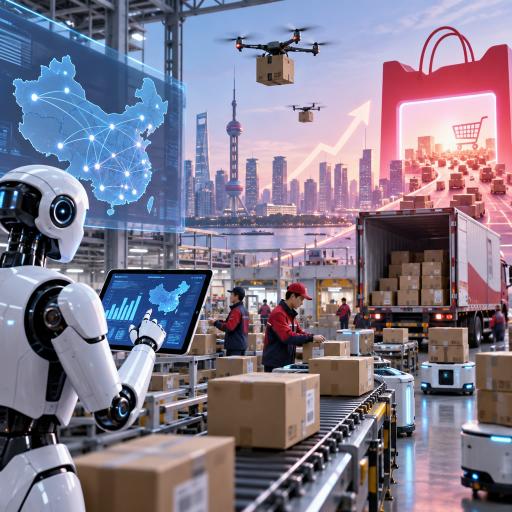
During the annual Double 11 shopping festival, AI is appearing in more visible and practical ways across the express delivery chain. In some areas, drones now lower packages into smart lockers without a courier present. In sorting centers, robotic arms identify and handle parcels with high precision. Behind the scenes, large AI models are forecasting demand, allocating transport capacity and helping delivery firms respond to surges in real time.
The shift marks a new stage for China’s logistics sector. AI is no longer limited to background data analysis or experimental pilots. Instead, it is taking on frontline operational tasks during one of the busiest retail periods in the world.
AI moves from back office to frontline logistics
Among the major changes this Singles’ Day is the appearance of AI “digital employees” inside courier networks. STO Express, one of China’s leading delivery firms, has introduced intelligent agents through its SClaw platform to support customer service, detect abnormal shipments, plan trunk routes and assist couriers with outbound calls and delivery sequencing. The company is also using digital quality-control tools to monitor sensitive shipments such as fresh produce.
According to STO Express, the goal is to use AI computing power to absorb part of the operational burden during the extended peak season while maintaining safety and service standards. That reflects a broader industry trend: using AI not just to analyze demand, but to directly support real-world logistics work.
Smarter decisions at national scale
AI’s influence is also expanding at the strategic level. JD Logistics has upgraded its Super Brain 3.0 large model to act as a central decision engine, predicting regional order volumes and adjusting logistics resources across the country in real time. The company says AI-recommended delivery routes are being adopted more than 90 percent of the time, suggesting strong trust in machine-generated planning.
This matters during Singles’ Day because delivery pressure is not evenly distributed. Some cities, regions and product categories experience sharper spikes than others. Predictive systems can move vehicles, warehouse capacity and labor to the right places before bottlenecks emerge.
Robots, drones and unmanned delivery expand their reach
Physical automation is becoming another defining feature of this year’s peak season. JD Logistics is scaling up embodied intelligent robotic arms in sorting centers, where they are reportedly achieving parcel tracking accuracy of 99.9 percent. Such systems help process huge package volumes faster and with fewer errors.
Drones are also becoming more practical in difficult terrain. In southwestern China, where villages may be separated by mountains and rivers, aerial delivery is helping solve long-standing last-mile challenges. These deployments show how AI and automation are no longer only about efficiency in urban hubs; they are also extending logistics access to remote communities.
Supply chains get more predictive
Beyond parcel handling, AI is increasingly shaping how inventory is positioned before orders are even placed. SF Express is using sales forecasts and digital supply-chain tools to move goods closer to consumers in advance, cutting last-mile distance and reducing delivery times.
YTO Express is taking a similarly broad approach. The company has embedded more than 100 intelligent agents into route optimization, dispatch analysis and customer-service workflows, while assigning 28 digital employees to operations and service functions. Its digital-twin systems now extend across the full network of consolidation hubs, giving managers a more detailed view of performance and pressure points.
For the biggest logistics players, the competition is no longer only about fleet size or warehouse footprint. It is increasingly about how effectively AI can orchestrate the entire chain.
AI is reshaping e-commerce beyond delivery
The impact is not limited to logistics companies. Industry experts say AI is now being used across the full e-commerce cycle, from selecting products and generating content to attracting traffic, serving customers and analyzing competitors. That means the Singles’ Day ecosystem is becoming more automated from end to end, with logistics serving as one of the most visible applications.
Recent data highlight the speed of this transition. A report from the China Federation of Logistics and Purchasing found that AI adoption in China’s logistics and supply chains has surpassed 37 percent. Adoption rates were especially high in transport, at 78 percent, followed by safety and compliance at 52.73 percent and smart warehousing at 47.27 percent.
Scale gives China a real-world AI testing ground
China’s parcel economy provides a massive proving ground for these technologies. Official data from the State Post Bureau show that the country’s express delivery sector handled 151.3 billion parcels in the first nine months of 2026, up 4.3 percent year on year. That scale creates countless operational scenarios where AI systems can be tested, refined and commercialized quickly.
Analysts say this is pushing the sector from isolated use cases toward whole-chain coordination. Instead of applying AI to one warehouse, one route or one customer-service function, companies are now connecting those systems across larger networks and even across industrial supply chains.
Policy support accelerates adoption
The momentum is also being reinforced by national policy. China has been encouraging deeper integration of AI into the real economy, and its 2025 “AI Plus” policy framework laid out priorities for applying the technology across business and society. Logistics, with its rich data flows and urgent efficiency demands, has emerged as one of the clearest examples of that strategy in action.
This year’s Singles’ Day peak suggests that the sector is entering a more mature phase of AI deployment. Drones, robotic arms, digital employees and predictive large models are no longer side experiments. They are becoming part of the standard toolkit for handling one of the busiest shopping events on the planet.
For China’s express delivery industry, the next competitive edge may come less from sheer scale and more from how deeply AI is embedded across the entire operation.