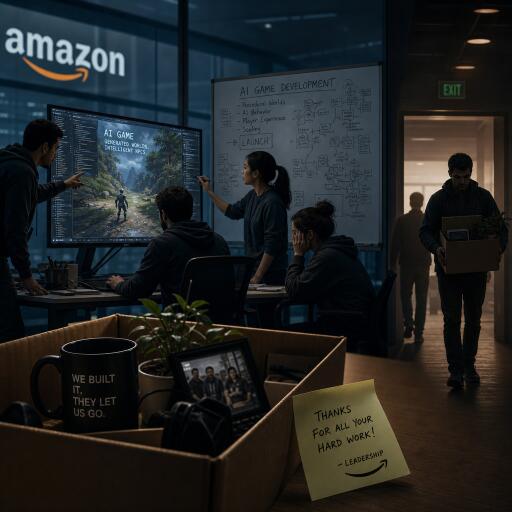

Amazon pressured one of its teams to develop an AI game, they scrambled to make it work – then got laid off anyway
In October 2025, developers across Amazon’s gaming division learned they were out of work. The cuts mirrored a wider industry contraction that’s followed the pandemic boom: projects axed, studios downsized, and teams locked out of tools within hours. Among the casualties were multiple internal groups, including the team behind New World, which was wound down after announcing its tenth season, Nighthaven, as the game’s swan song.
What few outside the company knew: a separate project—internally nicknamed Project Trident—was also canceled despite strong internal momentum. Members of several Amazon teams describe a top-down push to “innovate with AI” that reshaped development across the division. Project Trident became the test bed for that mandate—and then was shuttered anyway.
The big pivot
Amazon’s gaming arm had been juggling a variety of efforts: ongoing MMOs like New World and publishing partnerships, cloud projects for Luna, and smaller experiments. But alongside the layoffs came a decisive shift away from big-budget internal MMO development, hitting studios in Irvine and San Diego especially hard. Staff say even the long-rumored Lord of the Rings MMO dwindled to a skeleton crew, absorbed developers from New World late in the process, and was ultimately shelved, though Amazon maintains it is exploring ideas with the license.
From colossus hunts to AI-driven banter
Project Trident began life as a co-op action game set in a Nordic-inspired world, with players scaling towering giants using grappling hooks and mounts—think tense, vertical boss fights in sprawling arenas. Internally, this version generated real excitement. Developers recall colleagues asking to jump in even during unpolished test builds because the core loop felt “special.”
Then, around mid-2024, leadership pushed for generative AI adoption. Teams were encouraged—sometimes instructed—to find ways to apply large language models. For Trident, that mandate arrived right as the colossus pitch neared its greenlight moment. Faced with a choice between pivoting or likely shutdown, the San Diego team re-scoped the game under a brutal timeline: roughly 18 months from approval to launch.
The first pivot leaned into a faster-to-build “Helldivers-style” structure: roguelite missions with drop-in, drop-out co-op and AI-driven companions you could talk to for mission intel and light story beats. It worked on paper, but many on the team quietly wished they were still making the giants game.
The AI experiment takes center stage
As the schedule shifted, Trident morphed again—this time into a single-player, linear action adventure with a comedic tone and a parody startup, “Valhalla Ventures,” at its core. The hook: dynamic NPC interaction powered by an LLM. Players could chat with companions and enemies using voice or text. In combat and puzzle sequences, you could direct a character—often a boisterous “Thor”-like ally—to execute special moves or environmental actions by simply telling him what to do. Certain encounters let you persuade captured enemies to sign on with Valhalla Ventures, role-playing your pitch while the AI responded in character.
Crucially, the team says the game’s art, story, score, and core design were handcrafted. Generative tech was limited to NPC dialogue systems, dynamic lip sync, and animation polish—an attempt to use AI as a feature, not a shortcut. The comedic framing helped keep occasional AI misfires from breaking immersion.
“Ship it in 18 months” meets reality
Developers describe the original timeline as a shock. Multiple extension requests went in as the reality of building a robust, reliable AI interaction layer set in. Midway through development, the hard deadline quietly loosened, and the team leaned into the narrative-driven version they believed would best showcase the tech without overwhelming it.
By late 2025, the group was assembling an “E3-style” reveal for internal stakeholders, laying groundwork for a public debut in the first half of 2026. Then the layoffs landed. Some staff sensed it coming after word spread that New World would sunset; others were blindsided. Either way, the Trident team—a unit that had done exactly what leadership asked by integrating AI—was dissolved along with many colleagues who hadn’t touched AI at all.
Inside the cutbacks—and the fallout
The layoffs were part of a sweeping corporate reduction that eliminated thousands of roles. Internal communications framed the move as a strategic refocus: less bureaucracy, fewer layers, and resources shifted to the company’s biggest bets. Within games, leadership signaled a retrenchment from first-party AAA MMO efforts, impacting Irvine, San Diego, and central publishing teams.
People who worked on Trident say they tried to treat AI ethically and sensibly—augmenting human-made work rather than replacing it. Some came around to its possibilities, believing they’d found practices worth keeping and cautionary tales worth avoiding. Then the expertise walked out the door with the layoffs.
The lesson from Trident
Mandates and deadlines don’t turn emerging tech into shipped products. Even before you get to ethics, LLM-driven experiences demand time, iteration, and guardrails—and they thrive when built atop strong, conventional design. Trident’s evolution suggests there’s real spark in letting players talk to characters who can truly talk back. But it also underlines an industry truth: no AI is a cheat code for team size, clarity, or runway.
Amazon has maintained that AI wasn’t the reason for role reductions and says it intends to use the technology thoughtfully, guided by its teams’ creativity. Inside the studio, the story felt different: a fast-changing strategy, an ambitious experiment, and a finish line that kept moving—until it disappeared.
For the developers who lived it, the takeaway is simple. Generative AI can open new doors for storytelling and systems. It just can’t carry a project on its own, and it certainly can’t replace the one resource teams needed most: time.