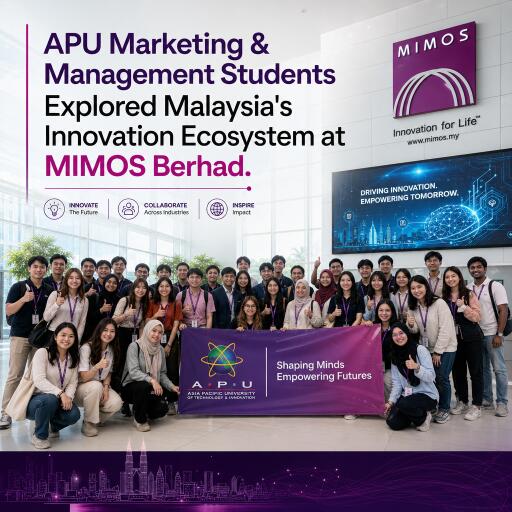

APU Marketing & Management Students Explored Malaysia’s Innovation Ecosystem at MIMOS Berhad.
Students from the Asia Pacific University of Technology & Innovation (APU) School of Marketing & Management stepped inside Malaysia’s national innovation engine at MIMOS Berhad, immersing themselves in advanced research environments that power the country’s digital ambitions. Across a packed agenda of briefings, hands-on demos, and lab tours, the group explored the inner workings of semiconductor fabrication, machine learning, reliability testing, and additive manufacturing—seeing how ideas move from concept to market-ready technology.
Cross-disciplinary learning meets real-world R&D
Guided by Senior Lecturer and Industry Advisory Panel Coordinator Ms Harjinder Kaur, the cohort brought together undergraduates and postgraduates specializing in Digital Marketing, Artificial Intelligence, Business Analytics, and International Business Communications. The visit was designed to help future marketers, analysts, and communicators understand how deep tech shapes products, brand experiences, and business strategy across sectors.
The day began with an overview of MIMOS’ mission to accelerate national capability through applied research and innovation. An interactive segment on machine learning—complete with a quick-fire quiz—challenged students to connect emerging AI concepts with real commercial outcomes, strengthening critical thinking around technology adoption and ethics.
From sand to silicon: inside the wafer journey
One of the most revealing moments came in the Wafer Fabrication Gallery, led by MIMOS engineers Ms Rahimah Mohd. Saman and Ms Nazrah Badaruddin. Students traced how silicon, the backbone of modern electronics, is transformed into wafers that eventually underpin smartphones, computers, automotive systems, and connected devices.
The walkthrough unpacked the precise choreography behind chipmaking—photolithography to pattern circuits, deposition and etching to sculpt layers, packaging to protect delicate components, and rigorous quality checks at every stage. The team emphasized the unforgiving tolerances and cleanroom standards required to manufacture devices that drive artificial intelligence, IoT networks, automation, and national-scale digitalization.
Stress-testing the future: reliability in focus
Next, the Reliability Laboratory showcased how electronics are pushed to their limits long before they reach consumers. Senior Engineer Mr Bukhari Saifulbahri demonstrated environmental testing setups that simulate extreme heat and cold, humidity shifts, and accelerated aging. Students saw how these stress profiles uncover potential failure points early, reducing recalls, improving user trust, and informing design refinements. The session underlined how reliability engineering is as much about customer experience as it is about hardware endurance.
Prototyping at speed with 3D printing
The final stop brought the group into the 3D Printing Laboratory, where digital designs leap into physical form. Through live demonstrations, students observed how additive manufacturing trims lead times, enables iterative prototyping, and supports cost-effective customization. Discussions spanned use cases from healthcare devices and aerospace components to automotive parts and consumer products—highlighting how fast-turn prototyping can de-risk innovation while opening new business models.
Technology, business, and communication—one conversation
Though the visitors came from varied academic tracks, a shared theme emerged: modern business fluency now includes an understanding of the technologies that power products, shape data, and define customer journeys. The experience connected the dots between lab breakthroughs and market realities—branding, pricing, compliance, and post-launch support.
Reflecting on the visit, faculty emphasized the importance of industry touchpoints in preparing graduates for the future of work. The sessions gave students first-hand exposure to advanced facilities while showing how technical milestones translate into commercial value and strategic communication.
Student takeaways: insight from the lab floor
- A Digital Marketing student noted that seeing the wafer process up close reframed how “invisible” infrastructure underpins the apps and platforms people use every day—clarifying why timelines, costs, and supply chains matter in go-to-market plans.
- An AI and Business Analytics student highlighted how the reliability workflows and fab processes demonstrate the precision required for data-driven products, underscoring why analytics and engineering must move in lockstep for quality outcomes.
- A postgraduate in Digital Marketing found the 3D printing segment especially inspiring, pointing to rapid prototyping as a catalyst for faster launches, differentiated offerings, and more agile campaign testing.
- A Master’s student in International Business Communications emphasized the role of clear, strategic storytelling in translating complex R&D achievements to partners, regulators, and the public.
Bridging campus and industry
By the end of the visit, students had gained a sharper view of how Malaysia’s innovation ecosystem is built—layer by layer, lab by lab. The day’s conversations and demonstrations underscored that tomorrow’s leaders must be comfortable speaking both the language of technology and the language of markets. APU expressed appreciation to the MIMOS teams for opening their doors and sharing expertise that will inform how these future professionals think, plan, and execute in an increasingly technology-driven world.