
Application of bilinear neural networks method to the deflection of nonlinear waves over a Kirchhoff plate
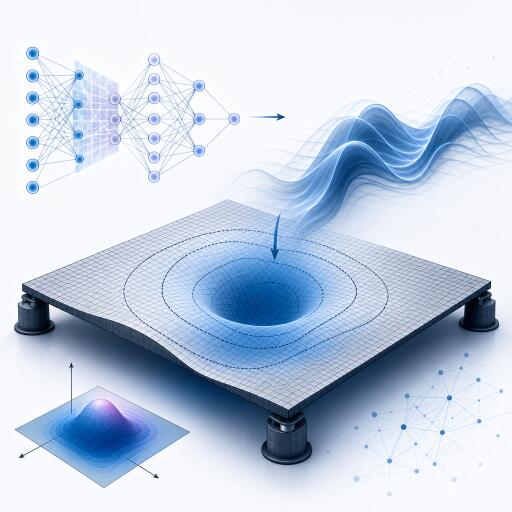
In a bid to bridge classic mathematical physics with modern machine learning, researchers have unveiled a symbolic–neural hybrid technique that finds exact solutions to a notoriously complex problem: the deflection of nonlinear waves over a Kirchhoff plate. While the manuscript is still undergoing editorial review, its core contribution is clear—by fusing Hirota’s bilinear formalism with a tailored neural network architecture, the team reports a practical and interpretable route to modeling multidirectional wave propagation across physics and engineering domains.
The Kirchhoff plate model describes the deformation of thin elastic plates and captures a delicate dance between nonlinearity and dispersion. This behavior isn’t just an academic curiosity; it underpins phenomena in plasma physics, nonlinear optics, and fluid mechanics. Yet, deriving closed-form solutions for such systems is rarely straightforward. The proposed bilinear neural network method attacks this challenge directly, yielding explicit solutions—including multi-soliton and lump waves—that are both analyzable and efficiently generated.
What’s new
- A hybrid architecture: The approach marries Hirota’s bilinear method—renowned for constructing soliton solutions—with a neural network that serves as a flexible ansatz. Instead of learning from data, the network’s parameters are determined by enforcing the bilinear equations symbolically.
- Symbolic precision meets adaptive modeling: By expressing the solution through neural trial functions, where activation choices shape the function space, the problem reduces to solving for weights and biases that satisfy the bilinearized equation.
- Exact solutions, not approximations: Unlike many machine-learning solvers that produce numerical approximations, this framework locks onto bona fide exact solutions, enabling clear physical interpretation.
How the method works
- Bilinearization: The nonlinear Kirchhoff plate wave equation is transformed via Hirota’s operators into a bilinear form—a well-trodden pathway for constructing solitons.
- Neural ansatz design: The solution is written using a neural network–inspired trial function. Activation functions (e.g., exponential, polynomial-like, or other smooth nonlinearities) define the structure of candidate solutions, while weights and biases become unknown parameters.
- Parameter determination: By substituting the trial function into the bilinear equation and equating coefficients, the system solves for the network’s parameters symbolically or semi-analytically—no gradient-based training loop required.
- Solution recovery: The resulting parameters reconstruct exact waveforms: single- and multi-soliton solutions, as well as localized lump structures in higher dimensions.
Key results
The team demonstrates a catalog of exact solutions for the Kirchhoff plate model, including:
- Multi-soliton solutions: Stable, coherent wave packets that retain their shape and interact elastically—signature behavior of integrable-like dynamics.
- Lump waves: Fully localized structures in multiple spatial dimensions, relevant for modeling spatially confined disturbances on thin plates or fluid interfaces.
Taken together, these solutions highlight recurring patterns, coherence, and rich interaction dynamics in multidimensional nonlinear systems. The method’s generality suggests it can be ported to other higher-dimensional nonlinear partial differential equations where traditional solution techniques are cumbersome.
Why a bilinear neural network?
- Interpretability: Hirota’s framework preserves the physics baked into the equation. Each term and transformation has analytical meaning, avoiding black-box pitfalls.
- Expressive ansatz: The neural trial function offers a structured yet flexible function space. Activation choices guide the type of solutions discovered without sacrificing analytical tractability.
- Symbolic tractability: Solving for weights and biases by enforcing bilinear constraints keeps the pipeline exact, not merely approximate.
- Scalability to higher dimensions: The bilinear form naturally accommodates multidimensional interactions; the neural ansatz scales without exponential blow-up in algebraic complexity.
Why it matters
Exact solutions are the north star of nonlinear wave research. They help benchmark simulations, uncover conserved quantities, and provide intuition about stability and interactions. For practical fields—plasma control, photonic device design, acoustic metamaterials, and fluid-structure interactions—such solutions inform design parameters, predict failure modes, and accelerate prototyping. The bilinear neural network method is especially valuable when data is scarce or expensive; it leverages theory, not measurements, to produce trustworthy solutions.
Caveats and open questions
- Model scope: The technique hinges on successful bilinearization. Not every nonlinear PDE admits a convenient bilinear form, and extensions may require custom transformations.
- Activation selection: Choosing activations effectively shapes the solution class. Systematic guidelines for optimal selections remain an open research thread.
- Boundary and forcing: Real-world systems often include boundaries, inhomogeneities, and forcing terms. Incorporating these without losing symbolic solvability is nontrivial.
- Stability analysis: While solutions are exact, their stability under perturbations and noise should be assessed for engineering use.
The road ahead
Future work could target non-integrable variants of plate models, couple the approach with perturbation theory, or hybridize with physics-informed training when symbolic closure is out of reach. Automated discovery of activation families tailored to specific PDE structures is another promising direction, potentially enabling push-button catalogs of exact or near-exact solutions for entire model classes.
Bottom line
By uniting Hirota’s bilinear method with a neural-network-inspired ansatz, the authors present an interpretable, efficient, and exact pathway to modeling nonlinear wave deflection on Kirchhoff plates. The resulting library of solitons and lump waves offers both theoretical insight and practical utility across physics and engineering. Even ahead of final edits, this hybrid framework stands out as a powerful tool for taming higher-dimensional nonlinear dynamics—without surrendering mathematical rigor.