
Neurons in the bat auditory cortex encode class and complexity of future vocalizations – Communications Biology
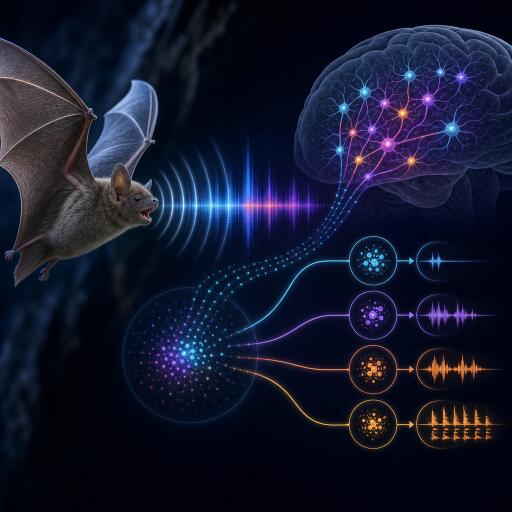
In a striking look at how the brain prepares to speak, researchers working with the audio-vocal specialist bat Carollia perspicillata show that neurons in the auditory cortex fire in distinct patterns long before a sound is made. These patterns don’t just preview that a vocalization is coming—they encode what kind of call it will be and how complex it will sound. The findings, shared in an unedited early-access manuscript, add a new layer to our understanding of how sensory areas help drive motor behavior.
Background: Listening areas that plan to speak
Vocal production across animals requires a tight choreography between motor circuits that move the vocal apparatus and sensory systems that track the results. While the motor side of this duet has been extensively studied, the role of auditory cortices—traditionally seen as “listeners”—has been less clear. This study zeroes in on whether the auditory cortex merely reacts to sounds after the fact or also anticipates and helps organize future vocal output.
The model: A bat with two languages
Carollia perspicillata offers a rare window into dual-purpose vocal behavior. It emits ultrasonic pulses for echolocation and produces rich repertoires of social communication calls. By recording neuronal spike rates directly from the bat’s auditory cortex, the team could compare how neurons behave in advance of these two distinct vocal classes.
Key finding #1: The brain’s early warning system
Neurons in the auditory cortex exhibited distinct spike-rate patterns several hundred milliseconds before a call began. Crucially, these patterns differed depending on whether the upcoming vocalization was an echolocation pulse or a social communication call. In other words, the auditory cortex carried a predictive signature of call category well ahead of vocal onset.
Key finding #2: Encoding complexity, not just category
Beyond call type, neuronal activity reflected the temporal complexity of forthcoming communication sequences. Specifically, spike patterns correlated with the number of syllables in a sequence, indicating that single neurons were sensitive to how long or elaborate the next string of sounds would be. This points to a representation of structure—akin to a preview of the rhythm and length of the “sentence” to come.
Key finding #3: Tuning matters
The predictive firing patterns were contingent on each neuron’s frequency receptive field—the range of sound frequencies to which a neuron is most responsive. Neurons tuned to particular frequencies contributed differently to encoding call class and complexity, suggesting that the auditory cortex recruits its frequency-specific map to help plan what will be said.
Why it matters
- Sensorimotor integration: The work supports the idea that sensory cortices are not passive observers. They appear to actively shape and anticipate motor output, tightening the feedback loop between hearing and vocalizing.
- Speech and communication: Although this study is in bats, the principle that sensory cortex encodes future vocal properties may extend to other mammals, offering clues to how human brains plan speech timing, prosody, and syllable structure.
- Brain–computer interfaces (BCIs): Predictive signals that reveal upcoming vocal class and complexity could inform next-generation BCIs aimed at restoring communication, where early decoding of intent is essential.
How the study advances the field
Previous research has emphasized that the auditory cortex processes incoming sounds and helps calibrate vocal output via feedback. This study adds pre-vocal prediction to the repertoire: single neurons carry information about both “what” (call category) and “how long/complex” (syllable count) before any sound is produced. That dual predictive coding strengthens the case that the auditory cortex participates directly in planning vocal actions, not merely evaluating them after the fact.
Open questions
- Causality: Do these predictive signals drive motor plans, or do they mirror plans formed elsewhere? Perturbation experiments could test whether disrupting these neurons alters forthcoming vocal behavior.
- Generality: How broadly do these findings apply across species and call types? Comparative work in other mammals could reveal whether predictive coding of vocal class and structure is a common design principle.
- Granularity: Can neurons encode finer-grained features—such as syllable order, pitch contour, or amplitude envelope—beyond syllable count?
Limitations and context
The authors emphasize that the manuscript is an unedited, early-access version and may contain errors or omissions. Interpretations should be viewed as provisional until peer review and final editorial processes are complete. Nevertheless, the core pattern—pre-vocal, category-specific, and complexity-sensitive firing tied to frequency tuning—provides a cohesive mechanistic narrative.
The big picture
This research reframes the auditory cortex as both a listener and a planner. By encoding the class and temporal structure of future vocalizations, single neurons bridge sensing and acting, helping the brain predict what it is about to say. For fields spanning neuroethology, speech science, and neuroengineering, the study underscores a powerful idea: perception and action are intertwined at the level of individual neurons, and the conversation between them starts well before the first sound is made.