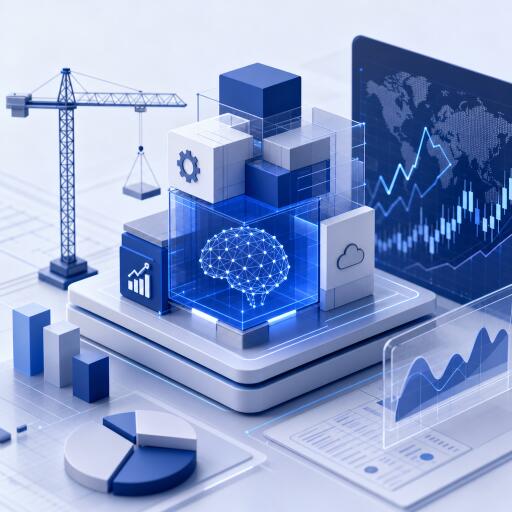

Building Production AI Platforms for Financial Analytics
From robust data pipelines to deployed intelligence: how financial institutions build scalable, compliant AI that works in the real world.
Author: Deepak Saxena
Key Takeaways
- Reliable AI in finance depends on production-grade data platforms as much as on models.
- End-to-end platforms blend data engineering, model lifecycle management, real-time systems, and governance.
- Explainability, auditability, and compliance are non‑negotiable in regulated financial environments.
- Event-driven data and messaging architectures enable low-latency, real-time AI.
- Treating ML as a long-lived production system—not a one-off experiment—boosts reliability and impact.
From Research to Production: The Gap
Financial institutions are expanding AI to improve trading, credit risk, portfolio analytics, and market intelligence. Yet many models that perform well in research falter in production. The stumbling blocks are rarely algorithms; they are operational: inconsistent data pipelines, brittle feature engineering, and weak MLOps. In finance—where outcomes affect capital, compliance, and risk—AI must operate with the dependability of core market infrastructure. That reality is pushing firms toward integrated platforms that unify data engineering, ML tooling, and governance.
Foundations of a Financial AI Platform
Successful platforms are layered systems that support data ingestion, processing, model development, deployment, and continuous monitoring. Critically, the heaviest engineering lift isn’t the model—it’s the data foundation, feature consistency, and operational scaffolding that keeps models dependable over time.
Data Ingestion and Integration
Financial AI relies on heterogeneous sources: market feeds, orders and executions, transactions, risk metrics, issuer fundamentals, research, and macro indicators—arriving at different latencies and formats. Event-driven ingestion with distributed messaging standardizes and transports these streams reliably across the enterprise, ensuring downstream analytics can consume both high-frequency updates and scheduled batches.
Data Processing and Feature Engineering
Raw data needs heavy refinement before it’s model-ready. Pipelines cleanse, align, and join datasets to produce stable, documented features. Consistency is paramount: the same feature definitions must power both training and inference. Centralized feature stores help teams reuse vetted features and maintain parity across batch and streaming paths—for example, producing T+1 risk reports with the same logic used for intraday calculations.
Model Development and Experimentation
With curated datasets in place, teams experiment to find performant models—but production readiness requires more than accuracy. Financial models must be stable, explainable, and resilient to market regime shifts. Backtests, stress tests, and scenario analysis validate behavior across historical and extreme conditions, mitigating the risk of costly errors when markets move.
Deployment and Real-Time Inference
Production platforms support both batch and streaming workloads. A trading desk, for instance, might stream top-of-book updates and fills into a messaging layer while a feature service maintains rolling volatility and liquidity signals. Inference services respond in tens to hundreds of milliseconds, logging feature values, model versions, and parameters so every prediction is reconstructible. Overnight, batch jobs recalibrate models and compute risk—without diverging from streaming feature logic.
Integrating AI with Financial Workflows
Models only create value when embedded into the tools practitioners use. Effective deployments deliver outputs directly into execution systems, portfolio platforms, and risk dashboards. Credit models feed probability-of-default into reporting and limits. Market surveillance flags anomalies for compliance review. Generative assistants summarize filings and transcripts, extracting signals that analysts can act on. The smoother the integration, the greater the business impact.
Observability and Model Governance
Continuous monitoring is mandatory. Observability tracks prediction quality, data drift, feature health, latency, and resource use; alerts trigger investigation when performance degrades or inputs shift. Governance provides transparency: documentation, lineage, decision logs, and reproducible pipelines allow firms to explain model-driven outcomes to auditors and regulators. Many organizations formalize model approval with validation, sign-off, controlled releases, and long-lived audit trails that tie every decision back to the code, data, and parameters used.
Cloud, Hybrid, and the Real-World Tradeoffs
Cloud elasticity accelerates experimentation and training at scale, while managed services simplify distributed data processing and streaming analytics. Yet hybrid is common due to legacy systems, data residency, and regulatory constraints. Designing the platform means balancing latency with model complexity, standardization with team autonomy, and cloud agility with vendor risk and sovereignty obligations. Central platforms set guardrails and shared services, while domain teams ship models without bottlenecks.
Emerging Trends
- LLM + data platforms: Natural-language interfaces over structured and unstructured financial data, with retrieval for context and grounded answers.
- Real-time AI at scale: Streaming architectures that process millions of events per second for anomaly detection, signals, and surveillance.
- Platform engineering: Treating AI infrastructure as a shared product, improving reuse, governance, and time-to-production across teams.
Conclusion
AI can transform financial analytics, risk management, and investment decisioning—but only when underpinned by production-grade platforms. Institutions that invest in resilient data pipelines, consistent features, robust MLOps, and transparent governance convert experimental models into dependable, auditable systems that drive outcomes. In a regulated, real-time domain, that platform mindset is the difference between promising prototypes and durable competitive advantage.
Author Bio
Deepak Saxena is a data engineering and AI practitioner focused on financial analytics platforms, distributed data systems, and machine learning infrastructure. He builds scalable pipelines and architectures that power data-driven decision making in modern markets.
Related Items: Financial AI Platforms, Machine Learning Infrastructure