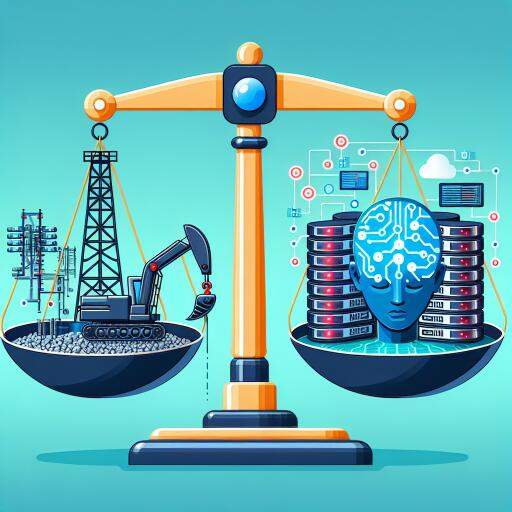

Fracking Industry Executives Are Salivating Over the AI Data Center Boom
Oil and gas executives are openly cheering the artificial intelligence buildout, framing it as a once-in-a-generation jolt to electricity demand. On a recent earnings call, Halliburton’s CEO, Jeff Miller, said the surge in power needs tied to AI is unlike anything he has witnessed — a clear signal that the fossil fuel sector sees data centers as a growth market tailor‑made for natural gas.
What’s changing isn’t just sentiment. A broad swath of the natural gas value chain — shale drillers, oilfield service firms, pipeline operators, and power developers — is racing to position itself as the indispensable partner to Big Tech’s energy-hungry server farms. The pitch is simple: where utilities and transmission lines can’t keep up, gas‑fired generation can be deployed quickly to deliver the round‑the‑clock, high‑reliability power that AI workloads demand.
From shale patches to server farms
Halliburton and its peers thrive when drilling accelerates, and AI is offering a new reason to ramp production. As data center developers scramble to lock in firm power, oilfield service companies are courting that demand, touting their ability to help bring new gas supply online, support compression and gathering systems, and enable the buildout of generation that can be tied directly to campuses or nearby substations. The message to investors is that AI isn’t just a tech story — it’s a hydrocarbons story, too.
AI’s bottomless electricity appetite
Generative AI models and high‑density GPU clusters require massive, continuous power and aggressive cooling. Utilities across major markets are warning that demand growth is outpacing recent forecasts, while interconnection queues for new power projects stretch into the latter half of the decade. Faced with tight timelines, developers are exploring “behind‑the‑meter” plants, private microgrids, and dedicated pipeline connections to keep construction schedules on track and latency low.
Natural gas, with its relatively fast build time and dispatchable profile, is becoming the default bridge. Batteries can firm renewables for some hours, but most AI facilities want 24/7 coverage and N+1 redundancy. Until transmission expands and more round‑the‑clock clean options materialize, gas is winning on speed and certainty.
Methane’s uneasy comeback
There’s a catch: methane leakage and combustion emissions. Gas‑fired plants lock in carbon for decades unless paired with credible mitigation. Methane, the primary component of natural gas, traps far more heat than CO₂ in the short term, and leakage across drilling, gathering, and transmission can undermine climate targets. For tech companies that have pledged “24/7 carbon‑free” energy, signing up for new gas capacity risks reputational blowback and regulatory scrutiny, even if accompanied by renewable credits or future carbon capture plans.
Deals and strategies taking shape
- On‑site or adjacent gas generation: Developers are considering turbines and reciprocating engines behind the meter to bypass long interconnection waits and secure dedicated capacity.
- Pipeline expansions and long‑term supply: Midstream companies are promoting new laterals and firm transport contracts aimed at data center clusters in fast‑growing corridors.
- Oilfield services tailwinds: Firms like Halliburton stand to benefit from more drilling, completions, and compression as producers chase steady offtake tied to digital infrastructure.
- Utility‑backed gas plants: Some utilities are proposing additional gas units framed as “reliability resources” to serve AI‑driven load growth while transmission upgrades lag.
Winners, losers, and the lock‑in risk
The immediate winners are clear: gas producers, pipeline operators, and service companies. For local communities, the calculus is more complicated. New pipelines and power plants can bring jobs and tax revenue, but also air pollution, noise, and safety concerns. At the system level, over‑reliance on new gas creates a risk of carbon lock‑in just as climate targets tighten. If superior low‑carbon options scale later, today’s gas assets could become costly stranded infrastructure — or leave tech companies paying premiums to decarbonize after the fact.
Can AI grow without a fossil surge?
Alternatives are gaining traction but face timing gaps. Developers are exploring:
- Massive solar and wind portfolios paired with longer‑duration storage to provide multi‑hour firmness.
- 24/7 clean power procurement matched hourly, not annually, to ensure true zero‑carbon operations.
- Locational strategies that site data centers near existing clean generation and robust transmission.
- Efficiency gains, waste‑heat reuse, and smarter workload scheduling to reduce peak demand.
Nuclear — including potential small modular reactors — is often floated as a future solution, but timelines and regulatory pathways remain uncertain. In the near term, the frictionless option is gas, which is exactly why the fracking industry is leaning in.
For now, AI’s explosive growth is rewriting the energy demand story and giving methane a powerful new narrative. Fossil fuel executives are eager to meet the moment, casting themselves as indispensable to the digital economy’s next chapter. The real test will be whether tech leaders and policymakers can channel this boom into long‑term, verifiably clean power — or whether the AI revolution becomes another engine for expanding the gas era.