
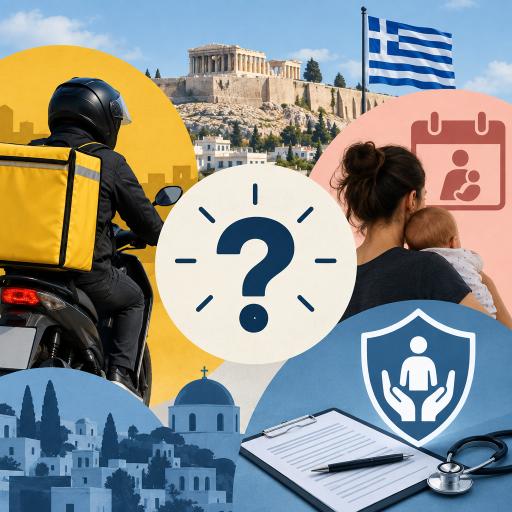
Greece’s labour bill: 12 questions on delivery riders, parental leave and insurance cover
Greece is preparing to debate a new labour bill that could reshape how digital platforms operate and how workers, parents and young people are protected. The draft law, set for discussion in parliament on 25 November, brings EU rules on platform work into Greek law while also introducing domestic changes on leave rights, maternity support and insurance continuity for under-26s.
At its core, the bill targets algorithmic management in platform work, especially in sectors such as food delivery. It would require more transparency around automated systems, make human review mandatory for major decisions and create a new official register for digital labour platforms through the ERGANI II system.
1. What is the bill trying to do?
The legislation has two big goals. First, it sets rules for the use of artificial intelligence and algorithms in platform work. Second, it strengthens labour protections by making it easier to identify when a platform worker should legally be treated as an employee rather than an independent contractor.
It also bundles in extra measures on parental and carers’ leave, insurance cover for young adults and maternity support for women insured through EDOEAP.
2. What changes for AI and algorithmic management?
Platforms will have to explain to workers which automated systems they use and what factors influence decisions. For a delivery rider, that could mean clearer information on how jobs are assigned, how performance is rated and what affects pay.
The bill also says workers’ representatives must be informed and consulted before major algorithmic systems are introduced or significantly changed. Workers would also gain the right to transfer personal data generated through their work, including ratings and reviews.
3. Can platforms collect any data they want?
No. The draft limits how platforms can collect and process personal data through automated systems. They would be banned from processing information about a worker’s psychological state or private conversations.
They also could not gather personal data when a worker is not actively offering or performing work through the platform. That is a notable restriction at a time when app-based work often relies on constant tracking and data capture.
4. Can an algorithm suspend or remove a worker?
Not on its own. Under the bill, decisions such as account suspension, removal from a platform or ending a working arrangement must involve a human decision-maker.
If a worker is affected by an automated or partly automated decision, they will have the right to ask for an explanation and request a review. If that review finds their rights were violated, the decision must be corrected or, if that is not possible, compensation must be paid.
5. What about health and safety for platform workers?
The bill pushes platforms to assess risks linked to automated systems, including accident risks, exposure to extreme weather and psychological pressure. They would then have to take steps to reduce those risks.
Algorithms that create excessive pressure or put workers’ health at risk would be prohibited. Importantly, data protection and algorithm-related safeguards would also apply to self-employed platform workers in many cases, not just formal employees.
6. Will all platform workers become employees?
No. The bill does not abolish freelance or contractor arrangements. Instead, it introduces a rebuttable presumption of employment when the real working conditions show that the platform directs and controls the worker.
Key indicators include being forced to accept jobs, being restricted from working for others or facing disciplinary penalties. In court, if this presumption applies, the burden shifts to the platform company to prove there is no employment relationship.
7. What if the worker is hired through a third-party company?
The draft law aims to stop protections from being diluted through subcontracting. Workers hired via an intermediary company would receive the same relevant protections as people contracted directly by the platform.
In some cases, both the platform and the intermediary could be held liable, giving workers a broader path to enforce their rights.
8. How does the new platform register work?
A new Register of Digital Labour Platforms would be created inside the ERGANI II information system. Platforms and intermediaries would have to declare everyone working through them, whether they are employees or independent contractors.
The register would also connect with migration records to improve oversight of third-country nationals legally living and working in Greece. Platforms would need to disclose how many people they engage, the type of contracts used, the general terms of work and which intermediaries they rely on.
For regulators, that means better inspection tools. For users of delivery and other app-based services, it could also mean stronger accountability.
9. What can workers do if their rights are violated?
Workers would be able to file complaints with the Labour Inspectorate or go to court. They could seek remedies including compensation.
The bill also protects them against retaliation, including dismissal, termination of working arrangements or other negative treatment for asserting their rights. With the worker’s consent, representatives could act on their behalf, and courts could order platforms to provide evidence.
Another notable provision would allow workers to communicate privately and securely with colleagues and representatives without platform monitoring.
10. What changes for parental and carers’ leave?
The bill loosens several conditions that currently make leave harder to access. Parents would no longer need an extra year of service with the same employer to qualify for parental leave and the related allowance for a second or later child.
Parents working for the same employer would also no longer need to submit a joint declaration setting out who takes leave first and for how long. For carers, the six-month service requirement with the same employer would be removed when leave is needed to support someone close for a serious medical reason.
11. What happens to insurance cover for under-26s?
The government is trying to close common insurance gaps for young adults entering the labour market. Three main changes are planned.
- Children turning 18 would keep cover through their parents until the end of February in the following calendar year.
- If a young person’s own work-based insurance ends, they could return to their parents’ cover until age 26, provided they are unmarried and have no active entitlement of their own.
- Those aged 18 to 26 who start working would stay covered through their parents until they build up enough workdays to qualify independently.
12. What changes for mothers insured through EDOEAP?
Women insured through EDOEAP would gain access to the supplementary maternity benefit paid by DYPA for the periods before and after childbirth.
To qualify, they would need to be employed under a private-law contract, be entitled to the corresponding EDOEAP benefits and satisfy the other general eligibility rules. The aim is straightforward: stronger income support during pregnancy and maternity leave.
Why this bill matters
This is not just another procedural labour reform. It is Greece’s attempt to respond to platform work as it actually operates in 2026: managed by apps, shaped by algorithms and often blurred between self-employment and traditional employment.
If passed, the law would give delivery riders and other platform workers more visibility into how software affects their livelihoods, while expanding practical support for families and young adults navigating work and social insurance. For Greece’s fast-growing app economy, that could mark a significant regulatory shift.