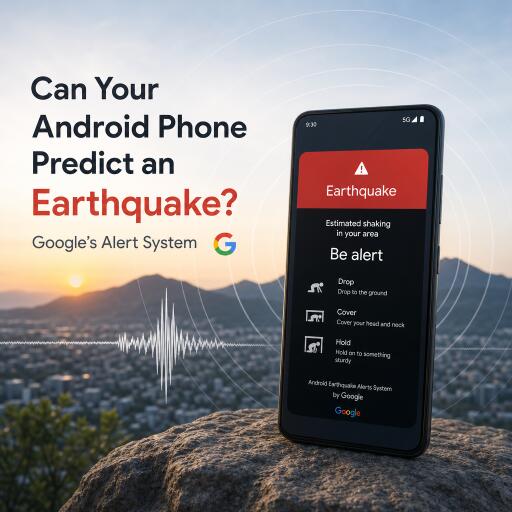

Can Your Android Phone Predict an Earthquake? Google’s Alert System
Back-to-back quakes in Venezuela in June 2026 were a brutal reminder of how little warning the planet gives. Yet amid the chaos, something quietly remarkable happened: millions of Android phones buzzed seconds before the strongest shaking arrived. That doesn’t mean anyone “predicted” an earthquake. It means phones detected the first ripples of motion and warned people in time to take a lifesaving action.
How Your Phone Becomes a Mini Seismometer
Earthquakes release two main wave types. P-waves travel fast and hit first, but they’re relatively weak. S-waves arrive later and do most of the damage. The Android Earthquake Alerts System listens for the earliest P-wave jitters using the accelerometer already inside your phone—the same component that enables motion controls in games or rotates your screen.
When many nearby devices detect the same motion pattern, anonymized signals are sent to Google’s servers. If the system confirms a quake, it pushes alerts to users in the affected area before the slower, stronger waves arrive. It’s not prophecy—it’s physics and speed.
Prediction vs. Early Warning
Predicting the exact time and location of a future earthquake remains out of reach. Early warning is different: it triggers when a quake has already begun and races information ahead of the dangerous shaking. Even a few seconds can help you drop, cover, and hold on; help operators pause trains; or prompt surgeons to step back.
Why a Phone-Based Network Scales
- No new hardware: Phones already carry accelerometers, creating a massive, distributed sensor grid at zero extra cost.
- Reach: Billions of Android devices can extend coverage to areas where traditional seismic stations are sparse.
- Speed: Signals move at network speed, allowing rapid confirmation and alerts.
- Equity: Rural and low-infrastructure regions benefit without waiting years for new stations to be built.
- Smarter over time: Algorithms learn to filter out noise such as construction vibrations or drops.
How Much Time Will You Get?
Warning time depends on distance from the epicenter and network conditions. Typical windows look like this:
- ≈3 seconds: Brace, protect your head, move away from glass.
- ≈10 seconds: Drop, cover, and hold on under sturdy shelter.
- ≈20 seconds: Put space between you and heavy objects that could fall.
- ≈30 seconds: Turn off a stove, pull over if driving, or step outside a small structure.
- ≈60+ seconds: Farther away, you might reach an open area or help others take cover.
Use every second. Even the shortest heads-up can reduce injuries from falling debris and shattered windows.
Real Limits You Should Know
- Connectivity: Alerts rely on cellular or data networks, which can be spotty or fail during disasters.
- False alarms: Algorithms work to suppress noise, but occasional false positives can happen.
- Power: A dead or switched-off phone can’t detect or receive alerts.
- Density: Fewer phones in remote areas mean slower confirmation and less precise alerts.
- Small events: Minor tremors may not meet alert thresholds yet can still jolt a neighborhood.
- Offshore quakes: Undersea events and tsunamis are harder to sense via phones alone.
- Coverage gaps: Availability varies; some regions still lack broad access.
AI and Next-Gen Sensors Are Pushing This Forward
Machine learning models are getting better at spotting the telltale signatures of P-waves in noisy data, cutting detection time and reducing false triggers. Edge AI—tiny neural networks running on devices—can flag motion faster and closer to the source. Beyond phones, fiber-optic cables can act like giant microphones along fault lines, while satellites and GPS track ground shifts with extraordinary precision. Fusing these streams—seismic, satellite, GPS, and IoT—helps refine magnitude estimates and tighten alert zones within seconds.
What Governments and Platforms Should Build Next
- Blend official seismic stations with crowdsourced phone data for redundancy.
- Integrate with telecom broadcast channels for wide, fast reach.
- Invest in public drills and education; practice makes those seconds count.
- Enforce strong building codes in high-risk zones to reduce casualties.
- Coordinate cross-border alerts, especially around shared fault systems and coastlines.
What To Do When Your Phone Buzzes
- Indoors: Drop to your knees, cover under a sturdy desk or table, and hold on. If no shelter is nearby, crouch against an interior wall away from windows, heavy furniture, and appliances. Protect your head and neck.
- Outdoors: Stay outside. Move to open space away from buildings, trees, streetlights, and power lines.
- In a vehicle: Pull over to a clear area and stay in the car with your seatbelt fastened.
- Never use elevators during or immediately after shaking.
- Keep a basic emergency kit in quake-prone regions.
- Rely on official updates; avoid rumors that can cause dangerous crowding or panic.
The Bottom Line
Your Android phone can’t foresee an earthquake—but it can hear the first, faint footsteps of one and warn you before the worst arrives. In those brief moments, you can act. As AI, sensors, and networks improve, the goal is simple: get timely alerts to everyone, everywhere. A warning that reaches you in time isn’t a prediction—it’s a head start.